

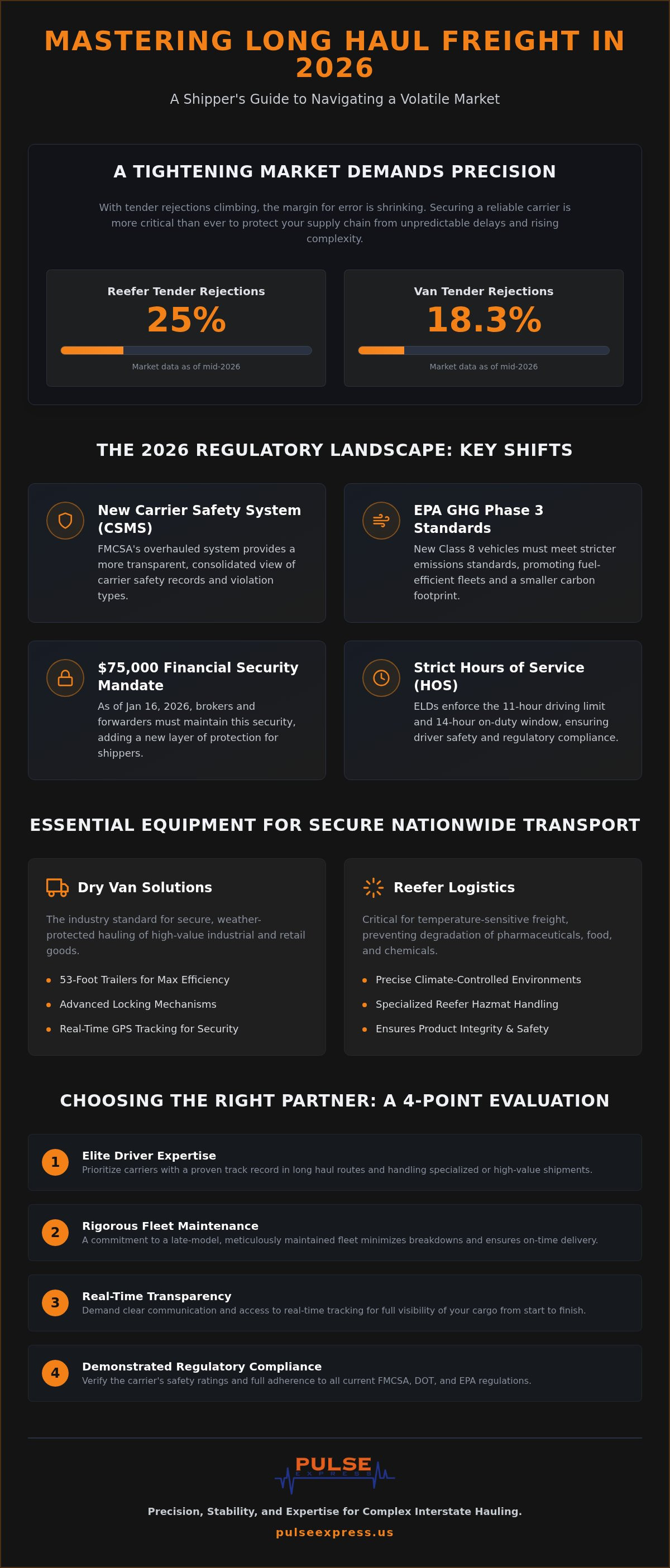
With reefer tender rejections climbing to 25% and van rejections hitting 18.3% in mid-2026, the margin for error in nationwide logistics has never been thinner. You've likely felt the frustration of unpredictable timelines and the growing complexity of interstate hazmat compliance. It's clear that securing reliable long haul general freight carriers requires more than just a low rate; it demands a partner with the stability to weather a volatile market. You deserve a logistics strategy that prioritizes precision, safety, and clear communication at every mile.
This guide empowers you to master the complexities of modern interstate transport through a comprehensive evaluation framework. We'll explore the 2026 Carrier Safety Measurement System overhaul, the impact of GHG Phase 3 emissions standards, and the critical equipment benchmarks for late-model fleets. By focusing on elite driver expertise, rigorous maintenance, and real-time transparency, you can transform your supply chain into a model of operational excellence. Let's look at how the right long haul partnership provides the reassurance and stability your business needs to grow.
Key Takeaways
- Define the 2026 landscape for Class 8 over-the-road transport to better align your freight with nationwide logistics requirements.
- Identify the essential equipment standards for long haul general freight carriers, from secure dry vans to specialized reefer units for sensitive cargo.
- Master the latest FMCSA safety metrics and DOT audit requirements to mitigate risk and ensure full regulatory compliance.
- Apply a rigorous evaluation framework that prioritizes carrier experience, equipment versatility, and the security of your high-value shipments.
- Recognize the value of established partnerships that offer the precision, stability, and expertise required for complex interstate hauling.
The Landscape of Long Haul General Freight Carriers in 2026
Long haul general freight carriers are the primary drivers of interstate commerce, moving palletized or bulk cargo across vast distances via Class 8 over-the-road (OTR) trucks. While standard industry classifications like NAICS code 484121 define this sector simply as truckload movement, the reality for supply chain managers is much more complex. This industry segment forms the foundation of The U.S. Trucking Industry Landscape, ensuring that industrial components, consumer goods, and raw materials reach their destinations without interruption. By 2026, the definition of general freight has evolved. It's no longer just about moving standard dry goods. We're seeing a significant rise in specialized general freight, where standard shipments require high-security tracking, climate-controlled environments, or specific safety protocols to protect the integrity of the load.
Interstate vs. Intrastate: Why Regulatory Nuance Matters
Choosing a carrier requires a clear understanding of the distinction between local hauling and nationwide logistics. Interstate carriers operate under the strict oversight of the Federal Motor Carrier Safety Administration (FMCSA). This federal authority dictates specific safety standards, insurance minimums, and driver protocols that don't always apply to intrastate (local) operations.
For shippers, this nuance translates to three critical areas of compliance:
- Hours of Service (HOS): Drivers must adhere to the 11-hour driving limit and the 14-hour on-duty window, which are strictly monitored via Electronic Logging Devices (ELDs) to ensure road safety.
- Safety Measurement System (CSMS): As of early 2026, the FMCSA has overhauled this scoring system, consolidating violation types to provide a more transparent view of carrier safety and intervention thresholds.
- Financial Responsibility: New rules effective January 16, 2026, require brokers and forwarders to maintain $75,000 in financial security, adding a layer of protection for the entire logistics chain.
The Role of Over-the-Road (OTR) Logistics
OTR trucking is specifically designed to bridge the geographic gap between major manufacturing hubs and regional distribution centers. These long-distance routes are the lifeblood of time-sensitive industrial sectors. In 2026, OTR efficiency has reached new heights through the adoption of AI-powered route optimization and predictive maintenance. These technologies help carriers anticipate traffic congestion, weather patterns, and potential mechanical issues before they cause delays.
Modern fleets also face stricter environmental standards. The EPA Greenhouse Gas (GHG) Phase 3 standards are now in effect for new Class 8 vehicles. This means leading long haul general freight carriers are investing in newer, more fuel-efficient tractors. These investments don't just meet regulations; they provide shippers with more reliable equipment and a smaller carbon footprint for their nationwide operations.
Specialized Equipment: Maximizing Security for Sensitive Interstate Loads
Long haul general freight carriers must provide more than just space in a trailer. In 2026, the security of your cargo depends on the synergy between advanced hardware and professional oversight. Whether you're moving standard retail goods or sensitive industrial components, the equipment used determines the stability of your entire supply chain. Modern logistics demands a high level of care, precision, and safety to ensure every shipment arrives in pristine condition.
Dry Van Solutions for High-Value Cargo
Dry vans remain the industry standard for secure, weather-protected hauling across the country. These 53-foot trailers maximize truckload efficiency for routes spanning over 2,000 miles, providing a clean environment for retail and industrial goods. Leading carriers now integrate advanced locking mechanisms and real-time GPS tracking to ensure cargo remains untouched from origin to destination. This level of protection is essential for maintaining the integrity of high-value freight during long-distance transit.
Reefer Logistics: Managing Temperature-Sensitive Freight
Refrigerated transport is a critical component for pharmaceuticals, high-end food products, and sensitive chemicals. Managing "Reefer Hazmat" is a highly specialized skill. It requires precise climate environments to prevent chemical reactions or product degradation. Shippers now expect real-time temperature monitoring and automated reporting to verify compliance throughout the journey. If you need a partner that handles specialized reefer and dry van freight, prioritize those with a proven record of temperature-control success.
Hazmat Hauling: Security and Federal Compliance
Transporting hazardous materials across state lines involves a complex layer of Federal Motor Carrier Safety Regulations. Drivers must hold specific endorsements and undergo rigorous training to navigate these routes safely. Federal compliance requires detailed emergency response planning and deep knowledge of various state jurisdictions. This expertise ensures that even the most sensitive hazmat loads move without regulatory delays or safety incidents, protecting both the cargo and the public.
Fleet age plays a decisive role in overall reliability. Late-model equipment, maintained to rigorous standards, significantly reduces the risk of long-haul breakdowns and unexpected delays. By choosing long haul general freight carriers that invest in new technology and late-model tractors, you gain a partner committed to operational excellence. This focus on modern equipment provides the reassurance and stability necessary for a successful nationwide logistics strategy.
Navigating the Regulatory Maze: Safety and Compliance in Nationwide Hauling
Compliance isn't just a legal obligation; it's a blueprint for reliability. In 2026, the FMCSA significantly updated the safety landscape by overhauling the Carrier Safety Measurement System (CSMS). This new framework consolidated over 950 violation types into approximately 116 categories, making it easier for shippers to assess the true risk profile of long haul general freight carriers. When you evaluate safety records, look specifically at recent violations from the past 12 months. These carry more weight in the current scoring system and provide a clearer picture of a carrier's present operational health.
DOT audits serve as the ultimate verification of a carrier's commitment to safety. A clean audit history indicates a disciplined approach to vehicle maintenance, driver qualifications, and hours-of-service (HOS) logs. Shippers should verify that their partners use integrated Electronic Logging Devices (ELDs) to manage HOS compliance. These systems don't just track time; they provide the data necessary to prevent driver fatigue and ensure every interstate route is planned with safety as the priority. While core HOS rules like the 11-hour driving limit remain stable, the use of technology to monitor these limits is non-negotiable for professional operations.
Safety as a Competitive Advantage
Low safety scores are more than just a badge of honor. They represent a tangible competitive advantage for your supply chain. Carriers with superior safety ratings experience fewer roadside inspections, which directly reduces the risk of transit delays. Professional driver training also plays a pivotal role. When drivers are trained to handle sensitive loads with precision, cargo damage claims drop significantly. At Pulse Express, we've focused on safety and reliability since 2000, ensuring every interstate mile is backed by 25 years of established expertise and elite driver talent.
Documentation and Legal Requirements
Managing nationwide logistics requires a deep understanding of Long-Distance Freight Trucking Industry Data and the documentation that keeps it moving. The Bill of Lading (BOL) serves as the foundational legal document for every shipment, defining the terms of transport and the condition of the goods. Beyond the BOL, carriers must manage the International Fuel Tax Agreement (IFTA) and various state-specific permits to ensure seamless transit across state lines without legal interruptions.
Proper insurance coverage is equally critical. You must verify that your carrier’s liability limits are appropriate for your specific cargo type. While standard general freight requires robust coverage, hazmat hauling demands specialized permits and significantly higher insurance tiers. Federal interstate permits and state-specific restrictions can change quickly. Partnering with long haul general freight carriers that stay ahead of these shifts is essential for maintaining a steady, compliant flow of goods across the country.
Choosing Your Partner: An Evaluation Framework for Interstate Shippers
Selecting a partner for interstate logistics involves more than just comparing rates or fleet sizes. While some databases rank companies by annual revenue, the best service for sensitive or high-value freight often comes from providers with a specific focus on operational precision. You need a framework that evaluates a carrier’s depth and commitment to your specific needs. Start by assessing their tenure in the long-haul space. A company that has successfully operated since 2000, like Pulse Express, brings a level of stability that newer firms simply can't match. Equipment versatility is another critical factor. You should verify that your long haul general freight carriers can seamlessly handle dry van, reefer, and hazmat loads to keep your supply chain flexible.
Technology integration is no longer optional in 2026. Shippers require real-time GPS tracking and automated temperature reporting to maintain full transparency. Beyond the hardware, analyze the carrier's communication style. A dedicated point of contact for complex, long-distance loads ensures that you aren't left waiting for answers during a transit disruption. This human connection provides the reassurance you need when moving cargo across thousands of miles.
The Human Element: Why Driver Quality is Non-Negotiable
The success of any shipment rests on the person behind the wheel. There's a direct link between a carrier's approach to hiring CDL drivers and the safety of your cargo. Elite Class A CDL experience is the most reliable predictor of success on interstate routes. When you evaluate a carrier, look closely at their driver retention rates. High turnover often signals a lack of support, which can lead to fatigue and increased safety risks. A partner that invests in its team is a partner that will protect your freight with the highest level of care.
Scalability and Nationwide Reach
Your logistics needs won't stay static. A reliable carrier must demonstrate network flexibility across all 48 contiguous states. This ensures they can handle seasonal surges in freight volume without sacrificing the safety standards you've come to expect. A robust partner network allows for quick adjustments when disruptions occur, maintaining your delivery timelines even when the market shifts. If you're ready to secure a partner with 25 years of proven experience, consider how our team can streamline your nationwide freight operations with precision and reliability.
The Pulse Express Advantage: Precision and Reliability Since 2000
Pulse Express has stood as a beacon of stability in the nationwide logistics market since 2000. For over 25 years, we've navigated the evolving complexities of the American road, establishing ourselves as a leader among long haul general freight carriers. Our longevity isn't just a number; it's a testament to our commitment to safety, precision, and partnership. We understand that your cargo represents your reputation. That's why we treat every load with the high level of care and attention to detail it deserves. Our approach combines the confidence of an established industry leader with the approachability of a service-oriented partner.
While many carriers focus on a single niche, we've built a specialized infrastructure to handle diverse needs under one roof. Our versatile capabilities include:
- Dry Freight Hazmat Transport: Secure movement of sensitive industrial goods.
- Reefer Hazmat Transport: Precise temperature control for volatile or sensitive chemicals.
- General Freight Service: Reliable, nationwide OTR hauling for standard palletized cargo.
This versatility allows you to streamline your operations without sacrificing the specific safety protocols required for sensitive cargo. We maintain an elite fleet of late-model tractors, each subject to rigorous preventive maintenance standards. This focus on modern equipment ensures that your shipments aren't just moving; they're moving safely and efficiently across all 48 contiguous states.
A Legacy of Reliability in Long-Haul Logistics
Our operational excellence is driven by founding values that haven't wavered in two and a half decades. Safety and integrity are the foundation of every route we plan. We've evolved from a standard general freight carrier into a specialized leader in hazmat and temperature-controlled transport. This growth has been fueled by the trust of our long-term shipping partners. They rely on us for our ability to manage the most sensitive freight with absolute professionalism and cargo security. Our elite Class A CDL drivers are the heartbeat of this legacy, providing the expertise needed to navigate complex interstate routes without incident.
Partnering for Future Supply Chain Growth
We don't just provide a service; we integrate with your supply chain to provide customized, scalable logistics solutions. As the industry faces new regulatory shifts in 2026, from CSMS scoring changes to GHG Phase 3 emissions standards, we take a proactive approach to ensure your compliance remains seamless. Our team is personally invested in your success, offering the reassurance of an established leader. If you're looking for long haul general freight carriers that prioritize cargo security through elite driver recruitment and operational excellence, we're ready to help you grow. Request a quote for your interstate freight needs today to see how a dedicated logistics partnership can transform your nationwide operations.
Securing the Future of Your Interstate Logistics
The 2026 logistics landscape demands more than just transportation; it requires a commitment to precision, safety, and regulatory mastery. You've seen how the recent CSMS overhaul and GHG standards have redefined the expectations for long haul general freight carriers. By prioritizing equipment versatility and elite driver expertise, you can navigate these shifts with confidence. Your supply chain deserves a foundation built on stability and proven performance.
Pulse Express provides the reassurance of 25+ years of OTR experience. Our comprehensive Hazmat and Reefer certifications, paired with an elite Class A CDL driver fleet, ensure your most sensitive cargo is handled with the highest level of care. We don't just move freight; we build partnerships focused on mutual growth and operational excellence. Secure your nationwide supply chain with Pulse Express today. Let's work together to drive your business forward with the reliability you expect and the precision you deserve.
Frequently Asked Questions
What is considered long haul general freight?
Long haul general freight refers to the movement of palletized or bulk cargo over extended distances, typically across state lines, using Class 8 over-the-road trucks. This service supports various industries by transporting retail goods, industrial components, and raw materials. It's distinguished from regional hauling by multi-day transit times and the strict federal regulations governing interstate commerce, driver safety standards, and equipment maintenance.
How do interstate freight rates differ from regional rates?
Interstate freight rates account for broader operational costs including higher fuel consumption, diverse state taxes, and complex routing requirements. Unlike regional rates that focus on local density, long-haul pricing reflects the extended time on the road and the specialized equipment needed for multi-day transit. These rates are also influenced by national market trends and the specific tender rejection levels observed across the country in 2026.
What are the requirements for hauling hazmat across state lines?
Carriers must hold specific federal hazmat permits and maintain higher insurance liability limits as dictated by the FMCSA. Drivers are required to have a hazmat endorsement on their Class A CDL and undergo specialized safety training. These requirements ensure that sensitive materials are transported in full compliance with both federal mandates and the varying state-specific safety restrictions encountered during nationwide interstate transit.
How does a reefer trailer maintain temperature on a 2,000-mile trip?
Modern reefer units use high-capacity cooling systems and heavily insulated trailers to provide a stable climate environment. These units are equipped with automated sensors that provide real-time monitoring and reporting to both the driver and the shipper. This technology is vital for long haul general freight carriers moving pharmaceuticals or sensitive chemicals that require precise temperature maintenance throughout a cross-country journey.
Why is a Class A CDL required for long-haul general freight drivers?
A Class A Commercial Driver's License is necessary for operating vehicles with a gross combination weight rating of 26,001 pounds or more, which includes the heavy tractors and 53-foot trailers used in OTR logistics. This certification ensures drivers have the advanced skills needed for safe interstate maneuvering, heavy equipment operation, and regulatory compliance. It represents a standard of professional expertise that protects high-value cargo.
How can I track my long-haul shipment in real-time?
Shippers can access real-time visibility through integrated GPS tracking systems and ELD data provided by their carrier. Most professional carriers offer a dedicated portal or automated updates that show the exact location and status of the freight. This transparency allows supply chain managers to anticipate delivery timelines, manage distribution schedules, and maintain the precision required in the modern 2026 freight market.
What insurance coverage should a long-haul carrier provide?
A professional carrier should provide comprehensive primary auto liability and cargo insurance that meets or exceeds federal requirements. For general freight, this typically starts at $750,000 for liability, though many elite carriers carry significantly more. If you are shipping hazardous materials, the carrier must provide specialized hazmat coverage to address the increased risk and regulatory complexities associated with sensitive, long-distance interstate transport.
How does Pulse Express handle high-value or sensitive interstate cargo?
Pulse Express leverages 25 years of OTR expertise to protect sensitive shipments through elite driver recruitment and late-model fleet maintenance. We combine specialized reefer and hazmat capabilities with a personal commitment to cargo security. By assigning experienced Class A CDL drivers and utilizing advanced tracking technology, long haul general freight carriers like us ensure that high-value freight is delivered with the precision trusted since 2000.


