

The best-fit carrier isn’t necessarily the one with the broadest service list. It’s the one whose equipment and freight capabilities match your shipment. Choosing among commercial freight transport companies can feel uncertain when you’re weighing trailer needs, route requirements, and specialized or hazardous cargo. Start by defining what your freight needs to move safely and efficiently.
Your shipment’s dimensions, handling requirements, temperature needs, and route all affect which service and equipment make sense. It also helps to understand whether you’re working directly with a carrier or through a broker. A carrier transports freight, while a broker arranges transportation between a shipper and a carrier.
This guide will help you define your freight and equipment requirements, prepare a useful shipment brief, and choose a transport partner that fits your operation. You’ll learn how general freight, dry van, refrigerated, and hazmat services relate to different shipment needs. Pulse Express provides over-the-road transportation across the United States for general and specialized freight, including temperature-controlled hazmat shipments. A structured approach can make the selection process clearer and help you plan your next move.
Key Takeaways
- Match your freight’s cargo, handling needs, route, schedule, and load size before choosing equipment.
- Understand the difference between general freight as a cargo category and dry van or reefer as equipment approaches.
- Compare commercial freight transport companies by service fit, equipment, route scope, communication, and shipment coordination, not rankings alone.
- Prepare a useful freight brief with the commodity, dimensions, weight, packaging, origin, destination, and timing.
- See how Pulse Express’s U.S. over-the-road services for general freight, dry van, reefer, and hazmat can align with different shipment profiles.
What Commercial Freight Transport Companies Do, and What Your Shipment Needs
A commercial freight transport company moves goods for businesses by road. A motor carrier operates the vehicles transporting the freight; a freight broker arranges transportation between a shipper and a carrier. Knowing which role a company performs helps you understand how your shipment will be transported and coordinated.
The company label alone won’t tell you whether its service suits your load. Start with the shipment profile: what the cargo is, where it needs to go, how it must be handled, when it should move, and how much space it needs. The broader Freight transport overview explains how road shipping fits within the wider movement of goods.
Start with the freight, not a company ranking
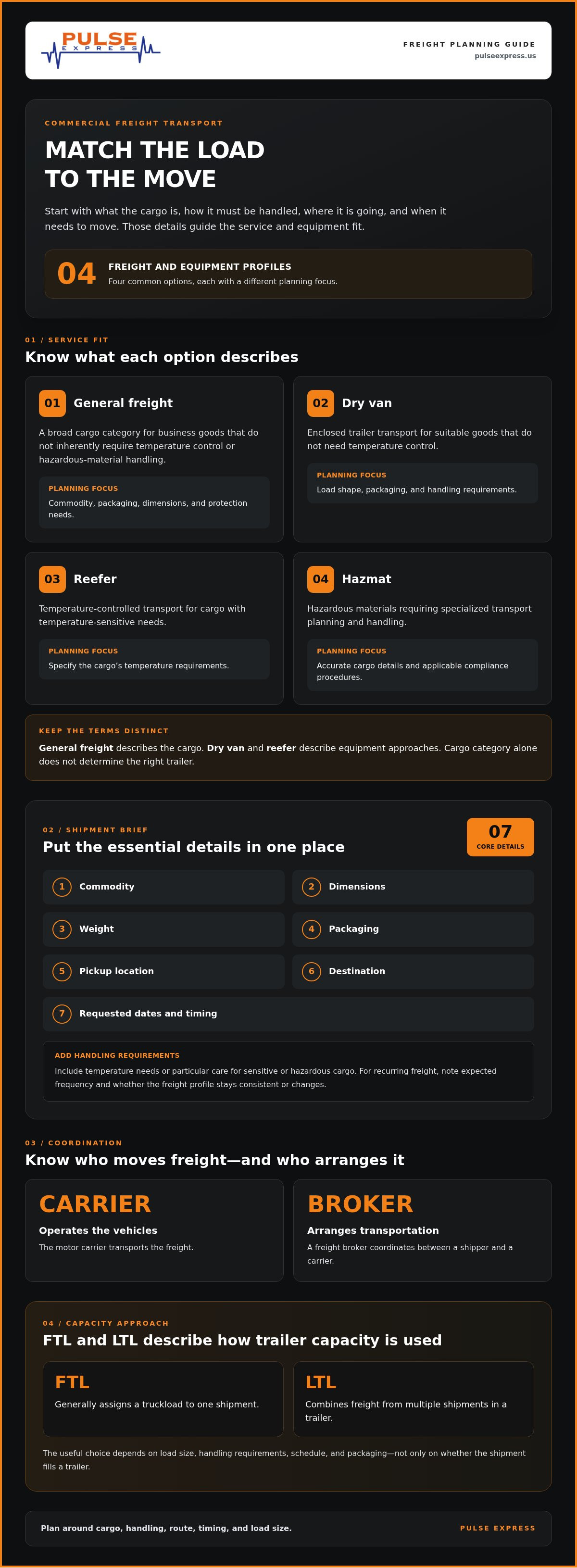
Before comparing commercial freight transport companies, gather the details that shape the move: commodity, dimensions, weight, packaging, pickup location, destination, and requested dates. Add handling needs, such as temperature control or particular care for sensitive or hazardous cargo. These details affect service and equipment fit just as much as distance or shipment size.
Also distinguish a one-time shipment from recurring freight. For a single move, focus on the load, route, handling, and timing. For regular shipments, note expected frequency and whether the freight profile stays consistent or changes. That pattern helps frame planning around your operation rather than treating every load as an isolated request.
Match shipment shape and service to the move
Full truckload (FTL) and less-than-truckload (LTL) describe different ways to use trailer capacity. FTL generally assigns a truckload to one shipment, while LTL combines freight from multiple shipments in a trailer. The useful choice depends on load size, handling requirements, schedule, and packaging, not only on whether the shipment fills a trailer.
Equipment is a separate decision. A dry van can suit general freight that doesn’t require temperature control; a reefer is used for freight needing a controlled temperature. Hazmat freight calls for specialized transport planning based on the cargo and its handling needs. General freight describes the cargo, while “dry van” or “reefer” describes an equipment approach. Pulse Express provides U.S. over-the-road service for general freight, dry van, reefer, and hazmat shipments.
Consider a palletized shipment of ordinary packaged goods and a temperature-sensitive load moving between the same cities. The route may be identical, but the handling requirements point to different equipment. Identify those needs early so you can describe each shipment accurately and coordinate the appropriate service.
For shipments moving across longer U.S. routes, route length is only one part of the plan. Pickup and delivery points, timing, load size, and handling requirements all contribute to service fit. Explore this long-distance freight transportation guide for more context on over-the-road moves.
How Commercial Freight Transport Companies Match Freight to Equipment
Equipment selection starts with how the cargo must travel, not with a trailer label or a broad category. Trailer choice follows the freight’s handling requirements. Shipment details help commercial freight transport companies identify a service and equipment approach that fits the cargo. Don’t assume the word “freight” alone tells you which trailer is right.
| Freight or equipment | Typical fit | Planning focus |
|---|---|---|
| General freight | Goods moved for business that don’t inherently require temperature control or hazardous-material handling | Describe the commodity, packaging, dimensions, and any protection needs |
| Dry van | Enclosed trailer transport for suitable goods that don’t need temperature control | Confirm load shape, packaging, and handling requirements |
| Reefer | Temperature-controlled transport for cargo with temperature-sensitive needs | Specify the cargo’s temperature requirements in the shipment details |
| Hazmat | Transport for hazardous materials that need specialized handling | Provide accurate cargo details and account for applicable compliance procedures |
When dry van or general freight is the right fit
“General freight” describes a broad cargo category. “Dry van” describes an enclosed equipment approach. The terms aren’t interchangeable: general freight may move in dry van equipment when the commodity and its handling needs suit that option, but the cargo category alone doesn’t establish the right trailer for every load.
Consider how the goods are packaged and protected, whether they can be handled as planned, and whether they need special conditions during transit. A clear description helps align equipment planning with the actual shipment instead of relying on a label. Pulse Express provides general freight service and dry van transportation for suitable over-the-road moves.
When temperature control or hazmat handling matters
Some cargo needs a controlled temperature throughout transportation to meet its handling requirements. That need can change the equipment choice even when the load size and route resemble those of ordinary freight. Pulse Express handles refrigerated transport, including temperature-controlled hazmat freight. Shippers planning temperature-sensitive loads can review cold chain logistics guidance for a deeper look at this type of transportation.
Hazardous materials also call for specialized transport planning. Accurate cargo identification helps establish the appropriate handling approach and applicable compliance procedures; requirements depend on the shipment. The U.S. Department of Transportation provides official transportation information. Pulse Express offers hazmat transport, including dry freight hazmat transport and reefer hazmat transport. For more detail on this specialized shipment type, consult specialized hazmat logistics guidance.
For a shipment that combines temperature control with hazardous-material handling, both requirements matter. Include the cargo description and handling needs in your shipment brief to support a focused service discussion. Explore Pulse Express freight transportation services for general, dry van, reefer, and hazmat freight.
How to Compare Commercial Freight Transport Companies Beyond the Quote
A quote matters, but it tells only part of the story. First compare whether a carrier’s services and equipment fit your shipment, then consider how the move will be coordinated. Match stated capabilities to shipment requirements before weighing broad claims. A company ranking or general reputation can offer context, but neither shows whether a carrier suits your cargo, route, and handling needs.
Use this scorecard to organize your comparison. Assess each area against the shipment brief and note what information supports your decision.
- Freight fit: Do the carrier’s services align with the commodity and any special handling needs, including temperature control or hazardous materials?
- Equipment: Does the equipment approach suit the cargo’s dimensions, packaging, protection, and handling requirements?
- Route scope: Does the carrier’s operating scope fit both the origin and destination, as well as the route between them?
- Communication: Are shipment details, expectations, and points of coordination explained clearly?
- Shipment coordination: Is there a shared understanding of the load details, requested timing, and steps needed to plan the move?
Assess service fit, safety, and operating scope
Start with the match between the cargo and the relevant freight service. General freight, dry van, reefer, and hazmat transport each relate to different shipment needs. Safety and compliance also belong in the comparison, especially when cargo calls for specialized handling. Look for clear descriptions of how the service aligns with the shipment, rather than unsupported claims about credentials or performance.
Nationwide over-the-road coverage can suit freight traveling across the U.S., but broad scope doesn’t mean every lane has the same fit. Consider the specific pickup and delivery locations alongside the carrier’s operating scope. Pulse Express provides OTR transportation across the United States for general freight, dry van, refrigerated, and hazmat shipments. For wider industry context, the American Trucking Associations shares information and resources about trucking in the U.S.
Look for clear coordination, not just broad promises
Good coordination starts with precise shipment information and shared expectations. Clarify what’s being transported, how it needs to be handled, where it’s going, and when it’s requested. Those details give everyone a practical basis for planning and help prevent a broad service description from being mistaken for a commitment to a particular outcome.
Be careful with performance metrics that lack context. A percentage or delivery claim is difficult to interpret without knowing its definition, the period measured, and the shipments included. Figures from different companies may not be directly comparable if their methods differ. Compare stated capabilities and coordination approaches with your needs instead of treating a ranking or headline metric as a prediction of shipment results.
A tailored fit is more useful than a high-level label. Compare each carrier’s freight services, equipment approach, route scope, communication, and coordination against the same shipment requirements. This gives you a clearer basis for choosing a transport partner and preparing the move.
Prepare a Clear Freight Brief for Commercial Transport
A clear freight brief gives commercial freight transport companies the information they need to understand the load and plan the move. It also helps you compare service options using consistent details rather than broad descriptions. Gather the information below before requesting transportation support. If a detail is not yet known, mark it as an estimate instead of presenting it as final.
Build the shipment brief
- Describe the commodity. Name the goods clearly and note any relevant cargo classification or special handling needs.
- Record dimensions and weight. Include the load’s length, width, height, and total weight. Accurate figures help inform equipment selection and load planning.
- Explain packaging. Describe how the freight is packaged, including palletization or unusual packaging that may affect handling.
- Provide the origin and destination. Include pickup and delivery locations, along with any access details that could affect loading or unloading.
- Set out timing and frequency. Give requested pickup and delivery dates, indicate whether timing is firm or preferred, and state whether this is a one-time or recurring shipment.
- Note reefer requirements. For temperature-controlled freight, provide the relevant temperature range and handling instructions.
- Include hazmat shipment details. For hazardous materials, share the applicable cargo classification and shipping documentation details for the shipment.
Once these details are organized, share your freight requirements with Pulse Express to start a focused service discussion.
Gather route, load, and schedule details
Specific locations make route planning more useful than city names alone, especially if a pickup or delivery point has access limitations. Note loading conditions, appointment requirements, and other known site constraints. For recurring freight, describe the usual shipment frequency and whether load size or route varies between moves.
Keep firm requirements separate from preferences. For example, state which date is necessary and which would simply be convenient. This distinction helps set realistic expectations during coordination without implying a delivery commitment.
Describe special handling requirements clearly
For refrigerated freight, include the temperature range the cargo needs and any relevant handling instructions. For hazmat freight, provide the classification and documentation details associated with the cargo; this guidance is for preparing a useful brief, not legal advice. Flag unusual packaging, loading, or delivery constraints early. Clear details help align the planned service with the freight’s actual needs.
Partner with Pulse Express for Commercial Freight Transport
Choosing a transport partner is more straightforward when you define the freight, match equipment to its handling needs, compare service fit, and prepare clear shipment details. This turns a broad search for commercial freight transport companies into a practical conversation about your cargo, route, and operating requirements.
Pulse Express is an over-the-road carrier providing transportation across the United States. Its services include general freight, dry van, reefer, and hazmat transport. This range supports different freight profiles, from suitable commercial goods to shipments that need temperature control or specialized hazardous-material handling.
Match Pulse Express services to your shipment
For suitable commercial cargo, general freight service and dry van transportation can support moves that don’t require temperature control. Reefer service is for freight with temperature-controlled requirements. For specialized cargo, Pulse Express handles hazmat freight, including dry freight hazmat transport and reefer hazmat transport.
Your shipment details guide the conversation. A packaged load that needs no temperature control has different handling needs from temperature-sensitive goods. A hazardous-material shipment, or one requiring both hazmat handling and temperature control, needs its own clear description. Sharing those distinctions helps align the service discussion with the freight instead of relying on a broad cargo label.
Make the next step straightforward
Bring the freight brief you prepared: commodity description, dimensions, weight, packaging, origin, destination, timing, and any special handling or cargo classification details. Include loading or delivery constraints, and distinguish firm schedule requirements from preferred timing. A complete brief gives coordination a useful starting point and keeps the shipment’s practical requirements in view.
Pulse Express provides transportation coordination for general freight across U.S. routes, refrigerated transport, and hazmat moves. Clear information supports a focused discussion of the cargo and service approach, and helps establish shared expectations before the move is arranged.
With the freight defined and service fit understood, take the next step with a partner whose OTR capabilities align with your operation. Discuss your commercial freight transportation needs with Pulse Express and start with the shipment details that matter.
Make Your Next Freight Move a Confident One
The right transportation relationship should support the way your operation works, not just solve an immediate move. Create a clear freight profile your team can build on as routes, shipment patterns, or handling needs change. That gives future planning a stronger starting point and keeps conversations with commercial freight transport companies focused on what matters to your cargo.
When you’re ready to plan a shipment, bring its requirements into the conversation. A direct discussion can connect your freight profile with an appropriate transportation approach and establish shared expectations from the outset.
Start a conversation about your next freight move with Pulse Express. A clear brief is a practical first step toward transportation that fits your operation.
Frequently Asked Questions
How much do commercial freight transport services cost?
Commercial freight transport costs depend on the shipment and service requirements, so there isn’t one universal rate. Factors may include distance, freight dimensions and weight, equipment type, handling needs, route, and timing. A reefer or hazmat move can have different requirements from ordinary dry freight. For a useful comparison, give each company the same shipment details and compare the service scope as well as the quoted amount.
Can one transport company handle both dry van and refrigerated freight?
Yes. A carrier can provide both services, though the equipment approach differs by shipment. Pulse Express handles dry van and refrigerated freight, including temperature-controlled hazmat transport. Packaged goods that don’t need temperature control may suit a dry van move, while temperature-sensitive cargo calls for reefer requirements to be included in the plan. Let the freight’s handling needs, not simply the carrier’s service range, guide the choice.
What happens if my shipment schedule changes after planning?
Tell the transportation partner as soon as you know about the change, and explain what has changed: pickup date, delivery timing, location, or another shipment detail. A schedule adjustment can affect coordination, so clear updates help the parties reassess the plan. If timing is still flexible, share the new preferred dates and any firm constraints. Keeping the brief current reduces the chance that outdated details shape planning.
How early should I arrange commercial freight transport?
Start planning as soon as you know the shipment’s likely timing, especially if the cargo needs reefer or hazmat handling or the pickup date is fixed. There’s no single lead time that fits every load and route. Early planning gives you time to organize cargo details, prepare relevant documentation, and coordinate around site requirements. For recurring freight, map expected shipment patterns before individual pickup requests.
Does nationwide freight service mean every route has the same options?
No. Nationwide scope describes a broad operating reach, not identical equipment or service arrangements on every route. A shipment’s origin, destination, cargo type, and handling requirements all affect the transportation plan. For example, a route requiring temperature-controlled movement has different service needs from one carrying suitable dry freight. Share the specific lane and load profile so coordination focuses on the actual move instead of assuming every route works the same way.
What information should I include when requesting commercial freight transport?
Provide the commodity, dimensions, total weight, packaging, pickup and delivery locations, and requested timing. Add loading or unloading constraints, shipment frequency, and any temperature-control instructions. For hazmat cargo, include its applicable classification and shipping documentation details. Identify which dates are firm and which are preferred. A named shipment contact and any site access notes can also help keep communication organized as the move is planned.
Can hazardous materials be shipped in a refrigerated trailer?
Yes, some hazardous materials can be transported with temperature control when the cargo’s handling requirements are compatible with that approach. Pulse Express handles reefer hazmat transport. The shipment brief should identify the material, its applicable classification, temperature needs, and relevant documentation details. Not every hazmat load has the same requirements, so the transportation plan should reflect the specific cargo rather than assuming all hazardous materials need the same equipment or handling.


