

Why settle for the seasonal feast-or-famine cycle when you could command a route that never goes cold? Many professional drivers find themselves caught between unpredictable home time, seasonal freight lulls, and the cold reality of being treated like a number at a mega-carrier. It's a frustrating cycle that often leaves your hard-earned Class A CDL feeling undervalued. If you're looking for a way to secure consistent 2,500+ miles every week while earning the respect of a dedicated partner, becoming an OTR driver for Reefer and dry Van is the strategic move for 2026.
We understand that you want more than just a paycheck; you want stability, precision, and clear communication. You deserve a career that rewards your specialized skills and respects your time on the road. This article will show you why specializing in both refrigerated and dry freight offers the best balance of steady pay and long-term career growth. You'll discover how adding specialized skills like Hazmat can further boost your earnings. We'll also look at how the 2026 market shift toward tighter capacity makes your expertise more valuable than ever before.
Key Takeaways
- Learn how hauling essential goods like food, medicine, and industrial supplies ensures your career remains resilient against economic shifts.
- Evaluate the practical differences between reefer and dry van operations, focusing on equipment maintenance, dock experiences, and daily routines.
- Discover how an OTR driver for Reefer and dry Van can maximize earnings by securing Hazmat endorsements for sensitive cargo.
- Identify the specific 2026 market trends that favor high-mileage routes and reward drivers who prioritize precision, safety, and reliability.
- Understand the value of joining an established carrier that prioritizes clear communication, professional growth, and mutual success.
What is an OTR Driver for Reefer and Dry Van?
An OTR driver for Reefer and dry Van is a specialized professional who operates both temperature-controlled trailers and standard enclosed trailers over long distances. In the 2026 market, where the ISM Manufacturing PMI has reached a four-year high, these drivers serve as the critical link in the nation's supply chain. You aren't just moving a trailer; you're managing the flow of essential goods across state lines. This role requires a high level of precision and the ability to adapt to different cargo requirements on the fly. What is a Truck Driver? Beyond the basic definition, an OTR professional is a logistics expert who ensures the stability of the economy through timely execution.
The versatility of hauling both reefer and dry van loads means you're never dependent on a single industry. You might move fresh produce one week and high-end electronics the next. By operating in both sectors, you eliminate the risk of seasonal lulls that often sideline specialized-only drivers. It's a career built on three pillars: stability, variety, and high mileage. This dual-equipment capability is especially valuable in 2026 as carriers look for drivers who can maximize every hour of their clock.
Understanding Reefer (Refrigerated) Transport
Reefer transport involves the cold chain, a sophisticated logistics network designed to keep perishables and pharmaceuticals at precise temperatures. This isn't just about hauling food; it's about protecting sensitive cargo that people rely on for their health. You'll be responsible for monitoring the reefer unit, checking fuel levels for the cooling engine, and verifying temperature logs. Because of the technical requirements and the high value of the freight, reefer routes often command higher rates and demand a greater level of professional care. It requires a driver who pays attention to the small details to prevent cargo loss.
The Efficiency of Dry Van Logistics
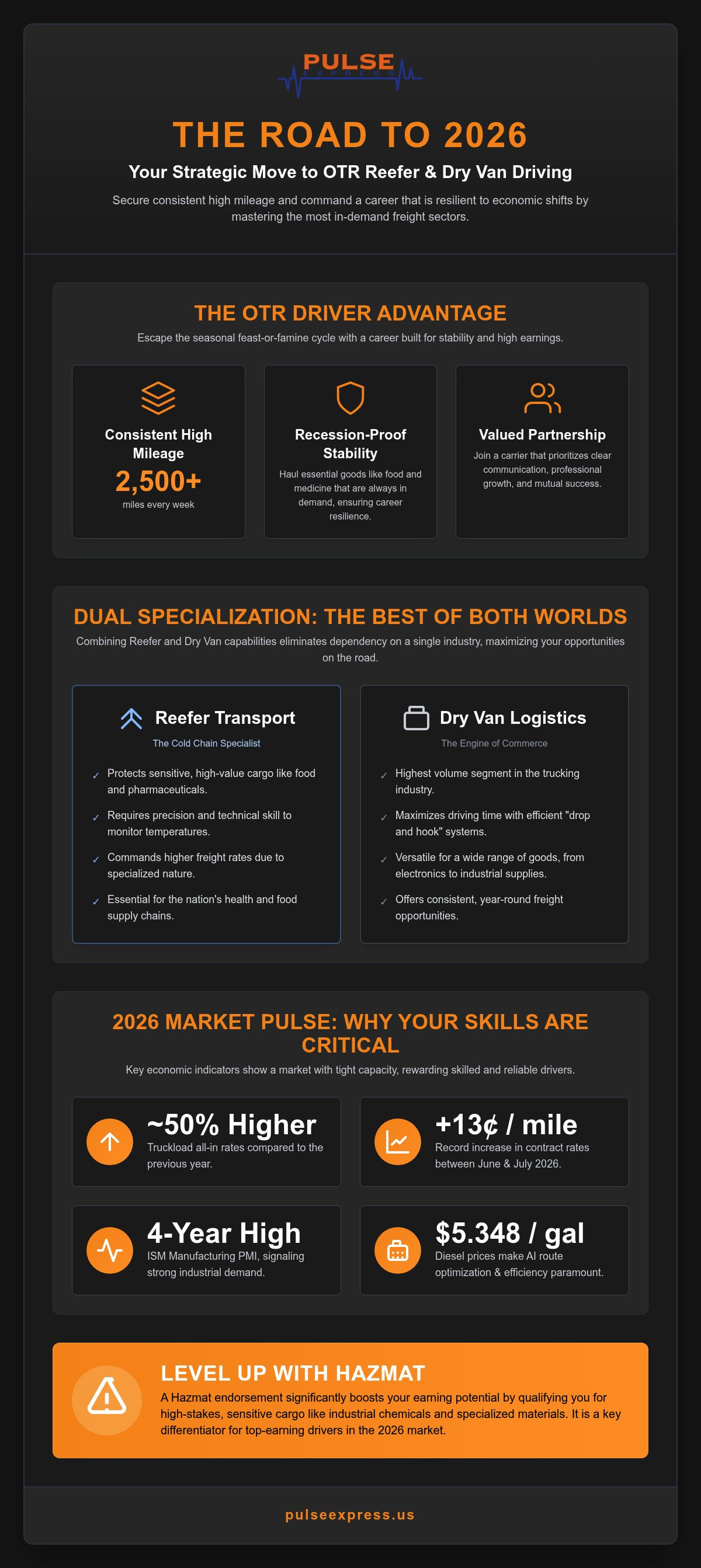
Dry van logistics remains the highest-volume segment of the trucking industry. It covers everything from non-perishable food to industrial chemicals. One of the biggest draws for an OTR driver for Reefer and dry Van is the "drop and hook" system common in dry van operations. This efficiency allows you to spend less time waiting at docks and more time earning miles. With diesel prices reported at $5.348 per gallon in August 2026, maximizing your time behind the wheel is essential for maintaining a profitable career.
With truckload all-in rates in early August 2026 sitting approximately 50% higher than the previous year, the demand for reliable dry van capacity is at a peak. This structural reset in the market favors drivers who can navigate high-volume lanes with efficiency. Dry van freight offers the simplicity of "load and go" while providing the consistent volume needed to keep your wheels turning throughout the year.
Key Advantages of Over-the-Road Careers in 2026
In a market defined by structural resets and rising contract rates, the role of an OTR driver for Reefer and dry Van has never been more vital. While spot rates fluctuate, contract rates for dry van freight saw a record 13-cent-per-mile increase between June and July 2026. This growth signals a shift toward long-term stability for drivers who commit to the long haul. Modern fleets now utilize AI-powered route optimization and real-time live GPS tracking to ensure efficiency. These tools don't just help the carrier; they reduce the stress of navigation for the driver and maximize active driving time. Efficiency is paramount when the national average on-highway diesel price is reported at $5.348 per gallon as of early August 2026.
Maximizing Your Miles and Earnings
Choosing to become an OTR driver for Reefer and dry Van allows you to leverage the highest mileage potential in the logistics industry. While regional drivers may struggle with frequent stops and unpaid dwell time, OTR professionals consistently aim for 2,500 to 3,000 miles per week. This volume is achievable because long-haul freight involves fewer loading events and more continuous highway time. Carriers often provide incentive structures for safety, fuel efficiency, and on-time delivery to reward professional excellence. If you are interested in obtaining a Commercial Driver's License to start this journey, the financial rewards of the OTR lifestyle are a significant motivator.
Career Longevity and Job Security
The demand for food, medicine, and industrial supplies remains constant regardless of economic cycles. This recession-proof demand creates a safety net for those hauling temperature-controlled cargo. Beyond basic goods, there is a growing need for drivers capable of handling sensitive, high-stakes freight like chemicals and pharmaceuticals. August 2026 is experiencing tighter truck capacity compared to the previous three years, which places skilled drivers in a position of strength. Building a career around these specialized skills ensures your resume stands out in a competitive market. It demonstrates a commitment to precision, safety, and reliability.
Working with a stable carrier provides the reassurance needed to focus on the road ahead. You can explore career opportunities with a trusted partner to see how professional support transforms your daily experience. Choosing a path that offers both reefer and dry van options ensures your wheels keep turning regardless of seasonal shifts.
Reefer vs. Dry Van: Which Path is Right for You?
Deciding between temperature-controlled and general freight is a pivotal choice for any OTR driver for Reefer and dry Van. Each equipment type offers a distinct rhythm on the road. Refrigerated units require a high level of technical care, while dry vans focus on volume and speed. For a professional OTR driver for Reefer and dry Van, the ability to switch between these modes is the ultimate career safeguard. At Pulse Express, we've found that the most successful drivers are those who master both, allowing them to follow the freight wherever the market is strongest.
Beyond the freight itself, the daily experience changes based on what's behind the cab. Reefer units produce a rhythmic hum that many drivers eventually find soothing, while dry vans offer the silence of a standard trailer. Dock experiences also differ; grocery warehouses often involve complex check-in processes and longer wait times than industrial distribution centers. To truly maximize your potential, obtaining Hazmat Endorsements allows you to bridge these two worlds, hauling everything from sensitive pharmaceuticals in reefers to industrial chemicals in dry vans.
The Pro/Con Breakdown for Reefers
Hauling refrigerated freight is a commitment to precision. The primary advantage is financial; reefer drivers in August 2026 can expect to earn between $0.50 and $0.65 per mile. This specialized work provides steady, year-round demand because the need for food and medicine doesn't stop during economic shifts. However, the trade-off often involves longer loading and unloading times at food warehouses. A professional tip for managing your clock is to communicate early with dispatch and use split-sleeper berth provisions to preserve your driving hours during unexpected detention.
The Pro/Con Breakdown for Dry Van
Dry van operations are the engine of efficiency. You'll enjoy faster turnarounds and simplified equipment maintenance since there's no cooling engine to monitor. The national average contract rate for dry vans reached $3.01 per mile in July 2026, showing strong value for this segment. The downside is that dry van freight can be more susceptible to seasonal retail fluctuations. Pulse Express balances these two freight types to ensure our drivers don't experience the typical lulls found at other carriers. We focus on keeping your wheels turning regardless of the season.
Leveling Up: The Power of Hazmat Endorsements
To truly maximize your potential as an OTR driver for Reefer and dry Van, you should look toward specialized endorsements. Hazmat-endorsed drivers are consistently the highest earners in any professional fleet. This isn't just about hauling dangerous goods; it's about demonstrating a higher level of professional responsibility. In 2026, the total cost for a hazmat endorsement typically ranges between $150 and $350, which includes the $85.25 TSA Security Threat Assessment fee. This small investment serves as a gateway to high-stakes logistics that general freight drivers cannot access. It signals to carriers and shippers that you possess the discipline, knowledge, and safety-first mindset required for sensitive cargo.
Pulse Express recognizes that specialized skills deserve specialized support. We focus on helping our team members maintain their credentials through clear communication and a strong emphasis on DOT compliance. In an era where the USDOT number has become the primary identifier for carrier monitoring, maintaining a clean safety record is essential for your career longevity. We provide the stable foundation you need to handle complex loads with confidence. You'll find that hauling hazardous materials isn't just a job; it's a career path built on precision, safety, and mutual respect.
Reefer Hazmat: The Elite Tier of Trucking
Hauling temperature-sensitive chemicals or medical isotopes represents the elite tier of the transportation industry. This niche provides a double-premium by combining the higher base pay of refrigerated routes with specialized Hazmat incentives. Precision is the absolute priority in this role. You're responsible for maintaining the integrity of the cold chain while adhering to strict federal safety protocols for hazardous cargo. Because these goods are essential for healthcare and advanced manufacturing, this position remains one of the most secure roles in the 2026 supply chain. It's a role that rewards those who pay attention to the smallest details.
Dry Van Hazmat for Industrial Goods
Dry van Hazmat transport focuses on moving bulk industrial supplies, cleaning agents, and high-value chemicals that don't require temperature control. These loads require a meticulous mindset and a deep understanding of segregation rules and placarding. Transitioning from general freight to specialized dry van logistics is a clear path for professional growth. It proves you can handle sensitive materials with the care and attention to detail that modern shippers demand. This expertise makes you an invaluable asset to any carrier focused on operational excellence. If you're ready to elevate your career, you can apply for a specialized OTR role and join a team that values your specialized skills.
Why Drivers Choose Pulse Express for OTR Careers
Founded in 2000, Pulse Express has spent over 25 years building a reputation for stability and operational excellence. Under the leadership of CEO Adelina Pavlov, we've grown from a specialized carrier into a nationwide logistics partner. We don't just hire employees; we build partnerships with Class A CDL professionals who take pride in their craft. You aren't just another truck number in a massive database. You're a vital part of a close-knit team that values your expertise, your safety, and your contribution to the American supply chain. This commitment to professional authority and welcoming inclusivity is what sets us apart from mega-carriers.
Choosing to work as an OTR driver for Reefer and dry Van with Pulse Express means you're backed by a company that understands the road. We provide top-tier equipment that is meticulously maintained to ensure your safety and compliance with 2026 DOT standards. Our focus is on providing a stable environment where you can thrive. We believe that when our drivers are supported, our clients receive the best possible service. It's a cycle of mutual growth that has sustained us for over two decades.
Our Commitment to Operational Excellence
Our operations are built on three core pillars: precision in our execution, customization for our clients, and safety for our drivers. This rhythmic approach to logistics ensures that every load is handled with care. Our dispatch team is trained to minimize your downtime and maximize your earning potential by keeping your wheels turning. Because we specialize in both refrigerated and dry freight, we have the flexibility to pivot as market demands shift. This versatility keeps our fleet moving and our drivers' paychecks consistent, even when seasonal lulls affect other carriers.
Join the Pulse Express Family
The application process at Pulse Express is designed to be as efficient as our logistics. When you apply to join our OTR fleet, you'll experience clear communication and a supportive onboarding process. We offer ongoing training to help you maintain your Class A CDL and stay ahead of regulatory changes, such as the stricter verification processes implemented in 2026. We're looking for dedicated professionals who are ready to elevate their careers through precision and care. If you're ready to be treated like a valued partner, we're ready to welcome you to the team.
Apply now to join the Pulse Express OTR fleet and discover the difference that a driver-focused carrier can make for your career.
Driving Toward Your Professional Future
Success in the 2026 freight market requires a blend of versatility and specialized expertise. By mastering the demands of both refrigerated and dry freight, you position yourself as a resilient professional capable of navigating any seasonal shift. Adding Hazmat credentials further elevates your earning potential and ensures your role remains essential within the nationwide logistics network. Choosing to work as an OTR driver for Reefer and dry Van isn't just about miles; it's about building a career on a foundation of precision and care.
Pulse Express has provided this stability since 2000, offering a culture where you're treated as a partner rather than just a driver. We combine our deep cold chain expertise with a commitment to operational excellence to keep your wheels turning safely. If you're ready for a carrier that respects your skills and invests in your growth, we're ready to talk. Start your high-paying OTR career with Pulse Express today. The road ahead is full of opportunity, and we'd be proud to navigate it with you.
Frequently Asked Questions
What is the average weekly mileage for an OTR driver at Pulse Express?
OTR drivers at Pulse Express typically average between 2,500 and 3,000 miles per week. Our dispatch team focuses on long-haul lanes that minimize unpaid dwell time and maximize your active driving hours. This consistent volume is supported by our nationwide logistics network and established shipper relationships. We prioritize efficiency, stability, and reliability to ensure your paycheck remains steady. By maintaining this high mileage, you can achieve your financial goals while exploring the country.
Do I need a Hazmat endorsement to apply for reefer or dry van positions?
You don't need a Hazmat endorsement to apply for our standard reefer or dry van positions. We welcome all qualified Class A CDL professionals who are ready to commit to the long haul. However, obtaining specialized endorsements can significantly increase your earning potential and career flexibility. Drivers with Hazmat credentials can access high-stakes cargo like pharmaceuticals and industrial chemicals. We encourage all our partners to level up their skills to secure the most resilient career path.
How does Pulse Express handle detention pay for reefer drivers?
We provide detention pay to ensure you are compensated for time spent waiting at customer facilities. Pulse Express recognizes that loading and unloading can sometimes take longer than expected, especially at large grocery distribution centers. Our policy is designed to protect your earnings and value your professional time. To secure this pay, we require clear communication and accurate logging through our integrated dispatch systems. This approach fosters a fair and transparent partnership between our drivers and clients.
What kind of equipment does Pulse Express use for OTR routes?
Pulse Express operates a fleet of late-model tractors and trailers that prioritize precision, safety, and driver comfort. Our equipment includes advanced reefer units with real-time temperature tracking and durable dry vans for general freight. We invest in AI-powered route optimization and live GPS tracking to streamline your journey. Regular maintenance schedules keep our trucks in peak condition, reducing the risk of breakdowns. This commitment to modern technology helps you stay focused on the road ahead.
Are there opportunities to switch between reefer and dry van trailers?
Our drivers have regular opportunities to switch between refrigerated and dry van equipment based on current freight volumes. Operating as an OTR driver for Reefer and dry Van allows you to remain versatile as market demands fluctuate. This flexibility is a key advantage of working with Pulse Express, as it ensures you never experience seasonal lulls. You can choose the equipment that best fits your current route or financial goals while maintaining consistent weekly mileage.
What are the requirements for a Class A CDL driver to join the fleet?
Applicants must hold a valid Class A CDL and maintain a clean safety record to join our team. We require drivers to meet all 2026 DOT standards, including stricter verification of work eligibility and identity. Our ideal candidates demonstrate a commitment to operational excellence, professional care, and timely execution. We look for seasoned professionals who value a close-knit partner environment. If you possess the discipline and skill required for long-haul trucking, we welcome your application.
How does Pulse Express support driver safety during long-haul routes?
Safety is supported through proactive maintenance, 24/7 dispatch assistance, and the latest in-cab technology. We utilize AI-driven tools to provide real-time weather and traffic alerts, helping you avoid potential hazards. Our team emphasizes strict adherence to hours-of-service regulations to prevent driver fatigue. We believe that a safe driver is a successful driver, so we provide the resources and support needed to maintain a high level of security. Your well-being is always our primary concern.
What is the difference between OTR and regional driving at Pulse Express?
OTR driving focuses on long-haul, nationwide routes that offer the highest mileage potential for our fleet. In contrast, regional driving keeps you within a specific area and typically provides more frequent home time. Choosing to be an OTR driver for Reefer and dry Van is often the best path for those seeking maximum earnings and consistent 2,500+ mile weeks. We work with you to determine which route structure best meets your personal needs and professional aspirations.


