

The right Class A trucking jobs nationwide are not necessarily the ones with the longest routes. They are the ones that match your experience, preferred freight, and expectations for time away. Searching can be frustrating when local, regional, and over-the-road listings appear side by side. Even OTR roles can differ in freight and route expectations, shaping what life on the road looks like.
Compare more than the job title. The freight you haul, the qualifications a role calls for, and the schedule and time away you can manage all matter. Start by separating your must-haves from your preferences, then use the details in each listing to focus on positions that fit.
This guide explains what distinguishes nationwide OTR work and how dry van and reefer opportunities may align with your qualifications and preferences. You’ll also learn what to review in a listing and what information to prepare before applying to Pulse Express, which recruits Class A CDL drivers for reefer and dry van operations.
Key Takeaways
- Class A trucking jobs nationwide can differ in route scope and time away, so compare the work pattern with your lifestyle priorities.
- Use a readiness checklist to review your CDL, driving history, medical qualification, and any role-specific requirements.
- Compare dry van and reefer freight to identify which category better matches your experience and preferences.
- Assess each listing for route scope, freight type, communication expectations, and time-away needs before applying.
- Pulse Express recruits Class A CDL drivers for OTR reefer and dry van operations. Prepare the details that help present your qualifications clearly.
What Class A Trucking Jobs Nationwide Actually Involve
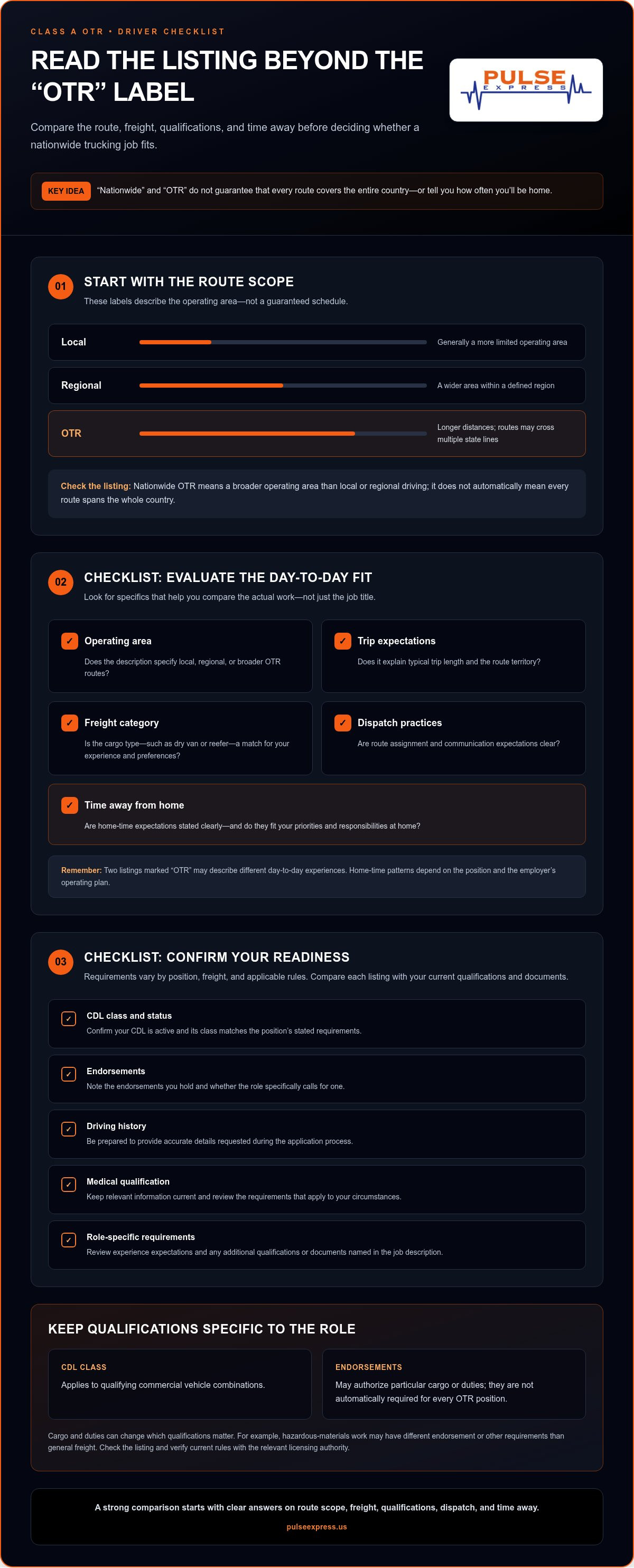
Job listings can use “nationwide,” “OTR,” “regional,” and “local” in different ways. The label alone doesn’t tell you how far a position travels, what freight it handles, or how often you may be home. Check the stated operating area and expectations, not just the headline.
Definition: Nationwide OTR driving is commercial driving in a qualifying tractor-trailer combination on long-distance routes that may cross state lines. It generally involves a broader operating area than local or regional driving, but it doesn’t automatically mean every route covers the entire country.
Nationwide OTR versus local and regional driving
Local roles generally focus on a more limited operating area, while regional jobs cover a wider area within a defined region. OTR work can span longer distances and cross multiple state lines. These labels describe route scope, not a guaranteed schedule: home-time patterns depend on the position and the employer’s operating plan.
Before applying for Class A trucking jobs nationwide, compare the route territory, typical trip length, freight category, dispatch practices, and expected time away. Two listings marked “OTR” may describe different day-to-day experiences. Look for specifics that help you decide whether the work fits your priorities and responsibilities at home.
What a Class A CDL establishes
A Class A commercial driver’s license applies to qualifying commercial vehicle combinations. The license class and endorsements are separate: endorsements can authorize particular cargo or duties, but they aren’t automatically required for every OTR position. For an overview of the credential and its general scope, see Commercial Driver's License (CDL) Class A.
Licensing and qualification requirements can depend on current federal and state rules, as well as the specific job. Verify the applicable requirements with the relevant licensing authority and review any role-specific qualifications before applying. Don’t assume that a job’s freight type means every driver needs the same endorsement.
Route scope is only one part of the decision. Dry van and reefer positions involve different freight categories, and the employer’s operating plan shapes how routes are assigned and communicated. Match those details to your background and preferences, then review the listing for qualifications and schedule expectations.
Use this first-pass review:
- Operating area: Does the description specify local, regional, or broader OTR routes?
- Freight: Does the cargo category suit your qualifications and preferences?
- Time away: Does the position explain its home-time expectations clearly?
- Requirements: Are the CDL class, endorsements, and other qualifications relevant to the role stated?
Clear answers make it easier to compare opportunities on practical fit, rather than relying on labels that may mean different things across employers.
Class A OTR Driver Requirements: Check Your Readiness
A useful application starts with a clear picture of your qualifications. Requirements can vary with the position, freight, and applicable rules, so don’t assume every OTR listing has the same standards. Review the job description and compare it with your current documents before applying. For official guidance, consult the FMCSA Commercial Driver's License Information and the relevant state licensing authority.
Documents and qualifications to prepare
Gather the information that lets you describe your readiness accurately. Check that your CDL is active, note any endorsements, and be prepared to discuss your driving history and applicable medical qualification. Review each listing for role-specific qualifications, including experience expectations, rather than assuming a universal minimum.
- CDL: Confirm the license class and status match the position’s stated requirements.
- Endorsements: Identify any endorsements you hold and whether the listed role calls for one.
- Driving history: Be ready to provide accurate details requested during the application process.
- Medical qualification: Keep relevant information current and review the requirements that apply to your circumstances.
- Other role requirements: Note any additional qualifications or documents specified in the job description.
Keep records organized so you can answer application questions consistently. Qualification rules can change, and individual circumstances matter. Verify current federal and state requirements before relying on general guidance, especially if you’re unsure how a particular document applies to you.
When freight may call for added qualifications
Cargo and duties can affect which qualifications a position requires. Hazmat is one example: a role involving hazardous materials may have endorsement or other requirements that differ from a general-freight position. Don’t infer the exact requirements from the cargo label alone. Read the listing and verify current rules with the appropriate licensing authority before applying for hazmat OTR driver jobs.
CDL class and endorsements are distinct qualification details: the class identifies the qualifying vehicle combination, while endorsements may apply to particular cargo or duties. An OTR job doesn’t automatically require every available endorsement. The freight and responsibilities of the specific role determine what qualifications are relevant.
Use this quick readiness check before submitting an application:
- Can you state your CDL class and confirm its current status?
- Can you clearly identify any endorsements you hold?
- Have you reviewed the listing’s driving-history, medical, and experience criteria?
- Are the requested details and relevant documents ready to share accurately?
Being prepared helps you assess fit as well as eligibility. Pulse Express recruits Class A CDL drivers for OTR reefer and dry van operations. If those freight categories match your interests and qualifications, explore Pulse Express OTR driver opportunities and review the application details for the role.
Dry Van or Reefer OTR Jobs: Compare the Work Before You Apply
Freight type can shape the focus of an OTR role, but it doesn’t tell the whole story. Dry van and reefer describe different freight categories, while route patterns, dispatch practices, and daily responsibilities depend on the position. Use the comparison below as a starting point, then look for details that show how each job works in practice.
| Factor | Dry van | Reefer |
|---|---|---|
| Freight category | General freight moved without a temperature-control requirement. | Freight that requires temperature-controlled transport. |
| What to understand | How the role describes its freight, route scope, and operating expectations. | Which temperature-related procedures and role expectations apply. |
| What can vary | Assignments, routes, and daily responsibilities differ by position. | Assignments, routes, and daily responsibilities differ by position. |
What to consider in dry van roles
Dry van is a freight category, not a promise about a particular route or routine. Read the job description for the freight handled, operating area, dispatch practices, and expectations for time away. Pulse Express recruits Class A CDL drivers for OTR dry van operations, so candidates can compare this freight category with their experience and preferences.
What to consider in reefer roles
Reefer freight involves temperature-controlled transport. The specific position determines its procedures, assignments, and route expectations, so review those details rather than assuming every reefer role works the same way. Pulse Express also recruits Class A CDL drivers for OTR reefer operations. Consider whether this freight category and the role’s stated expectations suit the work you want to do.
Before applying, turn the listing into a practical comparison. Note the freight category, route scope, communication expectations, and time-away needs. If the job description uses broad language, identify what you still need to understand about the position’s operating plan. This makes it easier to compare opportunities based on the work itself, not just the category name.
- Freight: Does the cargo category match your qualifications and preferences?
- Routes: Does the description explain the operating area and route pattern?
- Expectations: Are responsibilities and communication practices described clearly?
- Fit: Does the position’s stated time away work with your personal priorities?
Neither freight category is universally better. The right fit depends on the specific job and the kind of work you prefer. For broader context on CDL A long haul driver careers, consider how freight choice connects with route and schedule expectations discussed in the Occupational Outlook for Heavy and Tractor-Trailer Truck Drivers. Applying this comparison to Class A trucking jobs nationwide can help you focus on opportunities that align with your qualifications and road-life priorities.
How to Evaluate Nationwide Trucking Jobs Before You Apply
A strong job match is about more than a familiar title. Use a consistent process to compare the work, your qualifications, and the details that matter to your life. This makes it easier to assess Class A trucking jobs nationwide and spot differences between roles.
- Clarify your priorities. Decide what route scope and time-away pattern could fit your circumstances. Separate non-negotiables from preferences, such as freight category or communication expectations.
- Compare role details. Review each listing for route scope, freight, dispatch and communication expectations, and time away. Compare compensation and benefits only when those details are explicitly stated for the role.
- Review your qualifications. Match the listed CDL, endorsements, experience, and other requirements against your own records. Focus on the specific position rather than assuming every OTR role has identical criteria.
- Prepare your application. Organize relevant employment history and driving qualifications before you begin. Follow the role-specific application instructions and provide accurate information throughout.
Build a personal OTR job-fit checklist
Start with your real-life constraints. Consider what route scope and time away would work for you, then identify freight categories that fit your interests and relevant experience. Mark each preference as either essential or flexible. This helps you compare roles clearly and avoid overlooking a practical mismatch because a listing sounds appealing.
Use your checklist to assess the position’s details, not to make assumptions from a job title. A broad route description, for example, may not explain how assignments are organized or how the company communicates expectations. Give priority to information provided for the specific role. If compensation or benefits aren’t stated, don’t assume what they include when comparing opportunities.
Prepare a clear, accurate application
Before starting, gather your employment history and relevant driving qualifications so you can complete the application consistently. Be precise about your experience, endorsements, and availability. Don’t claim qualifications you don’t hold or leave details vague when the application asks for specifics. Accurate answers present your background clearly and keep the process focused on the role’s stated requirements.
Follow the application instructions for the position you’re considering. Let the listed requirements guide which information you provide and what details to review. If the role’s freight category or operating expectations are central to your fit, describe relevant experience without overstating it.
A deliberate review turns a broad search into a practical decision: compare priorities, role details, qualifications, and application steps. To explore Class A OTR driver opportunities with Pulse Express, review the driver application information.
Explore Class A OTR Opportunities with Pulse Express
Finding a role that fits means connecting the details of the work with your qualifications and priorities. Pulse Express is a trucking and logistics company founded in 2000. It recruits Class A CDL drivers for over-the-road reefer and dry van operations, giving drivers interested in these freight categories a place to explore OTR opportunities.
Where Pulse Express’s OTR work fits
Pulse Express recruits drivers for reefer and dry van work. Reefer operations involve temperature-controlled freight, while dry van work covers a different freight category. The right fit depends on your experience, preferences, and the details of the role. Review the position information so you understand its qualifications and expectations before applying.
Pulse Express’s broader freight operations include general and hazardous materials transportation. Its driver opportunities focus on OTR reefer and dry van operations. If you’re researching hiring CDL drivers in 2026, focus on the position’s stated freight category and application information rather than assuming all roles are alike.
Take the next step with confidence
A considered application starts with accurate information. Before you begin, organize your employment history and relevant driving qualifications. Review the role details and be ready to describe your experience, applicable endorsements, and availability truthfully. Clear, consistent information helps you present your background in a way that relates directly to the position.
As you explore Class A trucking jobs nationwide, compare each opportunity against your priorities: freight type, route expectations, qualifications, communication, and time away. Pulse Express recruits drivers for OTR reefer and dry van operations. Review the application information and follow the instructions for the role that aligns with your experience.
Explore Class A OTR driver opportunities.
Make Your Next Move with Confidence
Turn your priorities into a focused search. Decide what kind of OTR work fits your experience and circumstances, then review each position with those needs in mind. A clear sense of fit can help you approach Class A trucking jobs nationwide with purpose, rather than applying based on a title alone.
Pulse Express recruits Class A CDL drivers for OTR reefer and dry van operations. If those freight categories align with the work you’re looking for, review the company’s driver information and application details.
Explore Class A OTR driver opportunities and take the next step when you’re ready. Your experience and priorities are a strong place to begin.
Frequently Asked Questions
What does nationwide mean in Class A trucking jobs?
“Nationwide” generally describes a broad operating territory that may include routes across state lines. It doesn’t mean every trip crosses the country or follows a set schedule. For Class A trucking jobs nationwide, check the position’s stated service area, route expectations, and time-away details. Those specifics, rather than the word “nationwide,” help clarify where the work may take you and what routine to expect.
Do nationwide Class A trucking jobs require a Hazmat endorsement?
No. A Hazmat endorsement isn’t a blanket requirement for every nationwide OTR role; it depends on the cargo and duties assigned to the position. A carrier’s hazmat freight services alone don’t mean every driver hauls hazardous materials. Check the job posting and verify current endorsement and qualification rules with FMCSA and your state driver licensing agency before applying, since applicable requirements can change.
Can a new CDL-A driver get an OTR trucking job?
Potentially, yes. Eligibility depends on the employer’s requirements and the specific position, including any stated experience expectations. A new CDL-A holder should read those criteria carefully and distinguish required experience from preferred experience. If a listing doesn’t specify a threshold, follow the application instructions and provide an accurate account of your training and driving background.
What is the difference between dry van and reefer trucking jobs?
Dry van and reefer refer to different freight categories. Dry van freight generally doesn’t require temperature-controlled transport, while reefer freight does. Those labels alone don’t establish a particular schedule, route, or daily routine. Compare the freight description and role-specific expectations in each listing. Consider which category fits your experience and interests, then use the stated position details to assess the work.
How much do nationwide Class A truck drivers earn?
There isn’t one fixed earning amount for nationwide Class A drivers. Compensation depends on the specific employer and offer, so don’t infer pay from an OTR label, route scope, or freight category. Review the compensation information stated for the position, including its pay basis and any listed conditions or additional components. Compare only details provided for each role, and avoid treating general industry figures as a promise about a particular job.
How do I apply for a Class A OTR job with Pulse Express?
Start by reviewing Pulse Express driver opportunity information and the application instructions provided there. Prepare accurate details about your CDL qualifications, endorsements, driving experience, and employment history so you can complete the application clearly. Read the specific role information and follow its stated steps. This helps you present relevant experience without assuming every position has identical requirements or outcomes.


