

What if the most dangerous part of your shipment isn't the open highway, but the empty space inside your trailer? Many shippers believe that once a trailer door is sealed, the cargo is inherently safe. However, secure dry van shipping in 2026 requires far more than a sturdy lock and a heavy-duty bolt. With the global freight market projected to reach $2.81 trillion this year, the stakes for your high-value general freight have never been higher. You've likely felt that familiar anxiety as a truck pulls away, wondering if your pallets will survive the shifting forces of a long-haul route or if they'll arrive as a costly pile of damaged inventory.
We understand that your reputation travels with every load. You deserve a partner that prioritizes precision, customization, and safety over simple speed. In this guide, you'll discover why true security is an active process led by expert OTR drivers rather than a passive byproduct of an enclosed box. We'll explore the critical differences between standard and secure dry van service, clarify complex hazmat compliance, and outline the safety protocols that ensure zero-damage delivery. It's time to move beyond the box and build a shipping strategy rooted in stability, reliability, and mutual growth.
Key Takeaways
- Understand that secure dry van shipping is an active process involving physical enclosure, internal stabilization, and expert oversight.
- Discover how professional tools like load bars, ratchet straps, and friction mats work together to neutralize the physics of long-haul transport.
- Identify common industry myths that lead to cargo damage, including the misconception that trailer walls are built to hold freight in place.
- Access a practical checklist for evaluating carrier safety protocols, focusing on hazmat certifications, driver endorsements, and equipment maintenance.
- Recognize the value of partnering with a seasoned guide who brings over two decades of specialized expertise to every shipment.
Redefining Secure Dry Van Shipping: More Than Just an Enclosed Box
Secure dry van shipping is often misunderstood as a passive service. Shippers frequently assume that because their goods are inside a metal box, they're safe. In reality, true security is the result of physical enclosure combined with active internal stabilization. This dual approach ensures that your high-value freight remains stationary, protected, and intact from origin to destination. Dry van transport serves as the backbone of the American supply chain, moving the vast majority of non-perishable goods. Whether it's consumer electronics, textiles, or industrial components, these trailers provide a shield against environmental hazards and external threats.
Professional OTR carriers focus on a single, unwavering goal: Load Integrity. This standard means the cargo arrives in the exact condition it was loaded. Achieving this requires more than just a locked door. It demands an expert driver who understands the nuances of weight distribution and securement. A driver isn't just a pilot; they are a safety technician who monitors the load's stability throughout the entire journey. This level of oversight provides the stability, reliability, and precision required for modern logistics.
The Anatomy of a Secure Dry Van Trailer
The construction of a trailer determines its defensive capabilities. Most modern units feature a sealed aluminum or steel enclosure that provides a weather-tight environment. This structure follows established Intermodal container standards to ensure structural strength and durability. Below the surface, a heavy-duty hardwood floor serves as the foundation for bracing and blocking. These floors are designed to handle the weight of heavy machinery and provide a solid surface for securing pallets. Inside the walls, logistics tracks, often called E-tracks, provide multiple anchor points for ratchet straps and load bars. These features allow for a customized securement plan tailored to each specific freight type.
Why "Standard" Shipping Isn’t Always Secure
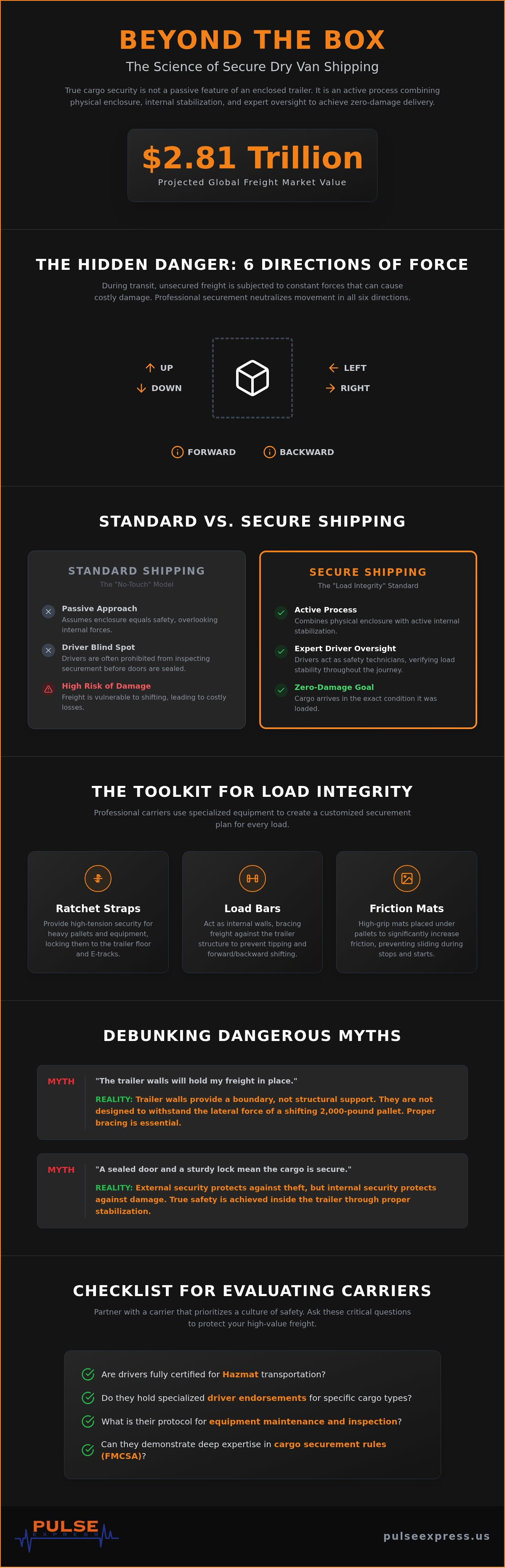
There is a significant difference between basic transport and high-security OTR logistics. Standard shipping often relies on the "no-touch" model. In this scenario, drivers are often prohibited from inspecting how the freight is secured before the doors are sealed. This creates a dangerous blind spot that can lead to cargo shifts during transit. Implementing professional secure dry van shipping protocols is the only way to account for the total prevention of cargo movement in all six directions: forward, backward, left, right, up, and down. Without active verification of these forces, your freight is at the mercy of every sharp turn and sudden stop. Choosing a partner who prioritizes safety protocols over mere speed is the only way to guarantee a zero-damage delivery.
The Mechanics of Load Integrity: How Professional Carriers Prevent Cargo Shift
Cargo shift is the silent enemy of the logistics industry. While trailer walls provide a physical boundary, they aren't designed to withstand the lateral force of a shifting 2,000-pound pallet. Professional secure dry van shipping relies on the science of securement to neutralize these forces. During long-haul OTR routes, freight is subjected to constant vibrations, sudden centrifugal forces during turns, and the impact of rapid braking. Without proper internal stabilization, even the most carefully packed box can become a projectile within the trailer. This creates a risk for the cargo, the driver, and everyone else on the road.
Compliance starts with understanding the FMCSA cargo securement rules. These regulations mandate that all cargo must be secured against movement in every direction. Weight distribution is equally critical for safety and legal compliance. Improperly balanced loads don't just risk cargo damage; they compromise the truck's braking efficiency and steering control. Professional carriers use precision loading patterns to ensure axle weights remain within legal limits while maintaining a low center of gravity for maximum road stability.
Essential Tools for Internal Cargo Securement
Stabilizing a load requires a specific toolkit designed for high-tension environments. Professional drivers utilize several key tools to maintain load integrity:
- Ratchet Straps: These provide high-tension security for heavy pallets, offering significantly more holding power than cam straps.
- Dunnage Bags: These air-filled cushions are inflated to fill lateral voids, preventing side-to-side movement and absorbing road shock.
- Friction Mats: Placed under pallets, these mats increase the coefficient of friction between the cargo and the trailer floor.
For heavy industrial machinery, drivers employ blocking and bracing techniques. This involves nailing wooden blocks to the trailer's hardwood floor to create a physical frame that locks the equipment in place. These methods ensure that freight remains stationary regardless of road conditions.
The Driver’s Vigilance: The Human Element of Security
Even the best tools require expert application. This is why hazmat OTR driver jobs are so vital; they demand a higher level of technical expertise and a meticulous approach to safety. A seasoned driver doesn't just drive; they manage the environment. They perform periodic load checks during long-haul routes, ensuring that straps haven't loosened and seals remain intact. They check door seals and padlocks at every stop to protect high-value freight from external threats. An experienced driver monitors the road ahead, anticipating sharp curves or construction zones that might stress securement points. This proactive mindset is what separates a standard haul from a premium service. For those seeking a partner committed to this level of detail, choosing expert freight solutions ensures your cargo is protected by both science and experience.
5 Dangerous Myths About Dry Van Security Debunked
Misconceptions often lead to preventable losses in the logistics industry. These myths create a false sense of safety that can result in damaged goods, missed deadlines, or serious compliance violations. To achieve true secure dry van shipping, you must separate industry fiction from operational reality. Many shippers rely on outdated assumptions that don't account for the physical rigors of long-haul transport or the complexities of modern safety regulations.
- Myth 1: The trailer walls will hold the freight in place. Aluminum and steel siding are designed for containment, not securement. Without internal bracing, a shifting 2,000-pound pallet can easily compromise the trailer's structural integrity.
- Myth 2: Insurance covers all damage, so securement is secondary. Financial reimbursement doesn't restore lost time, damaged customer trust, or the administrative burden of filing a claim.
- Myth 3: Dry van shipping is only for low-value commodities. Modern dry vans are the preferred choice for high-value general freight, including electronics, high-end textiles, and sensitive industrial components.
- Myth 4: All dry van trailers are structurally identical. Maintenance levels, floor strength, and roof integrity vary significantly between carriers.
- Myth 5: Hazmat can only be shipped in specialized tankers or reefers. Specialized carriers like Pulse Express have provided expert Hazmat dry van services since 2000, proving that dry formats are safe for many hazardous materials.
Why Structural Integrity Varies Among Carriers
The age and condition of a trailer directly impact the safety of your cargo. Older units often suffer from "soft" roofs that are prone to leaks or damaged hardwood floors that cannot support proper blocking and bracing. Water ingress is a major risk in poorly maintained dry vans, potentially destroying sensitive electronics or paper products. According to the American Trucking Associations, equipment maintenance is a cornerstone of industry safety standards. Pulse Express maintains a fleet of modern, well-maintained equipment to ensure every load remains dry, stationary, and secure throughout its journey.
The Reality of Cargo Insurance vs. Loss Prevention
A claim is never a substitute for a safe delivery. While insurance is a necessary safety net, it doesn't account for the hidden costs of damaged freight. These include the loss of business continuity, the cost of manufacturing replacement goods, and the impact on your brand's reputation for reliability. Effective secure dry van shipping focuses on loss prevention through rigorous securement protocols. By neutralizing movement in all six directions, carriers reduce the risk of incidents that lead to premium hikes. This proactive approach ensures stability, protects your bottom line, and fosters mutual growth between shippers and carriers.
Evaluating Carrier Protocols: A Checklist for High-Value and Hazmat Freight
Evaluating a carrier's internal culture is the final step in ensuring load integrity. You need a partner whose commitment to safety is documented and verifiable. A carrier that lacks a formalized plan for secure dry van shipping likely lacks the operational discipline required for sensitive freight. Start by checking their Compliance, Safety, Accountability (CSA) scores. These ratings provide a transparent look at a carrier's historical performance in areas like vehicle maintenance and driver fitness. A low score in vehicle maintenance often signals a higher risk of equipment failure during transit. Inquire about the average age of the fleet and the frequency of their inspection cycles. Modern trailers equipped with the latest securement technology are essential for high-value logistics.
The Hazmat Factor in Dry Van Logistics
Shipping hazardous materials in a dry van format requires specialized expertise. Class 3 (flammable liquids), Class 8 (corrosives), and Class 9 (miscellaneous) materials each have unique securement requirements. For instance, corrosives must be blocked and braced to prevent any movement that could lead to a breach of the container. Segregation rules are equally vital; certain materials can't be transported in the same trailer due to the risk of dangerous chemical reactions. If your freight is sensitive to environmental shifts, you might consider temperature controlled trucking services for reefer hazmat transport instead. Professional OTR drivers must hold specific endorsements and undergo regular training to handle these sensitive loads safely.
Visibility and Communication Standards
Real-time visibility is no longer a luxury in the logistics industry. In 2026, 24/7 GPS tracking is a non-negotiable requirement for secure dry van shipping. Shippers need to know exactly where their high-value freight is at any given moment. This transparency builds trust and allows for proactive decision-making if a delay occurs. Beyond automated pings, the value of direct communication with the OTR driver and dispatch can't be overstated. Pulse Express uses integrated technology to provide peace of mind, ensuring that you're never left in the dark. This approach combines precision tracking, expert oversight, and clear reporting to keep your supply chain moving. When you're ready to upgrade your logistics strategy, you can request a secure freight quote to see how our protocols protect your bottom line.
Why Pulse Express is the Trusted Partner for Long-Haul Securement
Choosing a logistics partner is a decision rooted in trust and operational stability. Pulse Express has spent over two decades refining the art of secure dry van shipping. Since our founding in 2000, we've navigated the evolving landscape of OTR transport with a single-minded focus on precision. Under the leadership of CEO Adelina Pavlov, we've built a culture that prioritizes safety, integrity, and partnership. We understand that a "standard" delivery is no longer enough for high-value or sensitive freight. You need a partner that anticipates risks before they become disruptions. Our approach combines the confidence of an established leader with the personal attention of a service-oriented business.
We position ourselves as a seasoned guide for shippers who cannot afford the costs of cargo damage or compliance failures. Our operations are built on a foundation of established reliability, ensuring that your freight is protected from origin to destination. This sense of stability allows our clients to focus on their own growth while we handle the complexities of the road. We don't just move boxes; we manage a comprehensive safety ecosystem designed for the modern supply chain. Our focus remains on operational excellence, timely execution, and mutual success.
A Legacy of Reliability Since 2000
Our safety protocols are the result of 25 years of hands-on experience. This legacy informs every aspect of our operation, from equipment maintenance to route planning. Our commitment to excellence starts with our hiring CDL drivers program, which attracts career professionals who value integrity. These Class A CDL OTR drivers undergo rigorous training in advanced securement techniques and hazmat compliance. Pulse Express treats every load like a high-value asset, ensuring that your cargo receives the care it deserves. We believe that a safe driver is the most effective tool in any securement strategy.
Customized Logistics for Complex Freight
No two shipments are identical. We specialize in creating tailored logistics solutions for unique or complex dry van cargo. By owning our fleet, we maintain total control over equipment standards and driver schedules. This asset-based model allows us to offer a level of reliability that non-asset brokers cannot match. We're personally invested in your success, acting as a protective guide for your most sensitive freight. When failure isn't an option, you need the stability of a proven leader. Contact Pulse Express for a secure dry van shipping consultation today to secure your supply chain with a partner that values precision as much as you do.
Securing Your Supply Chain for the Long Haul
True security in logistics requires a shift from passive containment to active prevention. We've explored how physical enclosures, internal stabilization tools, and driver vigilance form the foundation of secure dry van shipping. By debunking common myths and prioritizing rigorous carrier protocols, you protect your inventory, your reputation, and your bottom line. Precision isn't just a goal; it's a requirement for modern high-value and hazmat freight in a competitive market.
Pulse Express provides the stability, expertise, and reliability your sensitive cargo demands. Founded in 2000, we've built our legacy on a specialized hazmat endorsed fleet and a team of OTR long-haul experts. We manage every load with the care of a dedicated partner and the efficiency of a global leader. Take the next step toward zero-damage delivery by choosing a partner that is protective, efficient, and deeply committed to your operational excellence. Request a Secure Freight Quote from Pulse Express today and experience the peace of mind that comes with proven reliability. We look forward to supporting your continued growth and success.
Frequently Asked Questions
What makes dry van shipping "secure" compared to other methods?
Dry van shipping is considered secure because it provides a fully enclosed, weather-tight environment that shields cargo from external elements and theft. Unlike open-deck methods, the sealed aluminum or steel walls offer a physical barrier against the outside world. However, true security comes from combining this enclosure with professional internal stabilization. This approach ensures that high-value goods remain stationary during the vibrations and forces of long-haul OTR transport, maintaining the total integrity of the load from origin to destination.
Can I ship hazardous materials in a standard dry van trailer?
You can ship hazardous materials in a dry van if the carrier possesses the necessary certifications and expertise. Pulse Express has provided specialized dry freight hazmat transport since 2000, ensuring all loads comply with strict federal regulations. This service is ideal for non-perishable hazardous goods that require a secure, dry environment but don't need active temperature control. Our expert drivers hold the specific endorsements required to manage these sensitive shipments safely and efficiently.
What are the most common causes of cargo damage in dry van shipping?
Cargo shift is the leading cause of damage in dry van shipping, often occurring when pallets aren't properly braced against lateral forces. Other frequent issues include improper weight distribution, which can lead to stability problems, and equipment failure, such as roof leaks in poorly maintained trailers. Professional secure dry van shipping protocols mitigate these risks by using specialized tools like load bars and dunnage bags to fill voids and neutralize movement in all six directions during transit.
How does Pulse Express ensure the security of high-value freight?
Pulse Express ensures security through a combination of seasoned leadership and driver expertise. Founded in 2000 by CEO Adelina Pavlov, we focus on precision and load integrity for every shipment. We hire career-minded Class A CDL OTR drivers who undergo rigorous training in high-value cargo securement. By maintaining our own fleet and using advanced safety protocols, we provide the stability and reassurance that shippers need when failure isn't an option for their supply chain.
What equipment does a driver need to secure a dry van load?
Drivers utilize a specialized toolkit to secure cargo within a dry van trailer. This includes heavy-duty ratchet straps for high-tension holding power and adjustable load bars that create physical bulkheads between pallet rows. Dunnage bags are often inflated to fill lateral gaps, while friction mats are placed under heavy items to increase floor grip. For industrial machinery, drivers use wooden blocks and braces nailed directly to the hardwood floor to ensure the equipment stays locked in place.
Is driver tracking included in secure dry van shipping services?
Real-time 24/7 GPS tracking is a standard component of professional secure dry van shipping services in 2026. This technology provides shippers with full visibility into their freight's location and progress throughout the journey. Beyond automated pings, high-security logistics also emphasize direct communication between dispatch and the OTR driver. This transparency ensures that any potential delays or environmental risks are identified and managed immediately, providing an essential layer of protection for high-value general freight.
What is the difference between a dry van and a reefer for non-perishable hazmat?
The primary difference lies in temperature control and insulation. A reefer is a refrigerated unit designed for perishable goods or hazmat materials that are chemically sensitive to heat. A dry van is a standard, non-insulated trailer used for non-perishable freight. While both can transport hazardous materials, a dry van is the more efficient choice for hazmat that stays stable at ambient temperatures. Both formats require the same level of rigorous internal securement to prevent cargo shifting.
How do I verify a carrier’s safety record for dry van transport?
You can verify a carrier's safety record by reviewing their DOT safety ratings and Compliance, Safety, Accountability (CSA) scores via the FMCSA website. These scores reflect the carrier's performance in categories like vehicle maintenance, driver fitness, and crash history. A reputable carrier will have a transparent history of compliance and a modern fleet with documented inspection cycles. At Pulse Express, our 25-year history and commitment to safety standards serve as a benchmark for established reliability in the industry.


