

What if the secret to surviving a 47% year-over-year surge in spot rates isn't finding more brokers, but finding more drivers? In the supply-driven market of 2026, many shippers feel the sting of capacity ghosting, the frustration of rising costs, and the uncertainty of regulatory delays. You likely already know that securing reliable dry van capacity solutions requires more than just a digital load board. It requires a partner who actually owns the equipment, values the professionals behind the wheel, and understands the nuances of long-haul logistics.
We understand the pressure of maintaining predictable freight costs while managing sensitive or hazmat cargo. You deserve a logistics strategy rooted in precision, safety, and stability. This guide shows you how to secure consistent dry van capacity by leveraging asset-based reliability and specialized OTR expertise. We'll explore the impact of new FMCSA medical certification rules, the necessity of driver retention, and how a dedicated fleet ensures high on-time delivery rates even during peak seasons. Together, we can build a supply chain that is protective, efficient, and deeply committed to your operational excellence.
Key Takeaways
- Learn how to navigate the 2026 selective market by implementing asset-backed dry van capacity solutions that prioritize long-term stability over volatile spot market rates.
- Discover why partnering with asset-based fleets provides a higher level of operational security and execution compared to the inherent risks of traditional freight brokerage.
- Understand the specific regulatory and safety requirements necessary for securing specialized OTR capacity for sensitive industrial goods and Hazmat freight.
- Identify practical ways to improve your "Carrier of Choice" profile to attract elite Class A CDL drivers and minimize costly facility dwell times.
- Explore how a 26-year legacy of driver-focused hiring and operational excellence creates a more resilient supply chain for your most critical shipments.
2026 Dry Van Market: Why Capacity is Getting Selective
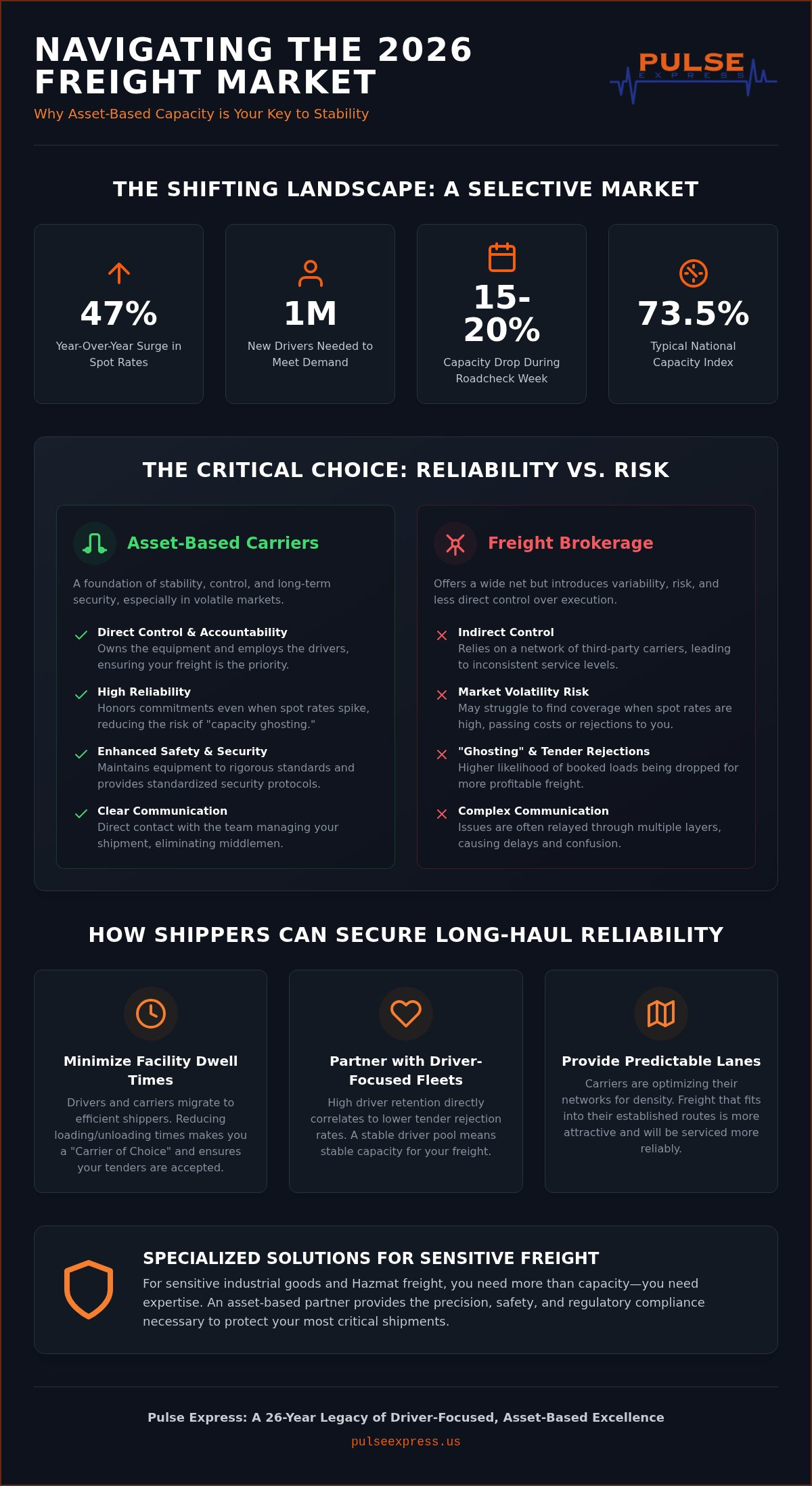
The 2026 freight market isn't just tight. It's selective. While equipment exists, carriers now prioritize high-margin freight and reliable partners over one-off spot loads. This shift defines "selective capacity," a state where having a budget doesn't always guarantee a truck. When the national capacity index hovers around 73.5%, linehaul spot rates react sharply. You've likely noticed that securing dry van capacity solutions requires more lead time than it did two years ago. This is largely due to disciplined restructuring by major public carriers. These entities have optimized their networks for maximum density, which often leaves small-to-mid shippers struggling to find space in secondary lanes. Even seasonal events like Mother's Day create unexpected ripples. The massive surge in floral demand displaces equipment across the country, causing a sudden drought in general dry van availability for non-seasonal goods.
Understanding Truckload shipping fundamentals is essential for navigating these shifts. In a supply-driven market, your freight's attractiveness matters just as much as your rate. Carriers are looking for stability and precision. They prefer lanes that keep their drivers moving and their equipment utilized. If your freight doesn't fit a carrier's restructured network, you'll likely face higher costs or frequent tender rejections.
The 2026 Driver Shortage and Its Impact
The industry's struggle to find and keep talent remains a primary driver of market volatility. Current ATA projections suggest the industry still needs to recruit nearly 1 million new drivers to keep pace with retiring professionals and growing demand. High driver turnover rates don't just affect the carriers. They directly correlate with your tender rejection rates. When a carrier loses a driver, that truck sits idle, and your booked load is the first to be dropped. We've seen a significant shift toward high-paying OTR trucking jobs as a way to stabilize capacity. Shippers who partner with fleets that prioritize driver retention find much more consistent dry van capacity solutions than those relying on the high-turnover spot market.
Predicting Seasonal and Regulatory Disruptions
Regulatory events can shrink the available truck pool overnight. During Roadcheck Week, total market capacity often drops by 15-20% as older equipment is sidelined and drivers take scheduled time off to avoid inspection windows. You can prepare for these quarterly market turns by identifying the signs of a tightening lane early. We use ELD data to monitor carrier dwell times and availability in real time. If drivers are spending too much time waiting at facilities, they'll migrate to more efficient shippers. Reducing your dwell time is one of the fastest ways to ensure a carrier accepts your next long-haul tender.
Asset-Based Capacity vs. Freight Brokerage: Choosing the Right Solution
Choosing between an asset-based carrier and a freight broker isn't a matter of right or wrong. It's a calculation of risk and reliability. Asset-based carriers provide a foundation of stability, especially when markets tighten and spot rates climb. According to the U.S. Department of Transportation's 30-Year Freight Projections, the volume of goods moving by truck will continue to grow, making long-term dry van capacity solutions even more critical. While brokers offer a wide net, they lack the direct control over drivers that ensures your freight moves when capacity gets selective.
At Pulse Express, we focus heavily on our "Driver-to-Freight" ratio. We believe that capacity is a human resource, not just a physical one. By prioritizing OTR CDL Class A driver hiring, we ensure our trucks are manned by professionals committed to our fleet. This focus reduces the risk of "ghosting" often found in the spot market. When spot rates see a 47% year-over-year increase, brokers may struggle to find coverage, but an asset-based partner honors the commitment because they own the wheels and employ the driver.
The Reliability of Dedicated OTR Fleets
Working with an asset carrier means you benefit from direct communication, standardized maintenance, and enhanced security. You aren't playing a game of telephone through multiple middlemen. Asset-based fleets maintain their own equipment to rigorous standards, which significantly reduces the chance of roadside delays or safety violations. The asset-based advantage ensures your cargo remains within a single, controlled chain of custody from pickup to final delivery. This level of oversight provides the precision, customization, and safety required for high-value industrial goods.
When to Leverage 3PL Partnerships
Brokerage and 3PL partnerships still hold value within a balanced supply chain. They are particularly useful for managing sudden overflow volume during unexpected production surges or accessing niche lanes where your primary carrier lacks density. A hybrid model often yields the best results. You use a core asset carrier for your primary lanes to ensure reliability and cost predictability. Then, you layer in strategic brokerage for seasonal peaks or irregular routes. This approach offers a sense of balance, completeness, and resilience that protects your bottom line.
Specialized Dry Van Solutions for Hazmat and Sensitive Cargo
While many view dry van freight as a simple commodity, shippers of hazardous materials or high-value industrial goods know better. These shipments require a level of precision and oversight that general freight carriers often cannot provide. In 2026, there is a critical shortage of Hazmat-endorsed dry van capacity. This shortage stems from the rigorous training, higher insurance requirements, and strict regulatory oversight involved in hazardous material transport. Many general carriers avoid these loads because the liability risk outweighs their operational capabilities. Pulse Express addresses this gap by offering specialized dry van capacity solutions that prioritize safety and compliance across every mile.
Our approach is rooted in stability and established reliability. We don't just provide a truck; we provide a secure, asset-based environment for sensitive cargo. By maintaining an OTR fleet with specialized Hazmat endorsements, we eliminate the uncertainty of the spot market for industrial shippers. This dedicated focus ensures that your freight moves through a controlled network designed for precision, customization, and safety. It's a persona of protection and efficiency that high-stakes shippers depend on during tight market cycles.
Safety Standards in Hazardous Material Shipping
Specialized driver training is the most effective way to reduce Hazmat liability. A driver who understands the chemistry and risks of their cargo is a driver who prevents incidents before they happen. Pulse Express ensures compliant hazardous material transport nationwide by adhering to three core pillars: accurate documentation, proper placarding, and robust emergency response protocols. We meticulously manage Bills of Lading (BOLs) and ensure every trailer is marked correctly to meet FMCSA standards. This methodical process provides the reassurance you need when moving sensitive chemical or industrial components across state lines.
Dry Van Carriers for High-Value Industrial Goods
High-value electronics and heavy machinery demand more than just space in a trailer. They require security protocols and late-model equipment to prevent damage from mechanical failure or environmental exposure. We invest in a modern fleet to minimize roadside delays and ensure a smooth ride for delicate cargo. Our rigorous standards for hiring CDL drivers mean we only employ elite professionals who understand the nuances of high-value OTR careers. This commitment to quality protects your investment and maintains the integrity of your supply chain from the moment of pickup to the final delivery point.
Strategic Capacity Management: How Shippers Can Secure Long-Haul Reliability
Securing reliable dry van capacity solutions starts with a shift in perspective. In a market where drivers are the most valuable resource, your facility must be a place where they actually want to work. Building a "Carrier of Choice" profile isn't just about offering higher rates. It's about respecting the driver's time and providing a streamlined environment for every pickup. When capacity gets selective, carriers look at your shipper scorecard first. They prioritize partners who offer precision, customization, and safety. If your freight is frequently delayed or your descriptions are inaccurate, you'll find yourself at the bottom of the tender list when the market tightens.
Lead times play a decisive role in your ability to secure space. A 48-hour notice is now the industry minimum for securing reliable long-haul service. Shippers who provide this window give carriers the time needed to optimize their networks and assign their best drivers. This proactive planning is especially critical during regulatory events. During Roadcheck Week, when national capacity typically drops by 15-20%, the only way to stay on schedule is to front-load your volume or secure dedicated assets weeks in advance. Communicating early ensures your cargo isn't left on the dock while drivers pull off the road to avoid inspection delays.
Improving Your Shipper Scorecard
A strong scorecard is built on three pillars: amenities, accuracy, and speed. Providing driver-friendly amenities like clean restrooms, safe parking, and break areas ensures repeat interest from elite fleets. Accuracy is equally vital. When you provide precise freight descriptions, you reduce "truck order not used" (TONU) charges and prevent equipment mismatches. Finally, never underestimate the power of fast payment. In a supply-driven market, carriers remain loyal to shippers who respect their cash flow. Reliable payment terms create a sense of stability that encourages a reliable OTR carrier to prioritize your lanes over others.
Technological Integration for Seamless Shipping
Modern logistics requires a digital handshake. Utilizing real-time tracking through API or EDI integrations allows you to manage customer expectations without constant phone calls. These tools reduce manual booking errors and ensure that every stakeholder has the same data at the same time. This transparency builds trust between you and the carrier. ELD data helps shippers optimize dock schedules by providing precise arrival windows, allowing for better labor allocation and reduced detention costs. By integrating these technologies, you move from a reactive shipping model to a methodical, purposeful strategy that protects your bottom line.
Pulse Express: Delivering Stability through Professional OTR Excellence
Since our founding in 2000, Pulse Express has built a reputation for operational excellence and unwavering reliability. We understand that in a market defined by selective capacity, your business needs more than just a vendor. You need a seasoned guide. Our 26-year legacy is built on a simple premise: we invest in the people who move your freight. By focusing on elite Class A CDL driver hiring and retention, we provide the consistent dry van capacity solutions that brokers often struggle to maintain. This asset-based foundation ensures that your most critical lanes remain stable, regardless of seasonal shifts or regulatory disruptions.
We combine the reach of a national entity with the personal touch of a dedicated partner. Our fleet is equipped to handle both general freight and specialized Hazmat shipments with equal precision. This dual expertise allows us to solve complex long-haul logistics challenges that would sideline less experienced carriers. Under the leadership of CEO Adelina Pavlov, we maintain a culture of stability and proactive communication. We don't just react to market changes; we anticipate them to protect your supply chain. Our persona is protective, efficient, and deeply committed to your operational success.
A Partner-First Approach to Logistics
Our commitment to your success is reflected in our customized approach to capacity. We recognize that every shipper has unique requirements, especially when transporting sensitive industrial goods. We offer a sense of balance and completeness by providing a reliable OTR driver for Reefer and dry Van service that meets your specific volume needs. This focus on driver quality directly benefits your bottom line by reducing cargo damage, minimizing roadside delays, and ensuring high on-time delivery rates. We prioritize three core values in every shipment: precision, customization, and safety.
Ready to Secure Your 2026 Capacity?
Securing your freight's future doesn't have to be a source of stress. Whether you need specialized Hazmat transport or standard dry van service, we're ready to build a partnership that lasts. Starting a collaboration is a straightforward process designed to respect your time. You can request a quote for your specific lanes and experience the difference that professional OTR excellence makes. Don't leave your 2026 logistics to the uncertainty of the spot market. Partner with Pulse Express for your OTR dry van solutions and gain the reassurance of an established leader.
Secure Your Supply Chain for 2026 and Beyond
Navigating the selective market of 2026 requires a shift from transactional booking to strategic partnership. You now understand that securing consistent dry van capacity solutions depends on three critical factors: asset-based reliability, elite driver retention, and specialized Hazmat expertise. By prioritizing these elements, you protect your cargo from market volatility, regulatory delays, and the inherent risks of the spot market. This approach ensures your most sensitive industrial goods arrive with the care they require.
Pulse Express stands as a member of the OTR Elite with over 26 years of operational experience. Our Hazmat certified dry van fleet and commitment to high on-time delivery rates provide the stability your supply chain deserves. We offer the precision, customization, and safety necessary to move your freight with confidence. We are personally invested in your success and ready to serve as your seasoned guide through the changing long-haul landscape.
Are you ready to move from uncertainty to operational excellence? Request a Dry Van Capacity Consultation with Pulse Express today to stabilize your 2026 freight strategy. We look forward to growing alongside your business and providing the reassurance of established reliability.
Frequently Asked Questions
What is dry van capacity and why does it fluctuate?
Dry van capacity represents the total volume of available enclosed trailers and professional drivers ready to move non-perishable freight. It fluctuates based on economic demand, seasonal shipping cycles, and the number of active drivers in the workforce. In a supply-driven market, capacity becomes "selective" as carriers prioritize high-density lanes and reliable partners. Understanding these shifts helps you implement better dry van capacity solutions by aligning your freight with established carrier networks.
How do I find a reliable dry van hazmat carrier?
Finding a reliable Hazmat carrier requires verifying FMCSA safety ratings, insurance coverage, and specific driver endorsements. You should look for asset-based fleets that offer specialized training and have a history of handling hazardous materials. A partner with a dedicated safety department and late-model equipment is essential. This ensures your sensitive cargo moves within a controlled environment that prioritizes precision, customization, and safety across every mile of the journey.
What is the difference between asset-based carriers and freight brokers?
Asset-based carriers own their trucks and employ their drivers, while freight brokers act as intermediaries that connect shippers with third-party carriers. Asset carriers offer direct control, enhanced security, and more predictable dry van capacity solutions during tight markets. Brokers provide flexibility for overflow volume but carry a higher risk of service failures. Choosing an asset carrier provides the reassurance of established reliability and a single point of contact for your logistics team.
How does Roadcheck Week impact dry van availability?
Roadcheck Week causes a sudden contraction in the truck pool as many drivers take scheduled time off to avoid intensive inspections. This event leads to higher tender rejection rates and increased spot market volatility for several days. Shippers can mitigate this impact by securing dedicated assets in advance or shifting their shipping schedules to avoid the inspection window. Proactive planning ensures your supply chain remains efficient, stable, and avoids costly delays during these regulatory events.
Why is driver retention important for my supply chain capacity?
Driver retention is the foundation of freight stability because a truck without a driver is not capacity. Fleets with high turnover rates are more likely to fail on tenders when drivers leave unexpectedly. When you partner with a carrier that prioritizes professional OTR careers, you gain access to a consistent pool of experienced drivers. This stability reduces cargo damage, improves on-time delivery rates, and protects your long-term logistics strategy through established reliability.
Can dry van trailers be used for sensitive industrial electronics?
Dry van trailers are the industry standard for transporting high-value industrial electronics and machinery. These trailers provide a secure, weatherproof environment that protects sensitive components from road debris and moisture. To ensure maximum safety, you should utilize carriers that maintain late-model equipment and employ drivers trained in high-value cargo security. This methodical approach minimizes the risk of mechanical failure or environmental damage during long-haul transit while maintaining a secure chain of custody.
What are the benefits of long-haul OTR services over regional delivery?
Long-haul OTR services provide a single, continuous chain of custody for freight moving across multiple states. This reduces the number of touches and transfers, which significantly lowers the risk of cargo damage or loss. OTR transportation also offers more streamlined transit times for shipments that need to cross the country quickly. It provides a sense of balance and completeness for national supply chains that require precise execution, timely delivery, and professional oversight.
How does Pulse Express ensure the safety of hazardous materials in dry vans?
Pulse Express ensures Hazmat safety through rigorous driver training, specialized endorsements, and strict adherence to federal placarding requirements. We manage every shipment with a focus on precision and safety, using our asset-based fleet to maintain total oversight. Our methodical process includes verifying emergency response protocols and ensuring all documentation is accurate before the truck leaves the dock. This protective persona instills confidence in shippers moving sensitive industrial goods across the country.


