

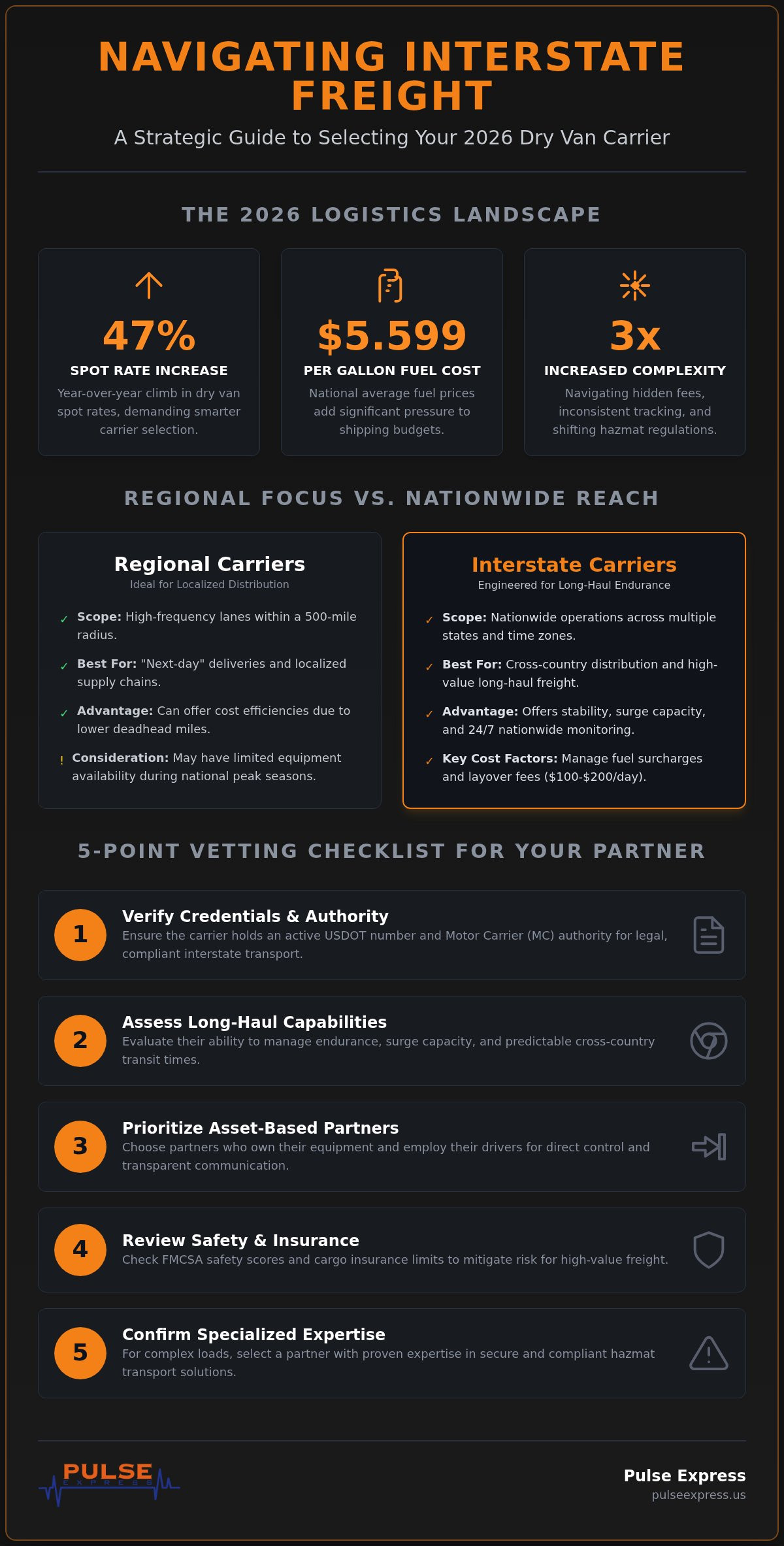
In a market where dry van spot rates climbed 47% year-over-year by mid-2026, the lowest bid is no longer the safest metric for your supply chain. You’ve likely felt the sting of rising fuel costs, which reached a national average of $5.599 per gallon this August, or the exhaustion of chasing down inconsistent tracking on long-haul routes. It’s challenging to manage a budget when hidden brokerage fees and complex hazmat regulations constantly shift the requirements for interstate dry van carriers.
We believe that your logistics strategy should be built on a foundation of reliability, transparency, and expert care. This guide will show you how to evaluate and choose a partner to ensure secure, compliant, and on-time nationwide freight delivery. We will walk through the steps to achieve predictable transit times across the country, simplify the complexities of dry van hazmat transport, and leverage the benefits of direct communication with asset-based dispatchers who are personally invested in your success. By focusing on stability and precision, you can transform your shipping department into a center of operational excellence.
Key Takeaways
- Verify operating authority and DOT credentials to ensure your freight remains legal, compliant, and protected across state lines.
- Evaluate interstate dry van carriers based on their ability to manage long-haul endurance, surge capacity, and cross-country transit times.
- Identify the advantages of asset-based partners who offer direct equipment control, specialized driver training, and transparent communication.
- Review FMCSA safety scores and cargo insurance limits to mitigate the risks associated with high-value long-haul transport.
- Simplify complex logistics by choosing a partner with established expertise in secure, efficient, and specialized hazmat transport solutions.
Defining the Role of Interstate Dry Van Carriers in 2026
The U.S. trucking industry serves as the lifeblood of the national economy, and dry van transport is its most critical artery. These carriers move the vast majority of retail goods, electronics, and industrial components that fill our shelves and factories. By 2026, the role of these providers has evolved from simple transportation into a sophisticated, data-driven partnership. Modern shippers don't just look for a truck; they seek a secure, compliant, and technologically integrated extension of their own supply chain.
To function as interstate dry van carriers, companies must maintain specific legal credentials. This includes an active USDOT number and Motor Carrier (MC) authority, which are federal requirements for any fleet crossing state lines. These certifications aren't just paperwork. They represent a commitment to federal safety standards, specific insurance minimums, and rigorous driver qualifications. This regulatory framework ensures that your freight moves within a system of accountability and professional oversight.
Dry van trailers remain the most versatile equipment in the logistics world. Their enclosed design offers a controlled environment that protects cargo from weather, road debris, and unauthorized access. As security threats become more complex, the industry has shifted toward high-tech solutions. Today’s leading carriers use real-time GPS tracking, electronic locking systems, and advanced telematics to ensure every load is monitored from the moment it leaves the dock until it reaches its final destination.
The Scope of Interstate Dry Van Operations
Over-the-road (OTR) logistics differ fundamentally from short-haul or local cartage. While local drivers stay within a small radius, OTR operations involve multi-day journeys across several time zones. To protect sensitive cargo during these long hauls, professional fleets utilize 53-foot air-ride trailers that dampen road vibrations. Interstate dry van carriers are asset-based entities with nationwide authority. This asset-based model is vital because it means the carrier owns the equipment and employs the drivers, providing a direct line of communication and a higher level of accountability for your freight.
Why National Reach Matters for Shippers
Partnering with a carrier that has a broad geographical footprint creates immediate efficiencies. It reduces the need for transloading, which is the risky process of moving goods between trailers at various hubs. Every time a pallet is moved, the potential for damage increases. A single interstate partner provides a seamless journey that protects your cargo. By utilizing dedicated long-haul lanes, shippers can achieve higher supply chain velocity, simplified multi-state distribution, and more predictable delivery windows across the entire country.
Regional vs. Interstate Dry Van: Which Scale Fits Your Supply Chain?
Choosing between a regional specialist and a national provider depends on the specific geography and velocity of your freight. Regional carriers typically focus on tight loops and high-frequency lanes within a specific territory. However, interstate dry van carriers are engineered for endurance. They handle the logistical weight of moving goods across multiple time zones while maintaining strict adherence to Federal Motor Carrier Safety Administration (FMCSA) regulations. These national providers offer the stability required for long-haul routes where a single delay can ripple through an entire distribution network.
The cost structure of long-haul logistics also differs significantly from local cartage. With diesel prices reaching a national average of $5.599 per gallon in late 2026, fuel surcharges are a primary consideration for every OTR shipment. Additionally, shippers must account for layover fees, which typically range from $100 to $200 per day when drivers are delayed. Because these routes span thousands of miles, 24/7 nationwide monitoring becomes essential. Unlike local dispatchers who might close at five, interstate partners provide constant visibility to ensure your high-value cargo stays on schedule regardless of the time zone.
When to Choose a Regional Carrier
Regional carriers are often the ideal choice for "next-day" deliveries within a 500-mile radius. They operate with lower deadhead miles on specific, high-frequency lanes, which can lead to cost efficiencies for localized distribution. The trade-off is often found in equipment availability. During peak national seasons, regional fleets may lack the trailer depth to handle sudden surges in volume. If your supply chain relies on consistent capacity during the busiest months of the year, a regional-only approach might leave you searching for spot market coverage at a premium.
When Interstate OTR Carriers are Essential
For cross-country routes, such as moving freight from the East Coast to the West Coast, OTR carriers are the only viable solution. These long-distance lanes require specialized equipment standards and drivers who are trained for multi-day transit. Security is another critical factor. Implementing secure dry van shipping protocols is necessary when cargo is in transit for several days across various states. A partner like Pulse Express provides the asset-based reliability needed to maintain equipment consistency and safety standards across the entire OTR route, ensuring your freight arrives exactly as it was loaded.
The Three Pillars of Interstate Freight: Asset-Based, Brokers, and Specialized Fleets
The interstate freight market stands on three distinct operational models: asset-based carriers, freight brokers, and specialized fleets. Each offers a different level of control and flexibility. Shippers often find that interstate dry van carriers with an asset-based foundation provide the most stability. Pulse Express, for instance, has built a legacy of reliability as an asset-based carrier since 2000. Unlike brokers who act as intermediaries, asset-based companies own their trucks and trailers. This direct ownership eliminates the risk of double-brokering, which remains a significant threat to cargo security on long interstate lanes.
Freight brokers provide valuable flexibility for overflow volume or one-off lanes. However, they often lack direct oversight of the driver's qualifications or the vehicle's mechanical health. For high-stakes freight, specialized fleets offer the technical expertise required to manage sensitive or regulated goods. Many modern shippers now adopt a hybrid approach. They use asset-backed logistics to secure their core lanes while leveraging brokers for seasonal surges. This strategy balances the need for guaranteed capacity with the agility of the spot market.
The Security of Asset-Based Interstate Carriers
Knowing the driver's name and the specific truck number reduces the inherent anxiety of long-haul logistics. Asset-based carriers maintain their equipment through rigorous in-house programs, which directly improves OTR reliability. When a fleet controls its own maintenance schedule, the risk of mechanical failure in the middle of a multi-state route drops significantly. Consistent equipment standards also lead to fewer cargo claims. When every trailer in a fleet meets the same high specifications for floor integrity and door seals, your goods stay protected from the elements, road debris, and unauthorized access.
Specialized Dry Freight Hazmat Transport
Transporting industrial chemicals or hazardous materials requires a carrier that understands the nuances of FMCSA regulations. While many think of hazmat as a tanker-only service, dry van hazmat transport is essential for palletized industrial goods. These routes demand drivers who hold specific endorsements and have undergone extensive safety training. The availability of hazmat OTR driver jobs has become a key indicator of a carrier's commitment to safety. By hiring and training these specialized professionals, carriers ensure that every load remains compliant with varying state-specific regulations. This level of expertise is a premium differentiator that protects your brand from the legal and environmental risks of non-compliance.
Vetting Your Next Long-Haul Partner: Compliance and Security Checkpoints
Vetting interstate dry van carriers requires a deep dive into technical safety metrics. Look past general reviews and focus on the FMCSA’s Safety Measurement System (SMS) scores. These scores provide an objective view of a carrier’s performance in critical areas like vehicle maintenance, hours-of-service compliance, and crash history. You should also verify that insurance limits are sufficient for high-value interstate loads. Safety is not just about equipment; it is about people. A competitive OTR truck driver salary is a primary driver of cargo safety. It ensures the carrier retains experienced Class A CDL drivers who understand the nuances of long-haul security and professional conduct.
Safety and Compliance Standards for 2026
Compliance in 2026 involves more than just keeping logs. The FMCSA has introduced technical modifications to ELD rules that require carriers to maintain up-to-date hardware and software. These systems provide indisputable proof of Hours of Service (HOS) compliance, which is vital for preventing driver fatigue on multi-state routes. Professional carriers also employ standardized protocols for weight station inspections and roadside checks. This preparation includes:
- Regular pre-trip and post-trip equipment inspections for every trailer.
- Continuous driver training on federal safety updates and cargo securement.
- Rigorous adherence to the FMCSA Drug and Alcohol Clearinghouse annual queries.
Technology and Visibility in Interstate Shipping
Real-time visibility is the standard for modern long-haul logistics. Leading carriers integrate GPS tracking with geofencing technology to provide automated alerts when a load crosses state lines or enters a delivery zone. This transparency reduces the need for manual check-calls and allows your team to focus on core operations. Equally important is the availability of 24/7 dispatch support. In the OTR world, issues don't only happen during business hours. Having a partner that offers around-the-clock monitoring ensures that any transit delays are addressed immediately. Digital documentation management for Proof of Delivery (POD) and Bills of Lading (BOL) further streamlines the process, providing a clear paper trail for every shipment. If you are ready to partner with a carrier that prioritizes these security checkpoints, explore our asset-based dry van services to see how we protect your freight.
Pulse Express: Reliability and Safety in Interstate Dry Van Logistics
Pulse Express has served as a cornerstone of the American trucking industry since 2000. For over 25 years, we have refined our approach to long-haul logistics to provide the stability our partners expect. We understand that choosing among various interstate dry van carriers is a decision rooted in trust and established reliability. Our asset-based model ensures that we don't just manage your freight; we own the responsibility for its safe, on-time arrival. By maintaining direct control over our equipment and our drivers, we offer the precision that sensitive and high-value cargo requires.
Our commitment to excellence is reflected in our specialized dry freight hazmat transport. We recognize that industrial chemicals and regulated goods demand a higher standard of care and deeper regulatory knowledge. We have built our reputation on being a seasoned guide for shippers who need to navigate the complexities of multi-state compliance. This focus on specialized service, combined with our nationwide reach, allows us to act as a protective and efficient extension of your own operations.
A Fleet Built for Interstate Security
Our in-house maintenance protocols for our 53-foot dry van trailers go beyond standard industry requirements. We believe that a meticulously maintained fleet is the first line of defense against transit delays and mechanical failures. Every vehicle in our fleet undergoes rigorous inspections to ensure peak performance across long OTR routes. Similarly, our Class A CDL long-haul drivers are screened for their extensive experience, impeccable safety records, and professional dedication. Our operations are designed around rhythmic, professional delivery cycles that ensure your freight moves with unwavering consistency.
Customized Logistics for Complex Interstate Needs
We specialize in bridging the gap between global-scale efficiency and personalized, service-oriented care. While we have the infrastructure to handle large-scale dry van logistics, we maintain the approachability of a close-knit partner. We don't believe in one-size-fits-all solutions. Instead, we offer customized logistics plans that address your specific pain points, from inconsistent tracking to complex hazmat documentation. This personal touch is why we are the preferred over the road logistics partner for shippers who value stability and direct communication.
Securing capacity on your most critical interstate lanes shouldn't be a source of stress. Whether you are moving general freight or specialized industrial goods, we provide the steady hand your supply chain needs. Reach out to our team today to discuss your 2026 shipping goals and discover how a dedicated asset-based partner can simplify your interstate operations and protect your bottom line.
Securing Your Supply Chain for 2026 and Beyond
Shifting from reactive shipping to proactive logistics is the key to achieving long-term operational success. We've explored how technical safety scores, asset-based reliability, and specialized compliance form the backbone of a resilient supply chain. Choosing between various interstate dry van carriers requires a partner that offers more than just a trailer; it requires a deep commitment to precision, safety, and established reliability. By prioritizing carriers with direct equipment control and specialized driver training, you protect your brand from the risks of inconsistent tracking and hidden brokerage costs.
Pulse Express has provided this stability for shippers since 2000. Our specialized hazmat endorsed fleet and 24/7 asset-based dispatch ensure your freight remains protected, compliant, and on time across every state line. We bridge the gap between global efficiency and personal service to give you the confidence you need in a complex market. It's time to ensure your most critical lanes receive the care of a seasoned expert that is personally invested in your growth. Request a Secure Interstate Dry Van Quote from Pulse Express today and take the first step toward a more predictable and secure logistics future.
Frequently Asked Questions
What is the difference between a regional and an interstate dry van carrier?
Regional carriers focus on localized routes typically within a 500-mile radius of their home base. In contrast, interstate dry van carriers cross state lines and operate across the entire country. These OTR providers require specific federal operating authority and are built for long-haul endurance. They manage multi-state logistics, handle time zone changes, and maintain compliance across various jurisdictions. This nationwide reach ensures that your supply chain remains stable over thousands of miles.
How do I check the safety rating of an interstate trucking company?
You can check a carrier’s safety rating through the Federal Motor Carrier Safety Administration (FMCSA) Safety Measurement System. By entering a company’s DOT or MC number, you can review their BASIC scores in categories like vehicle maintenance and crash history. High-quality carriers prioritize these metrics to maintain a reputation for stability, safety, and reliability. Reviewing these scores regularly helps you verify that your partner meets the highest federal standards for cargo protection.
Can dry van carriers transport hazardous materials (Hazmat)?
Specialized dry van carriers can transport hazardous materials if they hold the proper federal permits and employ endorsed drivers. Pulse Express specializes in dry freight hazmat transport, ensuring that industrial chemicals and sensitive materials move in compliance with all state and federal laws. This service requires meticulous attention to detail, secure equipment, and professional drivers. It provides a safe, efficient, and compliant solution for palletized hazardous goods across the United States.
What are the standard dimensions of an interstate dry van trailer?
The standard for interstate long-haul shipping is the 53-foot dry van trailer. These units typically offer an interior height of 110 inches and an interior width of 100 inches. They provide approximately 3,500 to 4,000 cubic feet of cargo space and can carry up to 45,000 pounds of freight. These dimensions are ideal for moving palletized general freight, electronics, and high-volume industrial goods safely and efficiently across long distances.
Why should I choose an asset-based carrier over a freight broker for OTR?
Choosing an asset-based provider over a broker offers direct control, improved security, and clear communication. Asset-based interstate dry van carriers own their equipment and employ their drivers, which effectively eliminates the risk of double-brokering. This model ensures that the company you hire is the one actually moving your freight. It results in higher accountability, consistent maintenance standards, and more reliable transit times for your most critical long-haul shipments.
What impact does the ELD mandate have on interstate transit times in 2026?
The ELD mandate ensures that transit times are based on realistic, legal driving hours as monitored by digital hardware. In 2026, technical modifications have made these transit times even more predictable and data-driven. Shippers benefit from accurate ETAs, reduced fatigue-related delays, and improved driver safety. Modern carriers use this data to optimize routes and ensure every delivery remains compliant with federal safety standards while maintaining a steady and purposeful communication rhythm.
How much insurance should an interstate dry van carrier carry?
While federal law requires a minimum of $750,000 in liability insurance, most professional interstate carriers carry at least $1,000,000 to ensure full protection. For high-value cargo, cargo insurance limits should start at $100,000 but can be scaled higher based on the specific shipment's value. You should always request a Certificate of Insurance to verify that the carrier's coverage matches your requirements for precision, customization, and safety across every state line.
How do interstate carriers handle cross-border shipping to Canada or Mexico?
Handling cross-border freight requires specialized knowledge of customs protocols, bonded carrier status, and international documentation. Carriers must manage the hand-off at border crossings or utilize through-trailer services to maintain cargo integrity. This process involves coordinating with customs brokers to ensure that all duties and taxes are cleared properly. It ensures that goods move smoothly across borders without unnecessary delays, security risks, or compliance issues that could disrupt your supply chain velocity.


