

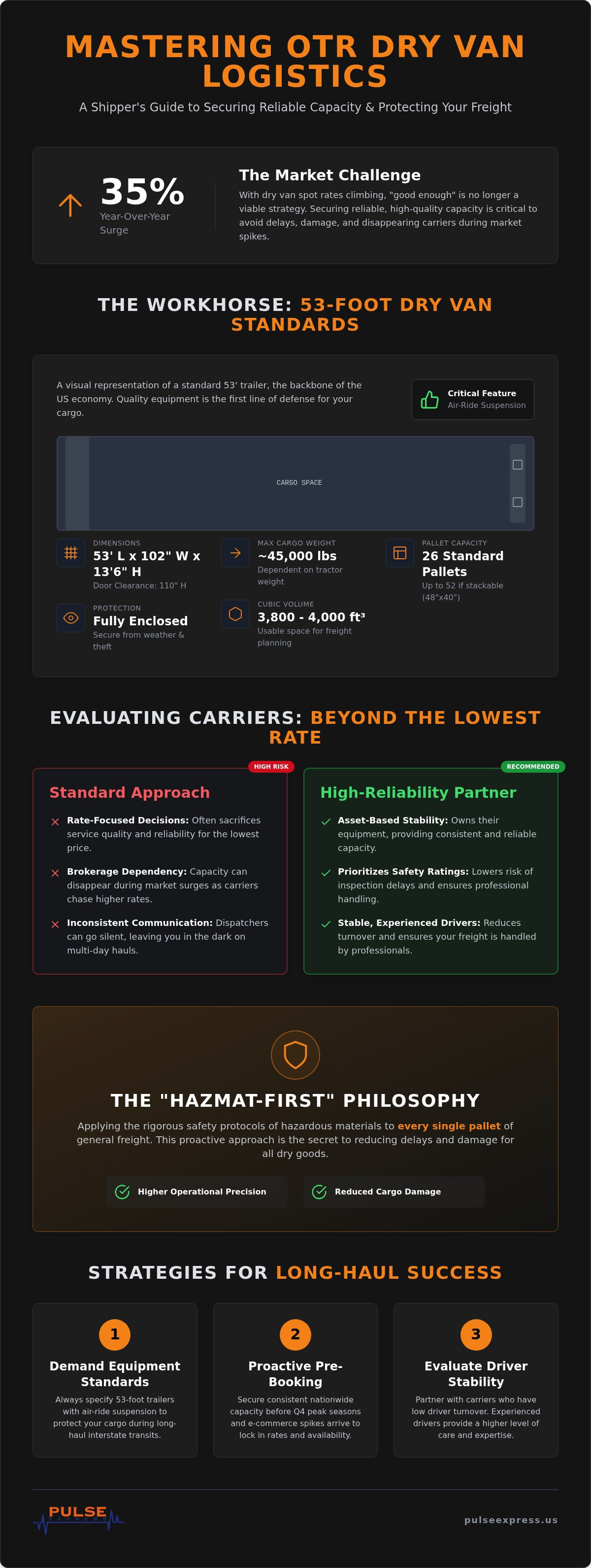
What if the rigorous safety protocols required for high-risk hazardous materials became the standard for every single pallet in your supply chain? In a market where dry van spot rates have surged nearly 35% year-over-year as of August 2026, settling for "good enough" capacity is no longer a viable strategy for your business. You've likely felt the sting of a dispatcher going silent during a multi-day haul or the frustration of a carrier backing out when market volumes spike. It's exhausting to manage logistics when you're constantly worrying about cargo damage or whether your OTR dry freight transportation will actually arrive on schedule.
At Pulse Express, we believe that reliability isn't a commodity; it's the result of precision, stability, and a safety-first culture. This guide will help you master the complexities of nationwide dry van logistics so you can secure reliable capacity that doesn't disappear when the market tightens. We'll explore how to evaluate carrier stability, the benefits of asset-based partnerships, and why specialized Hazmat expertise is the secret to reducing delays for all dry goods. You'll gain a clear roadmap to choosing a partner that protects your cargo, your timeline, and your reputation.
Key Takeaways
- Identify the essential equipment standards, such as 53-foot trailers and air-ride suspension, that protect your cargo during long-haul interstate transits.
- Discover why prioritizing safety ratings and Hazmat endorsements ensures more reliable OTR dry freight transportation during volatile market surges.
- Master proactive pre-booking strategies to secure consistent nationwide capacity before Q4 peak seasons and e-commerce spikes arrive.
- Understand how a "Hazmat-first" philosophy applied to general freight reduces cargo damage and provides a higher level of operational precision.
- Learn to evaluate carriers based on their driver stability and long-term experience to build a partnership that supports your business growth.
What is OTR Dry Freight Transportation?
OTR stands for Over-the-Road. It refers to long-haul interstate trucking where distances typically exceed 250 miles. While local delivery keeps cities moving, OTR keeps the country connected. It's the essential bridge between manufacturing hubs and consumer markets. This sector is often called the backbone of the US economy because it facilitates the movement of nearly every consumer good we use. Without it, store shelves would sit empty and production lines would stop.
In the context of Truckload shipping, the dry van trailer is the industry standard. These fully enclosed trailers act as the primary vessel for non-perishable goods. Unlike flatbeds or specialized equipment, dry vans offer a secure, climate-protected environment for a vast range of products. Managing OTR dry freight transportation involves high-level planning, precise timing, and a deep understanding of nationwide logistics networks.
The Role of Dry Van in Modern Supply Chains
Dry vans are valued for their incredible versatility across the retail, manufacturing, and industrial sectors. They provide a high level of protection from weather, road debris, and theft. This security is vital for high-value electronics, clothing, and palletized industrial parts. For shippers, the dry van offers a scalable solution for high-volume nationwide distribution. It allows for efficient loading, standardized dock operations, and reliable scheduling across the lower 48 states. It's the most common and reliable way to move freight at scale.
Regional vs. OTR Long-Haul: Key Differences
Planning for long-haul routes requires a different mindset than managing regional or local deliveries. The complexity increases as a truck crosses multiple state lines. Long-haul drivers make a significant commitment to being away from home for several days or weeks. This lifestyle requires specialized dispatch support to manage hours-of-service (HOS) compliance and route optimization over thousands of miles. Pulse Express has refined this process over 25 years, focusing on driver stability and operational precision.
While regional hauls might focus on a single state, OTR logistics involves three key challenges:
- Navigating diverse state regulations and weigh station requirements.
- Managing multi-day transit times with constant, clear communication.
- Ensuring driver safety and equipment reliability during cross-country treks.
Success in this field isn't just about moving a truck from point A to point B. It's about maintaining a steady pace, respecting the driver's time, and executing every delivery with care. This methodical approach ensures that your freight arrives exactly when and where it's needed.
Dry Van Logistics: Capacity and Equipment Standards
Success in OTR dry freight transportation depends heavily on the quality and configuration of the equipment used. Shippers must look beyond just a trailer number. They need to understand how the hardware itself protects their investment. The 53-foot dry van is the industry standard for a reason. It balances maximum volume with the maneuverability required for interstate highways. However, the internal condition and suspension type often dictate whether a load arrives intact or damaged.
Air-ride suspension is a critical feature for sensitive or high-value cargo. Unlike traditional leaf-spring systems, air-ride uses compressed air to absorb road vibrations and shocks. This technology is essential for transporting electronics, medical supplies, or fragile industrial components across thousands of miles. According to the American Trucking Associations, maintaining high equipment standards is a cornerstone of operational safety and efficiency in the modern fleet. At Pulse Express, we prioritize modern equipment to ensure every mile of the journey is as smooth as the first.
Standard 53-Foot Trailer Specifications
Standard trailers are 53 feet long, 102 inches wide, and 13 feet 6 inches high. These dimensions allow for a maximum cargo weight of approximately 45,000 pounds, depending on the tractor's weight. Door clearances are typically 110 inches high, which is vital for shippers using tall pallets or specialized loading equipment. A standard 53-foot dry van typically offers approximately 3,800 to 4,000 cubic feet of usable space for freight planning. Optimizing this space usually involves fitting 26 standard 48x40 pallets in a single floor layer, or up to 52 if the freight is stackable.
Asset-Based vs. Brokerage Models
Choosing between an asset-based carrier and a brokerage is one of the most important decisions a shipper can make. Asset-based carriers own their trucks, employ their drivers, and manage their own maintenance schedules. This model offers higher accountability, direct communication, and a clear chain of custody. It eliminates the risk of "double brokering," where a load is passed between multiple parties, often leading to poor communication and increased liability. By maintaining a private fleet and in-house maintenance, Pulse Express provides the stability and precision required for complex hauls. If you are looking for a partner with a safety-first culture and reliable equipment, you can learn more about our asset-based services here.
Fleet age also plays a significant role in delivery timelines. Older equipment is more prone to mechanical failures, which can cause cascading delays during multi-day OTR routes. A carrier that invests in a modern fleet demonstrates a commitment to operational excellence. Regular maintenance isn't just about avoiding breakdowns; it's about ensuring that every trailer is clean, dry, and secure before it ever reaches your loading dock. This methodical approach to maintenance reflects a broader commitment to customer success and operational reliability.
Evaluating OTR Carriers: Beyond the Lowest Rate
Choosing a carrier solely on the lowest per-mile rate often leads to hidden costs that surface during transit. When capacity tightens, as seen in the market shifts of August 2026, the cheapest option is usually the first to fail. Shippers need a framework that prioritizes long-term stability and operational excellence over short-term savings. A carrier's safety rating is the most transparent window into their daily operations. High CSA scores aren't just numbers; they reflect a culture of discipline and equipment maintenance that prevents costly roadside delays.
Compliance with FMCSA regulations is a non-negotiable requirement for reliable OTR dry freight transportation. Beyond basic compliance, look for carriers that integrate advanced technology into their workflow. Electronic logging devices (ELDs) ensure drivers stay within legal hours of service, while real-time tracking provides the visibility you need for multi-day hauls. These tools reduce the need for constant check-calls and allow your team to manage inventory with greater confidence.
Safety Ratings and Compliance (Hazmat Focus)
One of the most overlooked indicators of quality is a carrier's Hazmat competency. Even if you only ship general dry goods, a carrier with a strong Hazmat background offers a higher level of precision. Drivers with Hazmat endorsements undergo rigorous background checks and specialized training. This training instills a meticulous attention to detail regarding load securing, documentation, and safety protocols. Pulse Express applies this "Hazmat-level" security and care to every general freight shipment. This methodical approach ensures that your cargo is handled with extreme caution, significantly reducing the risk of damage or transit errors across state lines.
Driver Reliability and Professionalism
A carrier's service stability is directly tied to its driver retention rates. When drivers are treated as professional partners, they are more invested in the success of every delivery. High turnover often leads to inexperienced drivers handling complex nationwide routes, which increases the likelihood of delays and communication breakdowns. We focus heavily on hiring CDL drivers who view their roles as long-term careers. This professional recruitment strategy directly impacts your brand reputation. The driver is often the only face-to-face contact your customers have with your supply chain. A professional, punctual driver reinforces your company's commitment to quality and service excellence.
Best Practices for Long-Haul Dry Freight Success
Long-haul success isn't accidental. It's the result of a deliberate strategy that balances physical cargo safety with operational foresight. Shippers who treat OTR dry freight transportation as a strategic asset rather than a last-minute necessity often see fewer claims and more reliable delivery windows. This proactive approach starts with understanding the seasonal rhythms of the freight market and the physical demands of cross-country transit. By focusing on preparation and precision, you can turn your supply chain into a competitive advantage.
Peak Season Capacity Planning
Planning for Q4 surges should begin long before the first holiday orders arrive. Forecasting your volume accurately allows you to secure dedicated lanes and avoid the volatility of the spot market. Establishing multi-year partnerships provides a level of stability that transactional relationships simply can't match. Scheduling shipments at least two weeks in advance allows carriers to optimize their networks and guarantees your spot during high-demand windows. This foresight also helps reduce "deadhead" miles, where trucks travel empty to reach a load, which helps lower overall costs through better efficiency.
Load Securing and Cargo Integrity
Cargo doesn't just sit still during a 2,000-mile journey. It faces constant vibrations, sudden stops, and shifting forces that can compromise the entire load. Proper load securing is non-negotiable for maintaining cargo integrity. Using high-quality dunnage, industrial-grade straps, and adjustable load bars prevents pallets from shifting or toppling during transit. For high-value or fragile dry goods, these tools are your first line of defense against damage. You should also ensure that all interstate documentation is precise and accessible to prevent unnecessary delays at weigh stations or inspection points.
Clear communication protocols are the final piece of the puzzle. A successful haul relies on a transparent flow of information between the shipper, the dispatcher, and the receiver. When everyone is aligned on pickup windows and delivery requirements, the risk of "silent" hauls or missed appointments vanishes. Pulse Express prioritizes this level of transparency to ensure you're never left wondering about the status of your freight. If you're ready to partner with a carrier that values precision and communication, contact us today for a dry freight quote.
Pulse Express: Precision and Safety in OTR Logistics
Pulse Express has spent over 25 years refining the art of nationwide logistics. Founded in 2000 and led by CEO Adelina Pavlov, our organization has grown from a specialized carrier into a trusted expert partner for shippers across the country. We don't view ourselves as just another vendor in the supply chain. Instead, we act as a seasoned guide, providing the stability and reassurance you need to manage complex hauls with total confidence. Our approach to OTR dry freight transportation is rooted in operational excellence, modern fleet standards, and a safety-first culture that permeates every level of our business. This commitment to reliability ensures that your supply chain remains resilient, even during unpredictable market shifts.
Our Specialized Hazmat-Ready Dry Fleet
Every load we carry benefits from our "Hazmat-First" philosophy. Because we specialize in the transport of hazardous materials for both dry and temperature-controlled cargo, we apply those same rigorous safety protocols to every single dry van shipment. This means your general freight receives the same level of precision, security, and care as a high-stakes Hazmat load. Our asset-based fleet consists of modern equipment maintained to the highest safety standards, ensuring that mechanical failures don't disrupt your timeline or your customers' expectations. Our drivers are professional Class A CDL experts who are trained to handle complex logistics with a solution-focused mindset. We prioritize:
- Precise load securing to prevent transit damage.
- Rigorous equipment inspections before every haul.
- Continuous training in safety and regulatory compliance.
Nationwide Coverage and Support
Reliability shouldn't be limited by geography. Pulse Express provides seamless logistics support across all 48 contiguous states, ensuring your products reach their destination regardless of the distance or complexity of the route. Our dedicated dispatch teams offer 24/7 visibility, so you're never left in the dark during a multi-day cross-country route. This combination of global corporate capability and close-knit, service-oriented partnership allows us to support your growth while maintaining the personal attention you deserve. In 2026, we've deepened our focus on operational excellence to provide the most efficient OTR dry freight transportation solutions in the industry. If you're ready to secure reliable, safety-first capacity with a partner who is personally invested in your success, contact Pulse Express for a specialized freight quote today.
Securing Your Supply Chain for the Long Haul
Mastering nationwide logistics requires more than just finding an available truck. It demands a partner who understands that every pallet represents a promise to your customers. By prioritizing high equipment standards and vetting carriers for rigorous safety ratings, you protect your cargo from the inherent risks of cross-country transit. We've explored how proactive planning and a "Hazmat-first" philosophy can transform your approach to OTR dry freight transportation, turning a complex necessity into a streamlined advantage for your business.
Pulse Express has been a trusted guide in this industry since 2000. As specialists in both Hazmat and general freight, we provide the nationwide US coverage and asset-based reliability you need to thrive in a tightening market. Our team is committed to your operational excellence and long-term growth. When you're ready to experience a higher standard of care and precision, we invite you to request a quote for your OTR dry freight needs. We're here to help you move forward with confidence.
Frequently Asked Questions
What is the difference between OTR and regional dry freight?
OTR (Over-the-Road) involves long-haul interstate routes that typically exceed 250 miles, while regional freight stays within a specific geographic area. OTR requires more complex planning, multi-day transit support, and strict hours-of-service management across several state lines. It serves as the primary link between distant manufacturing hubs and consumer markets, whereas regional hauls often focus on shorter distribution cycles within a single territory.
How much weight can a standard 53-foot dry van carry?
A standard 53-foot dry van can typically carry approximately 45,000 pounds of cargo. This limit depends on the combined weight of the tractor and trailer, which must stay under the federal gross vehicle weight limit of 80,000 pounds on Interstate highways. Shippers must also consider axle weight limits, specifically 20,000 pounds on a single axle and 34,000 pounds on a tandem axle group, to ensure regulatory compliance.
Why should I choose an asset-based carrier over a freight broker?
Choosing an asset-based carrier like Pulse Express provides higher accountability because the company owns the equipment and employs the drivers directly. This model eliminates the risk of double brokering and ensures clear, direct communication regarding your shipment's status. Asset-based partners maintain their own fleets and safety standards, offering more stability and a consistent chain of custody for your cargo compared to the third-party networks used by brokers.
Does Pulse Express handle hazardous materials in dry van trailers?
Yes, Pulse Express provides specialized Hazmat Freight Service for both dry and temperature-controlled cargo. We maintain an asset-based fleet specifically equipped for hazardous materials and employ professional Class A CDL drivers with extensive Hazmat training. Our "Hazmat-First" philosophy ensures that every load, whether hazardous or general freight, is handled with extreme care and precision to meet the highest safety standards in the logistics industry.
How do OTR carriers handle delivery delays due to weather or traffic?
Professional OTR carriers mitigate delays through proactive route planning and real-time communication. Dispatch teams monitor weather patterns and traffic conditions constantly to suggest alternate routes before a truck gets stuck. When a delay is unavoidable, a reliable partner provides immediate updates to the shipper and receiver. This transparency allows you to adjust your dock schedules and inventory plans, minimizing the overall impact on your business operations.
What are the benefits of hiring drivers with Hazmat endorsements for general freight?
Drivers with Hazmat endorsements bring a higher level of discipline and attention to detail to OTR dry freight transportation. They undergo rigorous background checks and specialized training that focuses on precise load securing and safety compliance. This meticulous mindset reduces the risk of cargo damage and transit errors for general freight. You benefit from a professional who views their role as a high-stakes career rather than just a job.
How does real-time tracking work for long-haul OTR shipments?
Real-time tracking utilizes GPS technology integrated with Electronic Logging Devices (ELDs) to provide constant visibility into a shipment's location. This data allows dispatchers and shippers to monitor the vehicle's progress across state lines and verify hours-of-service compliance. At Pulse Express, we use these tools to ensure that your OTR dry freight transportation stays on schedule. It provides the reassurance of knowing exactly where your cargo is at any moment.
Can Pulse Express handle high-volume seasonal freight surges?
Pulse Express is equipped to manage high-volume surges during peak seasons through strategic capacity planning and dedicated lane support. Our 25 years of experience allow us to forecast market shifts and provide the stability needed during Q4 or e-commerce spikes. By building long-term partnerships with our clients, we ensure that you have access to reliable, safety-first capacity even when the broader freight market tightens significantly.


