

The highest advertised pay doesn’t always make a reefer job the right fit. If you’re comparing the best reefer companies to work for, look at the full picture: freight, routes, time at home, equipment, communication, and the expectations of the specific position.
Reefer driving can involve pre-cooling a trailer, monitoring temperatures, and documenting the load. Those responsibilities make delivery coordination and clear procedures important parts of the job, alongside pay and road-life expectations. Details can vary by position, even within the same company.
This guide offers a practical way to compare reefer employers and current job postings. Use the criteria below to assess routes, home time, equipment, and support, then weigh them against the type of freight and schedule you want. Pulse Express, founded in 2000, hires Class A CDL drivers for OTR reefer and dry van operations. Comparing those opportunities with your own priorities can help you build a shortlist that fits the road life you’re looking for.
Key Takeaways
- Focus on carriers that employ drivers and operate transportation services, rather than brokers that arrange freight between shippers and carriers.
- Compare compensation terms alongside routes, time away, dispatch communication, and delivery expectations.
- Use consistent criteria to compare reefer employers, including the type of OTR work each offers.
- Set your must-haves before reviewing postings so schedule, routes, and freight type stay central to your decision.
- Consider Pulse Express for OTR reefer and dry van driver opportunities.
What makes a reefer trucking company a good place to work?
A good reefer trucking company is one whose specific driving role fits your priorities for freight, routes, time at home, equipment, and communication. There isn’t one universal best employer. A job that suits a driver who wants varied long-haul miles may be a poor fit for someone who values familiar lanes or a more predictable schedule. The best reefer companies to work for are those whose day-to-day expectations match what matters to you.
Start by distinguishing a carrier from a freight broker. A refrigerated trucking carrier operates transportation services and may hire drivers to move temperature-controlled loads. A broker arranges freight between shippers and carriers, but generally isn’t the carrier employing the driver for that trip. Knowing the difference helps you focus your search on driving jobs with a transportation employer.
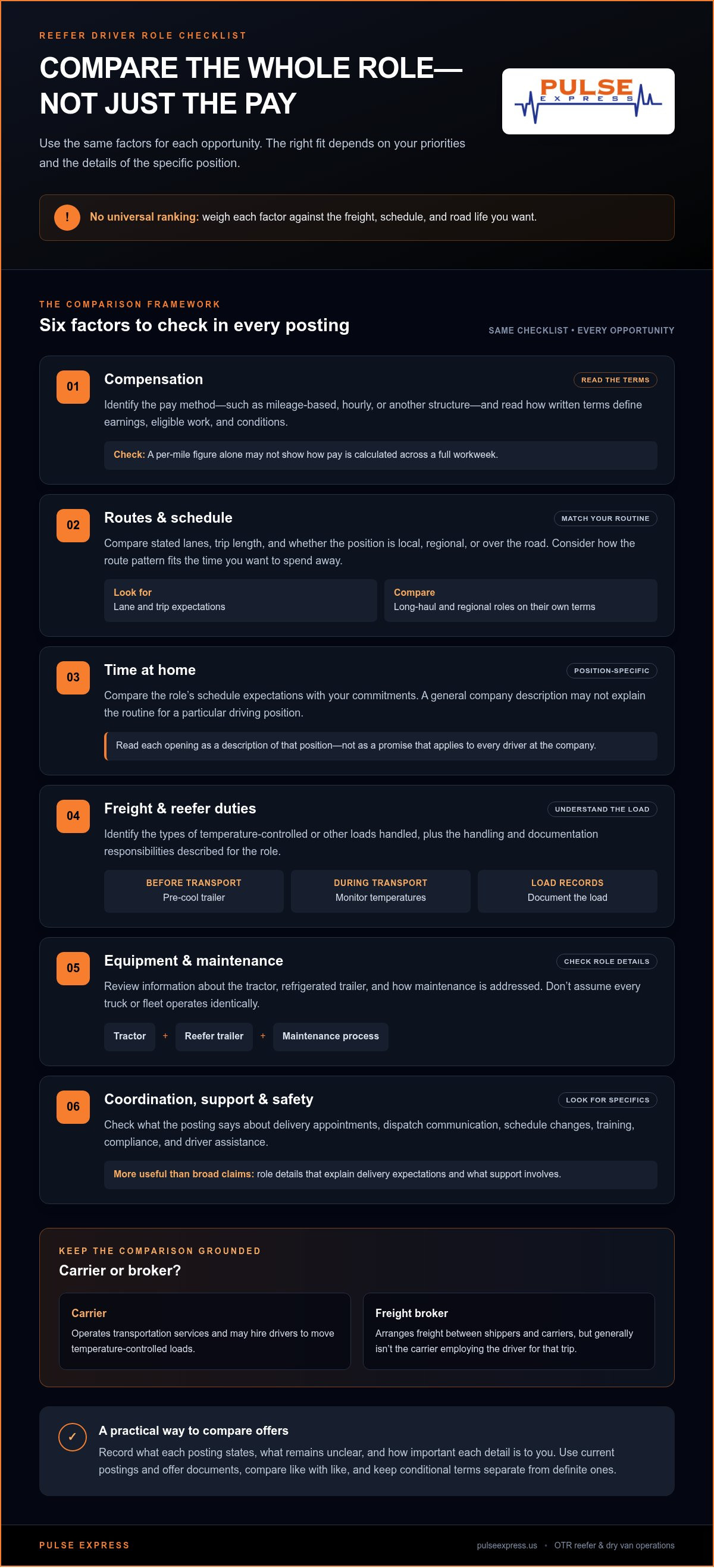
Compare the work as a whole instead of relying on a single advertised feature:
- Freight: Identify the types of temperature-controlled or other loads the role handles, and consider the handling or documentation responsibilities described.
- Routes: Look for the stated lanes and whether the position is local, regional, or over the road. Match the route pattern to the amount of time you want to spend away.
- Time at home: Compare the position’s schedule expectations with your commitments. A general company description may not explain the routine for a particular driving role.
- Equipment: Review details about the tractor and refrigerated trailer used in the role, along with how maintenance is addressed.
- Communication: Look for clear descriptions of dispatch coordination, delivery expectations, and support when a schedule changes.
What reefer driving involves on the road
A reefer trailer is designed to maintain temperature-controlled conditions for freight during transport. Depending on the load and role, drivers may need to follow temperature procedures, monitor conditions, coordinate delivery timing, and complete load documentation. Understand the expectations attached to a position before comparing it with other driving work. The refrigerator truck provides a basic overview of the vehicle, while this cold chain logistics guide explains why maintaining suitable conditions matters across a shipment.
Why the right employer depends on your priorities
Some drivers prefer route consistency and the familiarity that can come with repeat lanes. Others welcome varied long-haul work and changing destinations. Neither preference is automatically better; the right fit depends on the driver. Freight type, schedule expectations, and communication all shape the job between pickups and deliveries.
Read each posting as a description of a particular position, not a promise that applies to every driver at the company. Two openings with the same employer can differ in route pattern, freight assignment, or schedule. Compare the details that matter most to your working life, then decide whether the role is a practical match.
Which reefer-company qualities should drivers compare?
A useful comparison looks beyond the headline pay rate. Review the compensation structure, route pattern, expected time away, equipment information, and how the company describes communication and operational support. Then weigh each factor against your priorities. Judge an employer by the fit of the specific role, not by a company-wide claim or an advertised figure viewed on its own.
Use the same checklist for each opportunity so the differences are easier to see:
- Compensation: Identify the pay method and read how the written terms define earnings, eligible work, and any conditions.
- Routes and schedule: Compare the stated lanes, trip length, and home-time expectations for the position.
- Delivery coordination: Look for information on appointments, schedule changes, and communication with dispatch.
- Equipment: Review role-specific details about the tractor, reefer trailer, and maintenance process.
- Support and safety: Look for specific information about training, compliance, and driver assistance rather than relying on broad promotional statements.
Pay, routes, and time away from home
First, distinguish mileage-based, hourly, and other compensation structures. A per-mile figure alone may not show how pay is calculated across a full workweek, so read the written terms for the specific position. Compare route patterns and home-time expectations in the same way. A long-haul role and a regional role can involve different time away, even when both haul temperature-controlled freight.
Use current postings and offer documents rather than broad salary estimates. Record the pay method, route expectations, and schedule for each role, then compare like with like. Keep conditional terms separate from definite ones, and don’t assume an unclear detail will work in your favor.
Equipment, communication, and operational support
Reefer work depends on coordination as well as the tractor and trailer. Clear communication helps drivers understand delivery timing and respond to schedule changes while meeting the freight’s temperature requirements. Read the role-specific information about equipment and maintenance practices rather than assuming every truck or fleet operates identically. Safety, compliance, and support statements are more useful when they explain what the role involves.
Keep a simple side-by-side record as you review opportunities. Write down what each posting states, what remains unclear, and how important each factor is to you. That makes trade-offs visible: one position may better match your preferred route pattern, while another may fit your schedule needs. The best reefer companies to work for will depend on which factors carry the most weight in your decision.
For a comparison that includes an employer hiring for OTR reefer and dry van driving, review Pulse Express driver opportunities alongside the role details that matter to you.
Best reefer companies to work for: a practical 2026 shortlist
This shortlist is a starting point, not a ranking. It focuses on employers connected with reefer work and compares the available descriptions of their opportunities, rather than treating marketing claims as proof of job quality. Hiring needs and role details can change, so use current postings and written terms to compare the job you’re considering.
For a fair comparison, look for three things: a clear connection to refrigerated driving, OTR opportunities if long-haul work suits you, and enough position detail to assess the fit. The best reefer companies to work for will depend on your route, schedule, and support priorities.
Shortlist and source notes
| Company | What the available information indicates | Source and date |
|---|---|---|
| Pulse Express | U.S. OTR carrier founded in 2000; hires Class A CDL drivers for reefer and dry van operations. | Pulse Express company information summarized for this article, October 2026. |
| K&B Transportation | Its recruitment-page presentation includes route options and driver testimonials. These are employer-provided information, not a guarantee that every role offers the same conditions. | drive4kb.com recruitment-page summary in the supplied SERP review, October 2026. |
| Halvor Lines | Its company and recruitment materials present its history and position the company as an employer. Those details provide context, but do not by themselves establish the terms of a specific reefer job. | halvorlines.com company and recruitment-page summary in the supplied SERP review, October 2026. |
Pulse Express: OTR reefer and dry van opportunities
Pulse Express is a relevant option for drivers considering long-haul freight. The company hires Class A CDL drivers for OTR reefer and dry van operations. Its transportation work includes general and hazardous freight, including temperature-controlled cargo. Use the details of a specific position to compare its route, pay structure, schedule, and equipment with your priorities. The 2026 CDL driver hiring guide offers additional context on evaluating OTR opportunities.
K&B Transportation and Halvor Lines
K&B’s recruitment materials highlight route choices and driver testimonials, while Halvor Lines’ materials emphasize company history and recruitment. These are useful starting points for understanding how each employer presents its opportunities. They are not a substitute for the terms of a specific job. When comparing either company, separate broad employer messaging from position details such as freight, routes, pay structure, and schedule.
Use the shortlist to identify employers worth researching, then base your decision on current postings and written terms. That keeps the comparison practical and tied to the work you may actually do.
How to evaluate a reefer driver offer before applying
A consistent process makes it easier to compare opportunities on their actual terms. Start with your priorities, study the exact position, then check that the written offer matches the expectations described during recruitment. This keeps a polished company-wide message from overshadowing the details that will shape your working life.
Build your personal reefer-job scorecard
Before comparing employers, separate must-haves from preferences. A particular home-time pattern might be essential, while a preferred freight type or route could be flexible. Rank schedule, route type, freight, communication, and compensation terms by importance, then apply the same criteria to every opportunity. A CDL A long-haul career guide can also help you think through what OTR work may involve as you assess your fit.
Follow these steps to keep your comparison fair:
- Set your must-haves. Write down the schedule, route pattern, and freight type you need, not just the options you’d prefer.
- Rank your preferences. Decide which factors matter most after the essentials, such as communication style or compensation structure.
- Review the specific posting. Record what it says about the position instead of assuming all roles at that company share the same terms.
- Mark unclear details. Note what the description doesn’t explain. Keep unknowns separate from confirmed information.
- Compare each role side by side. Apply identical criteria to every opportunity so differences in presentation don’t distort your judgment.
Review requirements and offer details carefully
Job requirements can be position-specific and may change. Read the current posting for its CDL, experience, and other role-related expectations. If the position refers to a federal requirement, verify current guidance through the Federal Motor Carrier Safety Administration or another authoritative government source before relying on an outdated summary.
Next, compare recruitment materials with the written offer. Check that the position, pay method, route expectations, schedule, and freight description are consistent wherever they appear. If the posting uses broad language but the offer describes a narrower role, base your decision on the terms for the actual position. Treat an advertised feature as part of the offer only when the written details support it.
A simple scorecard can reveal trade-offs without pretending one employer suits every driver. The best reefer companies to work for are those whose specific opportunities align with your must-haves and acceptable compromises. Keep a copy of each posting and offer beside your notes so your comparison stays grounded in the same information.
If OTR reefer or dry van work fits your priorities, explore Pulse Express driver opportunities as part of your shortlist.
Explore reefer driving opportunities with Pulse Express
A useful shortlist narrows your options, but the right choice comes down to the details of a specific role. Compare freight type, route expectations, communication and support, and written terms together. A company’s general reputation or recruitment message can help you identify an employer to consider, but it can’t show whether an individual position suits your priorities.
Pulse Express is a U.S. trucking carrier that hires Class A CDL drivers for over-the-road reefer and dry van work. Its transportation services include general and hazardous freight, including temperature-controlled cargo. These details describe the company’s work; your comparison should also account for the terms and responsibilities of the position you’re considering.
Who may find Pulse Express worth considering
Class A CDL drivers interested in long-haul freight can include Pulse Express in their research, particularly if they’re considering OTR reefer or dry van operations. The company transports general and hazardous freight, but the freight handled can depend on the role. Review the position description to understand how its work aligns with your interests and experience.
Before moving from research to an application, revisit your own priorities. Use this checklist to focus on what the role actually involves:
- Freight: Does the position describe the type of work you want to do?
- Routes: Do its stated route expectations fit the kind of over-the-road work you’re seeking?
- Schedule: Are the time-away and home-time expectations clear enough for your planning?
- Communication: Does the role information explain how delivery coordination and support are handled?
- Written terms: Do the offer details match the position description and recruitment information?
Take the next step with a clear comparison
Use the same scorecard for every employer under consideration. Keep essential needs separate from preferences, and base your assessment on position-specific information rather than assuming that one company’s roles all share identical schedules, routes, or freight. Include any important open details in your offer review instead of filling gaps with assumptions. This makes it easier to identify which of the best reefer companies to work for aligns with your road-life priorities.
For drivers considering OTR reefer or dry van work, Pulse Express is an employer to include in that comparison. Explore Pulse Express driver opportunities and compare the role details with your goals.
Make Your Next Move With Confidence
Turn your priorities into a decision you can stand behind. Before applying, identify the conditions that matter most for your life on the road, then use them to assess each position consistently. The best reefer companies to work for aren’t defined by a headline alone. The right opportunity should suit your work preferences and the commitments waiting for you at home.
If OTR reefer or dry van driving is part of your plan, include Pulse Express on your shortlist. Review the driver opportunities and consider how a specific role aligns with what you’re looking for.
Explore OTR driver opportunities with Pulse Express and take your next step with a clear sense of what matters to you.
Frequently Asked Questions
How should I choose the best reefer company to work for?
Choose by evaluating the specific job, not the company’s broadest claims. Compare written compensation terms, routes, time away, freight expectations, equipment information, and communication. Use one checklist for every employer, and make sure current postings describe the details you’re comparing. The best reefer companies to work for depend on your priorities. For example, a preferred route pattern may matter more to you than a compensation feature that doesn’t affect your day-to-day work.
Do reefer companies hire new CDL drivers?
Some reefer employers may consider newer CDL drivers, but requirements vary by company, position, and current operating needs. A posting might specify prior driving experience or other qualifications, while another role may describe a different path into the work. Don’t assume one employer’s criteria apply across the industry. Read the current listing closely, including its experience requirements, before deciding whether a role matches your background.
Is reefer trucking harder than dry van driving?
Neither type of driving is automatically harder for every driver. Reefer work may add coordination around temperature-sensitive freight and delivery requirements, while dry van work has its own demands based on cargo and route. Compare the duties in each job description. Consider how you’d handle the stated schedule, freight responsibilities, and communication needs rather than relying on a general ranking of trailer types.
Can a reefer truck carry hazardous materials?
Yes, some temperature-controlled shipments may also involve hazardous materials, but that doesn’t mean every reefer load or job does. Cargo classification and applicable requirements depend on the shipment and the specific role. Read the position’s stated qualifications and responsibilities, then check current guidance from an authoritative government source for regulatory details. Don’t assume every reefer driver needs the same endorsement or handles the same freight.
What should I compare in reefer driver job offers?
Compare the written pay structure, route expectations, home-time details, freight responsibilities, equipment information, and operational support for the exact position. Separate definite terms from estimates or claims that depend on conditions, such as miles worked or assigned loads. A simple scorecard can help: mark each item as stated, conditional, or unclear. This makes it easier to spot differences between offers without letting a company-wide headline stand in for job-specific terms.
Are reefer driving jobs only for food transportation?
No. Reefer trailers can transport temperature-sensitive freight beyond food, though cargo depends on the carrier’s operations and the shipment. Different loads may come with different handling or documentation expectations, so don’t assume every reefer job involves the same products or procedures. Use the job description to understand the freight associated with the position. Unless specific cargo is identified, keep assumptions about load types general.
How can I tell whether a reefer trucking company is a good fit?
A good fit is an employer whose specific role aligns with your needs and working preferences. Consider a practical scenario: if a route keeps you away longer than you can manage, a strong feature elsewhere may not compensate for that mismatch. Review how clearly the posting describes the job, and treat testimonials or promotional language as context rather than proof of individual terms. Let your priorities guide the decision.


