

What if the right OTR job isn’t the one with the most attractive title, but the one whose day-to-day terms match your priorities? CDL A company driver positions can differ in freight assignments, schedules, compensation, and support. Before you apply, get clear answers about what each role actually involves.
A good fit starts with understanding the work and confirming the details that matter to you. This guide covers freight, home time, compensation, qualifications, and the application process. You’ll also learn how to compare openings and decide whether OTR work aligns with your goals.
Pulse Express recruits Class A CDL drivers for OTR reefer and dry van operations and has served the freight industry since 2000. Specific job terms can vary, so confirm current openings and details with the recruiting team rather than relying on a job title alone. Asking focused questions can help you assess an opportunity and identify a practical next step.
Key Takeaways
- Clarify what a company-driver role means and confirm the employment arrangement instead of assuming it from the job title.
- Compare reefer and dry van work by equipment purpose and freight expectations, then ask how those details apply to the specific position.
- Evaluate CDL A company driver positions using clear information about compensation, home time, routes, freight, and driver support.
- Prepare to apply by reviewing the posting, gathering relevant information, and confirming current qualifications directly with recruiting.
- Explore Pulse Express OTR opportunities in reefer and dry van operations, and verify current openings and role terms with the recruiting team.
What CDL A company-driver positions involve on the road
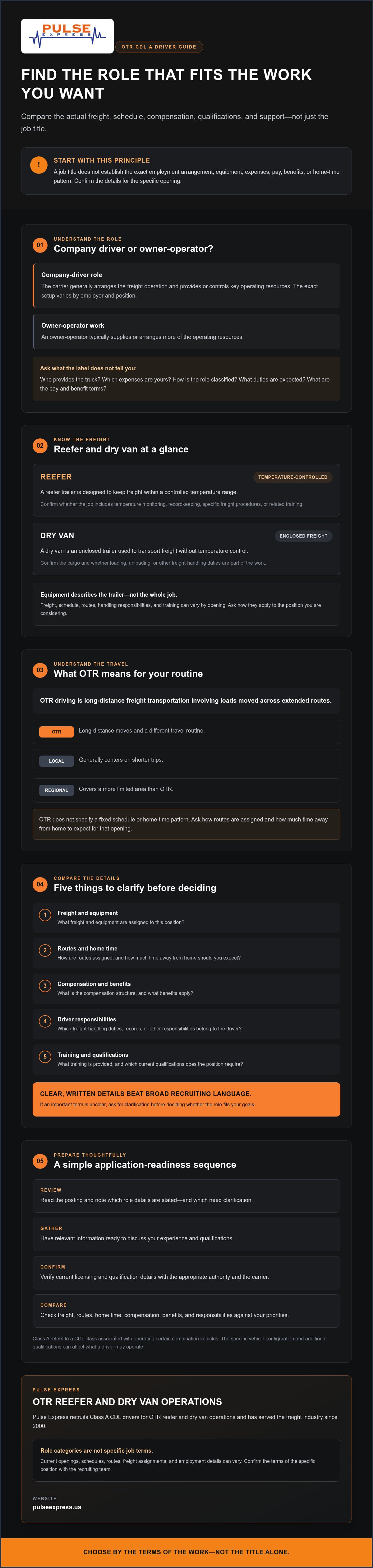
Before comparing postings, separate the type of work from the terms of employment. “Company driver” generally describes a driving role in which a carrier arranges the freight operation and provides or controls key operating resources. The exact setup varies by employer and position. A job title alone doesn’t tell you who supplies the truck, how expenses are handled, or which responsibilities belong to the driver.
Class A refers to a CDL class associated with operating certain combination vehicles. The specific vehicle and configuration, along with any additional qualifications, can affect what a driver may operate. For a general overview of CDL classes and federal standards, see Commercial Driver's License. Confirm current licensing and qualification details with the appropriate authority and the carrier.
How is a company-driver role different from owner-operator work?
Broadly, an owner-operator typically supplies or arranges more of the operating resources, while a company-driver role is organized around resources controlled or provided by the carrier. Those labels don’t settle the details. Before applying, ask who provides the equipment, which expenses you’re responsible for, how the role is classified, and what duties are expected. “Company driver” by itself doesn’t establish pay, benefits, or other employment terms.
What does OTR mean for a CDL A driver?
OTR driving is long-distance freight transportation that involves moving loads across extended routes. Compared with local work, which generally centers on shorter trips, or regional work, which covers a more limited area, OTR typically involves longer-distance moves and a different travel routine. The label doesn’t specify a fixed schedule or home-time pattern, so ask what applies to the particular opening.
OTR drivers may handle different freight and routes depending on the carrier’s operation. Pulse Express recruits Class A CDL drivers for OTR reefer and dry van operations. That describes its role categories, not the schedule or route of a specific position. Confirm those details, along with freight assignments and employment terms, directly with recruiting.
Use the posting as a starting point, then request specific answers before deciding whether the role fits your goals:
- What equipment and freight are associated with this opening?
- How are routes assigned, and how much time away from home should you expect?
- What are the compensation structure, benefits, and driver responsibilities?
Written details make CDL A company driver positions easier to assess than broad recruiting language. If an important term isn’t clear, ask for clarification before moving forward.
Reefer and dry van work: understand the freight before choosing
Freight type affects the equipment used and may shape the work a driver performs. A reefer trailer is designed to keep freight within a controlled temperature range. A dry van is an enclosed trailer used to transport freight without temperature control. These descriptions explain the equipment, not the exact cargo, schedule, or daily responsibilities of a particular position.
For a broader overview of the profession, the U.S. Bureau of Labor Statistics describes the duties of a heavy and tractor-trailer truck driver. Details of a specific opening still need to come from the carrier. For CDL A company driver positions, confirm the freight, equipment, and expectations before deciding which role suits you.
What should drivers know about reefer positions?
Reefer equipment supports temperature-controlled freight, but its purpose doesn’t establish what a driver must do during a trip. Ask whether the role involves monitoring temperature conditions, recording them, or following other freight-handling procedures. Clarify what training is provided and which responsibilities belong to the driver. For more context on temperature-controlled freight, see the cold chain logistics guide.
What should drivers know about dry van positions?
A dry van provides an enclosed space for transporting freight, but the trailer type alone doesn’t identify the cargo or determine how it’s handled. Ask whether the role involves loading, unloading, or other freight-handling duties, and whether training or additional responsibilities apply. The CDL A long-haul career guide offers more context about OTR work.
Compare the actual opening, not just the equipment label. Confirm:
- What freight and equipment are assigned to the position.
- Whether temperature checks, records, loading, or unloading are part of the work.
- What training and role-specific procedures the carrier provides.
Pulse Express recruits Class A CDL drivers for OTR reefer and dry van operations, though duties and terms depend on the specific opening. If either freight category aligns with your experience and goals, you can learn about Pulse Express OTR driver opportunities and verify current role details with recruiting.
How to compare CDL A company-driver positions before applying
A job title can’t tell you what a position will mean in practice. To compare CDL A company driver positions fairly, ask the same questions about every opening and record the answers. Focus on five areas: compensation, time at home, routes, freight and equipment, and driver support. If an employer describes a term broadly, ask what it means for the specific role.
Comparison checklist: Verify compensation, home-time expectations, routes, freight and equipment, benefits and eligibility, and the support available during onboarding and on the road. Confirm each important term with recruiting before accepting a position.
Which compensation and schedule details should you verify?
Ask how compensation is calculated, what conditions can affect it, and whether any deductions apply. Don’t compare headline figures without understanding the pay structure. Benefits vary by employer, so ask which benefits apply to the opening and when eligibility begins.
Get the expected home-time pattern and route expectations for the specific position. OTR work can involve longer-distance trips, but the label doesn’t establish a schedule. If hours on the road are part of your comparison, review the FMCSA’s Hours of Service (HOS) regulations and ask how the carrier plans and communicates schedules within applicable requirements.
How can you assess the freight, equipment, and support?
Confirm whether the opening is for reefer, dry van, or another operation identified by the carrier. Then ask what equipment is associated with the role, how maintenance concerns are handled, how drivers communicate with dispatch, and what onboarding covers. These are details to verify, not assume from a posting.
Use the same checklist with each employer. A consistent comparison helps distinguish confirmed terms from appealing but vague language. If recruiters describe “flexible routes” or “strong support,” ask for specific examples relevant to the opening and request written information where available.
- Compensation: How is pay calculated, and what conditions or deductions may affect it?
- Schedule: What home-time pattern and route expectations apply to this position?
- Freight and equipment: What operation and equipment are associated with the role?
- Support and benefits: What onboarding, communication, maintenance support, and benefits apply, and when?
Don’t assume pay, benefits, or time at home from the job title. Clear, consistent answers help you assess whether the actual terms fit your priorities before you move forward.
CDL A application preparation: documents, qualifications, and questions
A focused application process can help you identify missing information before submitting anything. Start by reviewing the posting, checking its stated qualifications, preparing accurate records, and contacting recruiting with questions. Requirements can differ by opening, so don’t assume that a qualification or document requested by one carrier applies to every role.
For CDL A company driver positions, verify the current CDL requirements, driving-history criteria, medical qualifications, and experience expectations directly with the employer. Endorsements are position-specific. Ask whether the particular posting requires one rather than assuming a hazmat endorsement is needed for every driving role.
What information should you prepare for a driver application?
Have accurate license, employment, and driving-history information ready so you can answer questions consistently. Before sending records, ask Pulse Express recruiting which documents it needs and how to submit them. Don’t send sensitive personal information through a channel you haven’t verified with the employer.
Application-preparation checklist: confirm each item with recruiting before submitting.
- Posting: Confirm the opening is current and review its stated duties and qualifications.
- CDL and experience: Confirm the required license class, driving-history criteria, and experience expectations.
- Medical qualifications: Confirm what medical information or records the employer requires.
- Endorsements: Confirm whether the specific position requires any endorsement.
- Documents and channel: Confirm which records to provide and the appropriate application method.
What should you ask a recruiter before moving forward?
Use the conversation to clarify both the role and the application process. Ask whether the position is currently open, which freight and routes it involves, what home-time expectations apply, and how compensation is structured. Confirm hiring criteria, required endorsements, and onboarding steps. Ask which application channel to use and what to expect after submitting information. The 2026 CDL driver hiring guide provides additional context as you prepare.
Write down the answers and note anything that still needs clarification. This gives you a practical basis for deciding whether to proceed without relying on assumptions about eligibility or job terms.
Ready to check whether an OTR opening may fit your qualifications? Explore CDL driver opportunities with Pulse Express, and confirm current availability and application details with recruiting.
Explore CDL A company-driver opportunities with Pulse Express
Pulse Express is an OTR carrier operating across the United States and recruits Class A CDL drivers for reefer and dry van operations. These role categories reflect the carrier’s freight operations, but they don’t establish what a specific driver will haul or the position’s terms. Pulse Express also handles general and hazardous materials freight. That doesn’t mean every driver transports those loads or needs a hazmat endorsement.
For CDL A company driver positions, confirm the details of the specific opening with recruiting. Availability can change, and requirements, routes, schedules, compensation, benefits, and employment terms shouldn’t be inferred from a job title or freight category. Ask for clear information before deciding whether an opportunity fits your experience and priorities.
Which Pulse Express role details should applicants confirm?
Start by asking which openings are currently available and whether your experience aligns with the position. If you prefer reefer or dry van work, ask which operation applies to the opening and what its freight assignments may involve. Then confirm route expectations, schedule and home-time details, compensation structure, benefits, equipment, and hiring requirements directly with recruiting.
Get clarity on any terms that matter to your decision. For example, ask what onboarding involves, what responsibilities come with the role, and whether the posting’s stated requirements are current. If an answer is unclear, follow up rather than relying on assumptions. The goal is to understand the actual opportunity, not just its broad description.
What is the next step toward a Pulse Express driving role?
Prepare a short list of questions before reaching out. Note your CDL class, relevant driving experience, preferred freight operation, and any schedule or route considerations you want to discuss. This helps keep the conversation focused and gives recruiting a clear picture of what you’re looking for.
Visit the company website to identify the current recruiting contact or application route. Confirm that a position is open and verify the application process before sharing personal documents or sensitive information. You can also ask which qualifications and records are needed for the specific role.
Review the details, ask follow-up questions, and decide whether the role aligns with your goals before applying. Explore Pulse Express and ask about current CDL A opportunities.
Choose Your Next OTR Step With Confidence
A strong fit comes from clear terms, not an appealing job title. As you compare CDL A company driver positions, focus on the freight operation, expected routes and home time, compensation structure, and support. Confirm qualifications and application requirements directly with recruiting, and make sure important details are clear before you move forward.
Pulse Express recruits Class A CDL drivers for OTR positions in reefer and dry van operations. Those role categories offer a starting point for your questions, not a promise about a specific opening’s freight, schedule, or employment terms. Verify current availability and the details that matter to you with the recruiting team.
Ready to explore a potential next step? Explore Pulse Express and ask about current CDL A opportunities. Take your time, ask direct questions, and choose the role that best supports your goals.
Frequently Asked Questions
What is a CDL A company-driver position?
A CDL A company-driver position is a driving role arranged through a motor carrier rather than a business you operate independently as an owner-operator. The carrier may provide or control key operating resources, but the exact arrangement differs. Ask who supplies the truck, handles operating expenses, and assigns responsibilities. “Company driver” alone doesn’t define your employment status, pay, benefits, or other terms, so confirm those details with the carrier.
Do CDL A company drivers work OTR?
Yes, some company-driver jobs are OTR, but others are local or regional. OTR work generally involves longer-distance freight trips, while local roles tend to center on shorter trips and regional positions cover a more limited area. Those labels don’t establish a fixed schedule or time at home. Check the specific posting and ask recruiting to clarify route expectations, typical trip patterns, and home-time arrangements before applying.
What qualifications do I need for a CDL A company-driver job?
A Class A CDL is the core license category for positions requiring that class, but it may not be the only hiring criterion. Employers can set role-specific expectations for driving experience, driving history, medical qualification, or endorsements. Review the posting, then ask the employer to confirm its current requirements and the records it needs. Don’t assume a requirement from another carrier’s application applies to this opening.
Do reefer driver positions require a hazmat endorsement?
No, not automatically. A reefer trailer is used for temperature-controlled freight, but that equipment type alone doesn’t mean the load is hazardous or that the position requires a hazmat endorsement. Requirements depend on the freight assigned and the specific job. Read the posting and ask recruiting whether an endorsement is required for that opening. Confirm any other qualification directly with the employer before applying.
How much do CDL A company drivers make?
CDL A company drivers’ compensation depends on the employer and the terms of a particular position, so there isn’t one figure that applies to every role. Ask how pay is calculated, what conditions affect it, whether deductions apply, and when any stated benefits begin. Compare written details rather than headline language. For Pulse Express, confirm current compensation and benefits directly with recruiting; don’t base your decision on unverified pay information.
How can I compare CDL A company-driver jobs?
Compare each job using the same written record: compensation method, expected home time, route scope, freight type, equipment, applicable benefits, and driver support. Ask the recruiter to clarify broad or missing terms, such as how routes are assigned or what onboarding covers. Then weigh those confirmed details against your priorities, including the work routine you prefer. Don’t assume two openings offer the same conditions just because their titles are similar.
Is Pulse Express hiring CDL A company drivers?
Pulse Express recruits Class A CDL drivers for OTR positions involving reefer and dry van operations. That recruiting focus doesn’t confirm that a particular opening is currently available or establish its eligibility criteria, routes, schedule, compensation, or benefits. Visit the Pulse Express website to identify the appropriate recruiting contact or application route, then verify current openings and position requirements directly before submitting an application.


