

Could a single paperwork error or an overlooked 2026 regulatory update sideline your entire supply chain? For many shippers, the pressure to maintain compliant hazardous material transport feels like a constant race against shifting federal standards. You understand that the stakes involve more than just logistics. They involve public safety, environmental protection, and the financial health of your organization. It's natural to feel concerned about the risk of catastrophic spills or the weight of massive FMCSA fines that follow non-compliance.
We're here to offer the stability and precision you need to move sensitive freight with absolute confidence. This guide serves as your comprehensive roadmap to mastering the complexities of Hazmat regulations in 2026. You'll discover how to streamline your logistics, protect your cargo, and achieve a zero-incident transport record. We will explore the latest 49 CFR updates, the importance of specialized reefer and dry van equipment, and the critical role of elite driver training in maintaining a secure supply chain.
Key Takeaways
- Master the foundational requirements of classification, packaging, and labeling to maintain full alignment with 2026 PHMSA standards.
- Navigate the nine DOT hazard classes with precision to ensure your materials are safely identified and correctly documented.
- Evaluate the specific benefits of reefer versus dry van equipment for compliant hazardous material transport across the United States.
- Recognize the vital importance of elite Class A CDL drivers whose specialized training and endorsements protect your high-value freight.
- Learn how to choose a logistics partner that prioritizes stability, safety, and a shared commitment to a zero-incident transport record.
What Defines Compliant Hazardous Material Transport in 2026?
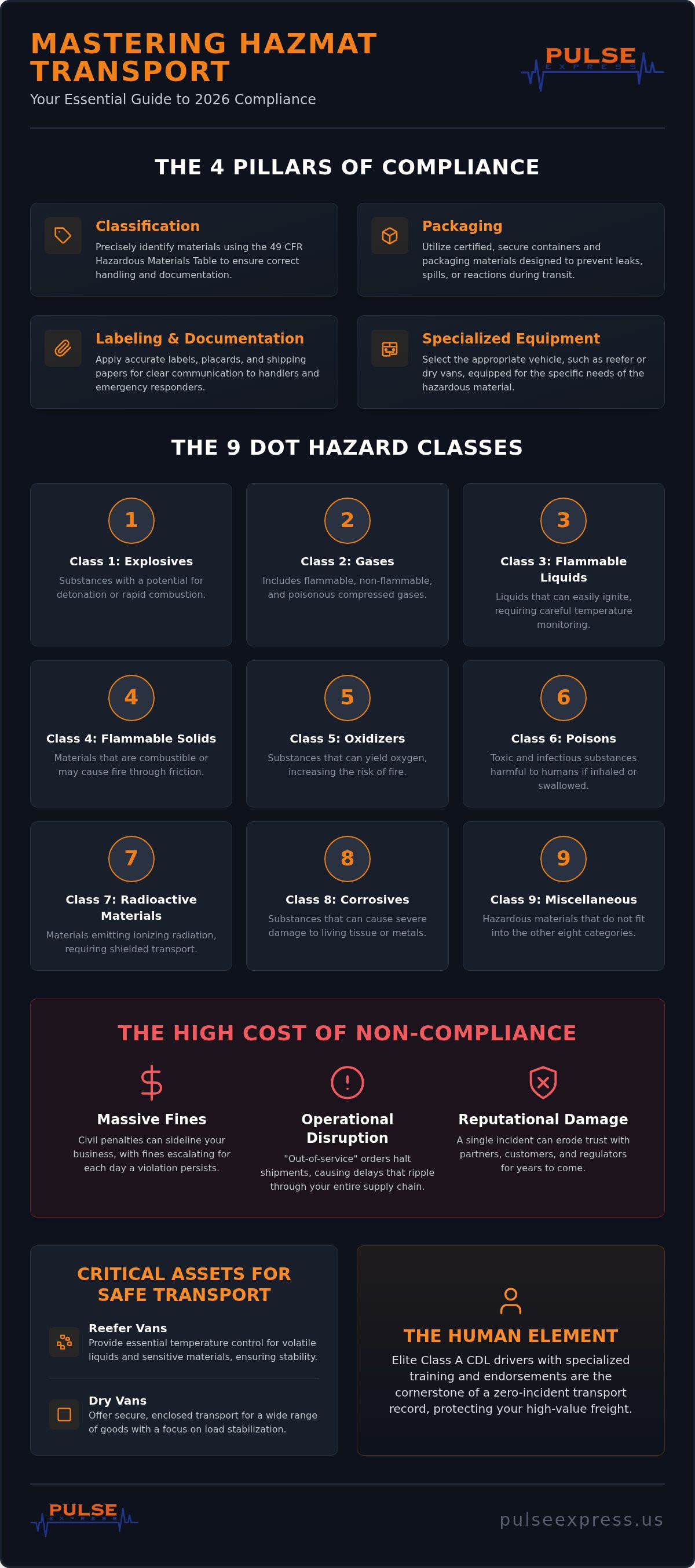
Achieving compliant hazardous material transport requires more than a basic understanding of logistics. It demands strict adherence to the standards set by the Pipeline and Hazardous Materials Safety Administration (PHMSA) and the Department of Transportation (DOT). True compliance involves four key pillars: precise classification, secure packaging, accurate labeling, and the use of specialized transportation equipment. Hazmat compliance exists at the intersection of legal duty and operational safety. In 2026, these standards have evolved to emphasize digital tracking and real-time reporting, ensuring every shipment is visible and accounted for throughout its journey. This shift toward digital documentation helps eliminate manual errors and provides a clear audit trail for every hazardous load.
Success in this field doesn't happen by accident. It's the result of a methodical approach to risk management and a deep commitment to operational excellence. Shippers must verify that every employee involved in the process is trained, every container is certified, and every vehicle is inspected. This level of detail ensures that your sensitive industrial goods arrive on time and without incident. By prioritizing these details, you build a supply chain that is resilient, reliable, and respectful of federal law.
The Role of PHMSA and the DOT
The Pipeline and Hazardous Materials Safety Administration (PHMSA) acts as the primary regulatory architect. They develop the safety standards found in 49 CFR Parts 100-180, which dictate how dangerous goods must be handled. While PHMSA creates the rules, the Department of Transportation (DOT) provides the enforcement on our nation's highways. For shippers moving goods across state lines, federal regulations generally take precedence over state rules to ensure a uniform safety standard. This hierarchy provides the stability and predictability needed for nationwide logistics operations. It allows your freight to move through different jurisdictions without the friction of conflicting local requirements.
The Consequences of Non-Compliance
Ignoring these regulations leads to severe outcomes that can threaten the future of your business. The civil penalty structure for 2026 reflects a zero-tolerance approach to safety violations, with fines reaching significant levels for each day a violation persists. Beyond financial loss, the operational risks are equally high. "Out-of-service" orders can halt your shipments mid-route, causing delays that ripple through your entire supply chain. Finally, the legal and reputational fallout from a hazardous incident often outweighs the initial fine. A single accident can damage your brand's standing with partners, customers, and regulators for years. Partnering with a carrier that prioritizes precision, safety, and care is the only way to protect your brand's integrity.
Understanding the 9 Classes of Hazardous Materials
Correct classification is the bedrock of all hazardous material logistics. Without it, you can't determine the right packaging, labeling, or vehicle type for your freight. To understand What Defines Compliant Hazardous Material Transport, shippers must start with the Hazardous Materials Table found in 49 CFR. This table dictates the "Proper Shipping Name" for every substance, which is the specific identifier used for all documentation and emergency response efforts. Using the wrong name or class can lead to dangerous handling errors and severe legal penalties.
Ensuring compliant hazardous material transport means matching your cargo's specific hazards to the right logistical setup. At Pulse Express, we specialize in Hazmat Freight Service, providing the stability and precision needed for these sensitive loads. We work closely with our partners to verify that every shipment is classified accurately before it ever leaves the dock.
Classes 1 through 4: Explosives and Flammables
Class 1 (Explosives) and Class 2 (Gases) require extreme caution due to their potential for immediate reaction. Class 3 Flammable Liquids represent a significant portion of OTR freight and demand rigorous temperature monitoring or ventilation. Class 4 Flammable Solids have unique packaging requirements to prevent spontaneous combustion during transit. Our team of dry van hazmat carriers is trained to manage these high-stakes materials with a focus on safety and regulatory adherence. We ensure that every load is secured correctly to prevent movement that could lead to an incident.
Classes 5 through 9: Oxidizers to Miscellaneous
Class 5 Oxidizers and Class 6 Poisons or Infectious Substances require specialized handling to prevent contamination and dangerous chemical reactions. Class 7 Radioactive materials are highly regulated and often require specific routing and shielding. Class 8 Corrosives can damage equipment and other cargo if not properly contained, making secure blocking and bracing a top priority. Finally, Class 9 Miscellaneous goods cover materials like lithium batteries that don't fit elsewhere but still pose a risk during transport. Whether you're moving industrial chemicals or miscellaneous dangerous goods, choosing a partner who understands these nuances is essential for your success. Achieving compliant hazardous material transport is a shared responsibility between the shipper and the carrier. If you're looking to strengthen your logistics network with a team that values precision, consider exploring our Hazmat Freight Service options today.
Equipment Standards: Reefer vs. Dry Van Hazmat Transport
Selecting the right trailer for your freight is a fundamental part of compliant hazardous material transport. It's a decision that impacts the safety of the cargo, the driver, and the public. Shippers must evaluate the chemical properties of their goods to determine if environmental control is required by federal law. Pulse Express maintains a fleet of late-model units designed for high-stakes logistics. We focus on equipment reliability, structural integrity, and advanced safety features. This commitment ensures your freight remains stable from the moment we seal the doors until it reaches its final destination.
Our maintenance standards are rigorous and uncompromising. Every trailer undergoes frequent inspections to verify that seals are tight, floors are sound, and tracking systems are operational. This proactive approach minimizes the risk of equipment failure during transit. By investing in the latest technology, we provide a level of security that older fleets simply cannot match. It's about creating a predictable environment for unpredictable materials. We prioritize precision, customization, and safety in every piece of equipment we deploy.
Reefer Hazmat for Temperature-Sensitive Cargo
Many industrial chemicals are highly sensitive to heat or cold. Temperature fluctuations can lead to destabilization, pressure buildup, or even chemical decomposition. Modern units for temperature sensitive hazmat shipping use sophisticated telematics to provide real-time climate data. These systems offer precision, redundancy, and immediate alerts for our drivers. We implement strict monitoring protocols that include continuous temperature logging, remote adjustments, and emergency backup procedures. This level of care protects your cargo and ensures it remains within the legal parameters specified on the bill of lading. Our drivers are trained to respond immediately to any climate variance, maintaining the stability of your supply chain.
Dry Van Safety and Security Protocols
Dry van transport is the standard for stable, non-perishable hazardous goods. However, these trailers must meet specific structural requirements to be considered safe for dangerous freight. Proper compliant hazardous material transport in a dry van relies on three critical factors: secure blocking, effective bracing, and appropriate venting. Our drivers utilize high-grade load bars, straps, and dunnage to prevent any movement during transit. We also consider environmental factors such as airflow and moisture control to ensure the integrity of the packaging remains intact. This methodical approach to securement reduces the risk of leaks or accidents, providing you with a reliable solution for your industrial logistics. We don't just move freight; we protect your investment through every mile of the journey.
The Human Element: Training and Driver Endorsements
While sophisticated equipment and precise paperwork are essential, the ultimate success of compliant hazardous material transport rests with the professional behind the wheel. A driver is more than just an operator. They are a trained specialist, a safety officer, and a brand ambassador. Obtaining a Hazmat endorsement (H) is a rigorous process. It requires passing a federal background check through the TSA and demonstrating advanced knowledge of hazardous substances. Pulse Express prioritizes hiring CDL drivers who maintain elite safety records and show a deep respect for the materials they carry. This human element ensures your cargo remains secure throughout the long haul.
Maintaining high hazmat transport safety standards involves a culture of continuous learning. It's not enough to be certified once. Compliance requires constant vigilance, updated knowledge, and a commitment to operational excellence. We believe that a well-trained driver is the most effective tool in any safety program. They provide the stability and reassurance you need when moving sensitive industrial goods.
Hazmat Training Mandates for 2026
The DOT specifies three primary categories of training: general awareness, function-specific, and safety training. General awareness provides a broad understanding of hazardous materials. Function-specific training focuses on the driver's exact role in the logistics chain. Safety training covers emergency response and accident prevention. Additionally, security awareness training is mandatory to protect against the unauthorized use of dangerous goods. Recurrent training must occur at least every three years, though Pulse Express often conducts more frequent reviews to keep our team sharp. This methodical approach ensures every person involved in the movement of your goods is prepared for any scenario.
Driver Safety and Operational Excellence
We vet our drivers through a comprehensive process that looks beyond their driving history. We seek individuals who value precision, care, and reliability. There's a direct relationship between driver retention and freight safety. When a driver feels supported and valued, they're more likely to uphold compliant hazardous material transport standards on every mile of the journey. Pulse Express drivers are trained, tested, and trusted. This stability in our driver network provides the confidence you need when moving sensitive industrial freight. If you're ready to partner with a team that puts safety first, explore our Hazmat Freight Service today.
Selecting a Logistics Partner for Compliant Transport
Selecting the right carrier is more than a logistical choice; it's a legal obligation. Shippers carry the responsibility of vetting their partners to ensure they meet every federal safety standard. When you're evaluating a partner for compliant hazardous material transport, you aren't just looking for a truck. You're looking for a risk management expert. A carrier's Safety Measurement System (SMS) scores offer a transparent window into their operational health. You should prioritize carriers with strong records in vehicle maintenance, driver fitness, and hazardous materials compliance. These scores reflect a company's true commitment to safety and reliability on the road.
Don't hesitate to ask detailed questions during the vetting process. You need to know how they handle emergencies, what their driver retention looks like, and how they maintain their specialized equipment. A partner that values transparency will provide this information readily. This open communication builds the foundation for a stable, long-term partnership that protects your freight and your brand's reputation.
Verifying Authority and Insurance
Verification begins with the legal essentials that authorize a carrier to move dangerous goods. You must confirm the carrier holds a valid MCS-90 endorsement. This document serves as proof that the carrier maintains the required financial responsibility for public liability related to hazardous incidents. Additionally, verify their current PHMSA registration and active DOT operating authority. Specialized insurance coverage is equally vital. Standard policies often fall short when dealing with the complexities of hazardous loads. Ensure your partner has the specific coverage limits required for the materials you're shipping. This step provides the financial stability and reassurance necessary for high-stakes industrial logistics.
Pulse Express: Your Partner in Secure Logistics
Pulse Express stands as a seasoned guide in the world of specialized freight. We offer a solution-focused approach that simplifies the most complex Hazmat challenges. Whether your cargo requires the climate precision of a reefer unit or the structural security of a dry van, we have the specialized equipment to get the job done. Our OTR network is built on the expertise of high-caliber Class A CDL drivers who treat every load with the highest level of care. We don't just follow regulations; we set a standard for excellence that instills confidence in our partners. Our approach is protective, efficient, and deeply committed to your operational success. Partner with Pulse Express for your next Hazmat shipment and experience the difference that precision and partnership can make.
Securing Your Supply Chain for 2026 and Beyond
Achieving compliant hazardous material transport is a continuous commitment to safety, precision, and regulatory mastery. By aligning your operations with the latest 2026 standards, you protect your cargo, your reputation, and the public. Success requires the right combination of specialized equipment and elite professional drivers who understand the high stakes of every mile. You've seen how classification, equipment selection, and driver vetting form a shield around your business, ensuring every shipment arrives without incident.
Pulse Express brings over 25 years of OTR expertise to every shipment we handle. Our specialized reefer and dry van hazmat fleet is built for stability, while our elite Class A CDL hazmat driver network ensures your freight is in the most capable hands. We're here to act as your trusted partner, providing the reliable logistics solutions you need to grow with confidence. Our team is ready to help you manage the complexities of modern hazmat shipping with ease, efficiency, and total transparency.
Request a Quote for Secure Hazmat Shipping
We look forward to helping you move your most sensitive industrial goods safely across the country. Your success is our mission, and we're ready to start the journey with you today.
Frequently Asked Questions
What are the main federal regulations for hazardous material transport?
The primary federal regulations are found in Title 49 of the Code of Federal Regulations, specifically Parts 100-180. These rules are established by the Hazardous Materials Transportation Act and overseen by PHMSA. They provide the legal framework for classification, packaging, and marking. Adhering to these strict guidelines is the only way to ensure compliant hazardous material transport. Shippers must also follow DOT operational rules to maintain safety and legality on public highways across the United States.
How often do hazmat drivers need to be retrained?
Hazmat drivers must receive recurrent training at least once every three years according to DOT requirements. This timeline ensures they stay current on the latest safety protocols and regulatory changes that affect the industry. If a driver’s responsibilities change or new regulations are introduced, they might need additional training sooner. Pulse Express maintains a rigorous schedule to verify that our elite driver network remains fully prepared for the complexities of moving sensitive freight safely.
What is the difference between a Hazmat endorsement and a Tanker endorsement?
A Hazmat endorsement (H) authorizes a driver to transport dangerous goods in any vehicle type, while a Tanker endorsement (N) is specifically for bulk liquids or gases in tanks. Drivers often obtain a combined endorsement (X) to handle both. While the Hazmat endorsement focuses on chemical safety and security, the Tanker endorsement addresses the unique physics of liquid surge. Both are essential for maintaining high safety standards in specialized OTR freight operations today.
Does my freight require a security plan under DOT rules?
Your freight requires a formal security plan if it meets the criteria outlined in 49 CFR 172.800. This typically includes large shipments of certain high-hazard materials, such as explosives, poisons, or radioactive substances. The plan must include a detailed risk assessment and strategies to prevent unauthorized access to the cargo. Shippers are responsible for identifying these risks and working with carriers to implement protective measures throughout the entire transport journey across the country.
What documents must accompany a hazardous material shipment?
Every shipment must be accompanied by accurate shipping papers that include the Proper Shipping Name, Hazard Class, and UN Identification Number. You also need to provide Emergency Response Information and a 24-hour emergency contact number. These documents must be readily accessible to the driver and emergency responders at all times. Proper documentation is a cornerstone of compliant hazardous material transport and ensures that any incident can be managed with precision, care, and speed.
Can hazardous materials be shipped in a standard dry van?
Yes, many hazardous materials are safely shipped in standard dry vans if they are non-perishable and stable at ambient temperatures. The key is ensuring the trailer is structurally sound and the cargo is properly secured using heavy-duty blocking and bracing techniques. However, temperature-sensitive chemicals always require a refrigerated unit to prevent destabilization. Shippers must evaluate the chemical properties of their goods to choose the most appropriate and safe equipment for long-haul transit.
How are hazmat shipping penalties calculated in 2026?
Penalties in 2026 are calculated based on the severity of the violation, the history of prior offenses, and the level of culpability. The FMCSA and PHMSA assess fines on a per-day, per-violation basis, which can quickly escalate into significant financial losses. Factors like the degree of hazard and the potential for environmental damage heavily influence the final penalty amount. Maintaining a zero-incident record through rigorous compliance is the most effective way to avoid these heavy operational burdens.
What happens if a hazmat shipment is involved in an accident?
If an accident occurs, the driver must immediately implement emergency response protocols and contact the 24-hour emergency number listed on the shipping papers. Carriers are often required to file a formal incident report with the Department of Transportation within 30 days. The focus shifts to containing the material, protecting the public, and coordinating with local authorities. A solution-focused partner will have established procedures to manage these high-pressure situations efficiently while protecting your brand's reputation.


