

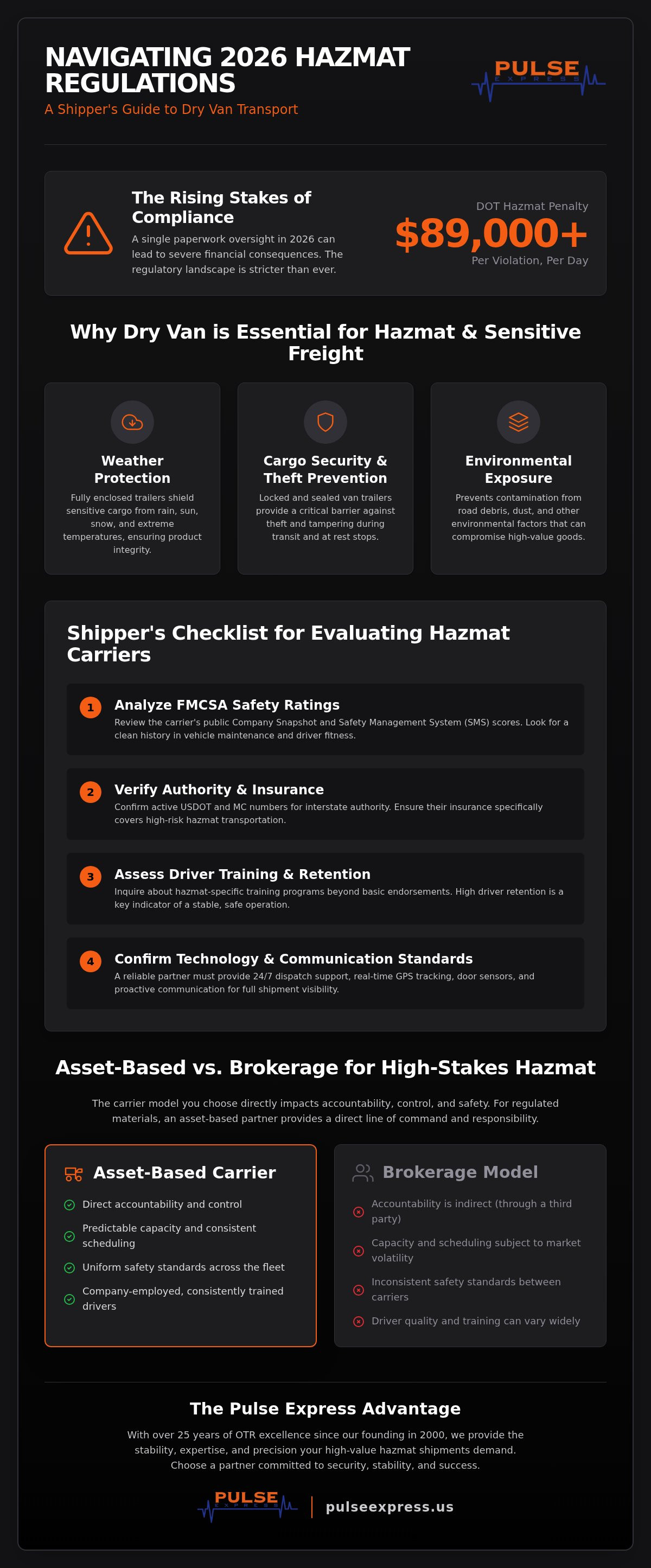
Did you know that a single paperwork oversight in 2026 can now result in DOT hazmat penalties exceeding $89,000 per violation? You're likely feeling the pressure of these rising stakes, especially when managing sensitive general freight across long-haul routes. It's stressful to worry about inconsistent driver communication or whether your cargo is truly secure in a standard trailer. Finding reliable dry van hazmat transport services shouldn't feel like a gamble with your company's reputation and bottom line. At Pulse Express, founded in 2000 by CEO Adelina Pavlov, we understand that precision is the only path forward.
This guide will show you how to evaluate carriers to ensure total safety, full regulatory compliance, and nationwide reliability. We'll explore the latest PHMSA electronic documentation standards that went into effect on September 3, 2026, the importance of elite driver training, and how real-time visibility protects your high-value shipments. By the end, you'll know how to build a logistics partnership that prioritizes security, stability, and success.
Key Takeaways
- Understand the 2026 regulatory shift toward electronic documentation and how it minimizes your liability during long-haul routes.
- Learn to evaluate dry van hazmat transport services by analyzing FMCSA safety ratings and modern equipment standards to ensure cargo security.
- Discover why dry van trailers offer superior protection from weather, theft, and environmental exposure for your sensitive general freight.
- Master the integration of hybrid supply chains by optimizing long-haul routes for both hazardous materials and general freight.
- Gain peace of mind by partnering with an established expert like Pulse Express, leveraging over 25 years of OTR excellence.
Understanding Dry Van Hazmat Transport Services in 2026
Dry van hazmat transport services are defined by the secure, long-haul movement of Dangerous Goods within enclosed, non-temperature-controlled trailers. While many shippers associate hazardous materials with specialized tankers, the dry van remains the essential backbone of the industrial supply chain. It provides a protective shell against three primary threats: unpredictable weather, cargo theft, and environmental exposure. This method ensures that sensitive general freight arrives at its destination without being compromised by external elements.
In 2026, the role of dry van shipping has expanded as supply chains become more integrated and demanding. Transitioning from local hazmat transport to nationwide over-the-road (OTR) logistics requires a significant leap in operational maturity. It isn't just about moving a trailer from point A to point B. It's about managing a mobile inventory of regulated materials across thousands of miles, multiple jurisdictions, and varying climates. This shift demands a partner who understands the nuances of long-distance safety and compliance.
General Freight OTR Services and Hazmat Integration
In a specialized industrial context, general freight often includes palletized chemicals, lithium batteries, or industrial cleaners that require specific handling protocols. Integrating these items into OTR routes, typically defined as distances exceeding 250 miles, changes the risk profile significantly. Longer routes mean more time on the road, increased vibration, and exposure to different traffic conditions. This complexity requires elite Class A CDL drivers who possess the technical skill for long-haul navigation and the specialized knowledge required for hazmat endorsements. At Pulse Express, we've focused on this intersection of skill and safety since our founding in 2000.
The Evolution of Secure Dry Van Shipping
The technology inside a standard trailer has advanced to meet modern safety needs. Modern securement now includes specialized load bars, anti-slip floor coatings, and high-tension strapping systems designed specifically for palletized hazardous goods. Beyond physical security, there's a clear shift toward tech-enabled monitoring. Real-time GPS tracking, door sensors, and telematics provide shippers with the visibility they need for high-value cargo. Under the leadership of CEO Adelina Pavlov, Pulse Express has prioritized these advancements to offer a level of precision that the volatile spot market simply can't match. Choosing a dedicated OTR partner ensures three things: consistent compliance, expert handling, and total peace of mind.
Evaluating Hazmat Carriers: A Comparison Framework for Shippers
Selecting a carrier for hazardous materials requires a methodical approach. You shouldn't rely on verbal promises alone. Instead, start by analyzing the FMCSA Company Snapshot and Safety Management System (SMS) scores. These metrics reveal a carrier's history with vehicle maintenance, driver fitness, and FMCSA Compliance. A carrier that prioritizes safety will maintain transparent records. They'll also carry insurance that specifically covers the high-stakes risks associated with dry van hazmat transport services.
Equipment standards and driver retention are the next pillars of evaluation. A well-maintained, modern fleet reduces the likelihood of roadside breakdowns that could endanger sensitive cargo. However, even the best truck needs an expert at the wheel. High driver turnover is often a precursor to safety incidents. When drivers stay with a company for years, they develop a deep familiarity with safety protocols and securement techniques. This stability is a hallmark of a reliable provider of dry van hazmat transport services.
Verification Checklist for OTR Partners
Before signing a contract, verify that your partner holds active interstate authority by checking their USDOT and MC numbers. You must also assess their hazmat-specific training programs. It's not enough for a driver to have an endorsement; the entire organization should follow a culture of continuous education. Look for these three essentials: 24/7 dispatch support, real-time GPS visibility, and proactive communication. These tools ensure you never have to guess the status of your high-value freight. If a carrier cannot provide these, they aren't ready for the demands of 2026 logistics.
Asset-Based vs. Brokerage for Hazmat
The choice between an asset-based carrier and a brokerage often determines the success of your long-haul strategy. Asset-based carriers own the equipment and employ the drivers, which provides a direct line of accountability. This model offers predictable capacity, consistent scheduling, and uniform safety standards across every load. Brokerages can be useful for general freight, but they often introduce uncertainty into hazmat logistics. For a secure and stable partnership, many shippers prefer the established reliability of asset-based OTR carriers who manage their own fleets. Since our founding in 2000, CEO Adelina Pavlov has focused on this asset-based model to ensure every load meets our rigorous standards for precision and care.
Safety Protocols and FMCSA Compliance in Long-Haul Hazmat
Dry van hazmat transport services require more than just a trailer; they demand an unwavering culture of safety. In 2026, compliance begins with strict adherence to updated Hours of Service (HOS) and Electronic Logging Device (ELD) regulations. These systems ensure that drivers remain alert and rested during long-haul routes across the United States. Pulse Express integrates these digital logs with real-time dispatch monitoring to prevent fatigue-related risks before they occur. Safe hazmat freight handling is the intersection of rigorous training and proactive maintenance.
Modern OTR safety also relies on advanced vehicle technology. We prioritize trucks equipped with Collision Avoidance and Lane Departure systems to provide an extra layer of protection on the highway. These tools act as a secondary set of eyes for the driver, helping to mitigate the risks of high-density traffic and long-distance travel. For a deeper look at how we manage these risks, you can review our guide on Safe Hazmat Freight Handling. This proactive stance on technology allows us to maintain the high standards of precision and care that CEO Adelina Pavlov has championed since our founding in 2000.
Hazmat-Specific Securement and Placarding
Ensuring compliant labeling and manifesting is a critical step for every OTR route. With the PHMSA regulatory update that became effective on September 3, 2026, carriers can now maintain hazmat emergency response information and registration documents electronically. This shift reduces the risk of lost paperwork while streamlining roadside inspections. Our team conducts meticulous paperwork audits to prevent transit delays and avoid the heavy fines associated with improper documentation. We focus on three core areas: precise placarding, accurate manifesting, and expert load securement. This attention to detail ensures that your sensitive general freight remains stable and legal from the moment it’s loaded until it reaches its final destination.
Preventative Maintenance for OTR Fleets
Reliability in dry van hazmat transport services is built on a foundation of rigorous inspection cycles. We don't wait for a breakdown to occur; we follow a proactive maintenance schedule for both tractors and dry van trailers. Every piece of 2026 safety tech, from IoT sensors to braking systems, is verified for functionality before a truck leaves the yard. Well-maintained equipment is the best defense against roadside incidents that could jeopardize your cargo’s integrity. By investing in the health of our fleet, we offer our clients a level of stability and efficiency that is essential for complex hazmat logistics. This commitment to operational excellence protects your freight, our drivers, and the communities we serve.
Strategic Logistics: Integrating Dry Van Hazmat with General Freight
Modern industrial operations often require a hybrid approach to logistics. You might need to transport non-regulated general freight alongside sensitive hazardous materials to maintain a lean inventory. Managing these mixed requirements requires a sophisticated understanding of segregation rules and route optimization. Our dry van hazmat transport services are designed to bridge this gap, offering a single, reliable solution for complex shipments. This integration is particularly vital for just-in-time manufacturing, where a delayed shipment of a single chemical component can halt an entire production line.
Efficiency in nationwide distribution relies on mastering Long Distance Freight Transportation. In 2026, with the dry van load-to-truck ratio reaching 10.61 in June, securing reliable capacity is more challenging than ever. By optimizing OTR routes, we help you navigate these capacity constraints while ensuring your freight moves through the safest, most efficient lanes. This strategic planning reduces empty miles, lowers costs, and improves the overall reliability of your supply chain. We focus on three core pillars: consistent lead times, better capacity utilization, and proactive planning.
Choosing Between Dry Van and Reefer for Hazmat
Deciding between a standard trailer and temperature-controlled equipment depends entirely on the stability of your cargo. Dry van hazmat transport services are the ideal choice for stable hazardous materials like palletized batteries, cleaning agents, or industrial coatings. However, if you're shipping temperature-sensitive chemicals that can degrade or become volatile in heat, you'll need reefer hazmat transport. You can find more details on managing these specialized requirements in our Cold Chain Logistics Reference. For stable goods, the dry van remains the most cost-efficient and widely available option for nationwide OTR shipping.
Scaling Nationwide Reach
Expanding your market access requires a partner with a truly nationwide footprint. By leveraging established OTR lanes, you can move industrial goods from regional hubs to distant markets with consistent lead times. Consolidating general freight and hazmat loads allows for better capacity utilization, which is essential during seasonal demand spikes. In 2026, proactive planning is the only way to avoid the volatility of the spot market. If you're ready to stabilize your logistics, you can partner with Pulse Express to secure dedicated capacity for your most sensitive shipments. Since 2000, CEO Adelina Pavlov has built our reputation on providing this level of strategic support to every client we serve.
The Pulse Express Advantage: A Trusted Partner Since 2000
Pulse Express has spent over 25 years refining the art of over-the-road logistics. Founded in 2000 by CEO Adelina Pavlov, our company has grown from a specialized carrier into a nationwide leader in high-stakes freight. We've built our reputation on a "Safety-First" culture that treats every load with meticulous precision. Our dry van hazmat transport services aren't just about moving trailers; they're about providing the stability and reassurance you need in a volatile market. With nationwide US coverage and a specialized fleet of modern dry vans, we ensure that your sensitive cargo reaches its destination through a network of proven lanes and expert handlers. This established reliability is why businesses trust us with their most critical shipments.
Our Elite Class A CDL Driver Fleet
The safety of your freight depends entirely on the person behind the wheel. We recognize that elite Class A CDL drivers are the primary safeguard for sensitive general freight. This is why we've focused on Hiring CDL Drivers who view hazmat transport as a long-term career rather than just a job. Our recruitment process is rigorous, involving deep background checks and continuous safety training to keep our team ahead of 2026 regulatory changes. By prioritizing driver well-being and professional growth, we maintain a low turnover rate that directly translates to higher reliability for our shippers. When a driver knows their equipment and their route, the risk of error drops significantly, ensuring your cargo stays secure.
Commitment to Operational Excellence
Operational excellence is more than a slogan; it's the core of our leadership vision. CEO Adelina Pavlov has instilled a focus on building stable, long-term logistics partnerships that go beyond simple transactions. We offer 24/7 support and direct communication for all general freight OTR services, ensuring you always have a human point of contact who understands your specific needs. This level of accessibility is critical when managing high-value or hazardous cargo across multiple time zones. We provide three key values to every client: absolute precision, established reliability, and personal investment in your success. Our methodical approach ensures that every detail, from paperwork audits to equipment maintenance, is handled with the highest level of care. If you're ready to secure your supply chain with a partner that understands the stakes of 2026 logistics, it's time to Partner with Pulse Express for Secure Hazmat Transport.
Securing Your Supply Chain for the Road Ahead
Navigating the complexities of 2026 logistics requires more than just equipment; it demands a partner committed to absolute precision. You've learned that staying ahead of PHMSA electronic documentation rules and FMCSA safety scores is the only way to protect your business from massive penalties. By integrating your general and hazardous freight into optimized OTR routes, you can achieve the nationwide reach your customers expect without sacrificing cargo security. Choosing the right dry van hazmat transport services isn't just a tactical decision. It's a commitment to stability, safety, and long-term growth.
Pulse Express has been a trusted guide in this industry since 2000. Under the leadership of CEO Adelina Pavlov, we've built an elite Class A CDL fleet specialized in both Hazmat and Reefer transport. We offer the three things every shipper needs: established reliability, specialized expertise, and a personal investment in every load. If you're ready to reduce your liability and gain real-time visibility over your most sensitive shipments, our team is here to help. Request a Quote for Dry Van Hazmat Transport Services today. Let's build a safer, more efficient future for your freight together.
Frequently Asked Questions
What are dry van hazmat transport services?
Dry van hazmat transport services involve the secure movement of hazardous materials using enclosed, non-temperature-controlled trailers. These services protect sensitive freight from weather, theft, and environmental exposure during long-haul over-the-road routes. They are essential for industrial goods like lithium batteries, cleaning chemicals, and industrial coatings that don't require refrigeration but do need a protective environment. Pulse Express has provided these specialized logistics solutions since our founding in 2000.
Which hazmat classes can be transported in a dry van?
Most hazardous material classes can be transported in a dry van as long as they are stable and don't require temperature regulation. This includes Class 3 flammables, Class 8 corrosives, and Class 9 miscellaneous dangerous goods. However, certain explosives or radioactive materials may have specific trailer requirements. We recommend reviewing the PHMSA regulations or consulting with our dispatch team to ensure your specific cargo class is compliant with our dry van equipment standards.
How does Pulse Express ensure FMCSA compliance for hazmat loads?
We maintain strict adherence to all FMCSA regulations through proactive monitoring and rigorous internal audits. This includes verifying driver ELD logs for Hours of Service compliance and ensuring all tractors meet 2026 safety technology standards. Our drivers undergo continuous training to stay updated on the latest PHMSA rules, including the September 3, 2026, transition to electronic documentation. Under CEO Adelina Pavlov's leadership, we prioritize precision in every aspect of regulatory compliance.
Do I need a reefer or a dry van for my hazardous materials?
The choice depends entirely on whether your hazardous materials are temperature-sensitive. If your cargo can degrade, become volatile, or change state when exposed to heat or cold, you require reefer hazmat transport to maintain a stable environment. For stable chemicals, industrial cleaners, or palletized batteries, dry van hazmat transport services offer a more cost-efficient and widely available solution. We operate both fleet types to provide the specific protection your freight requires.
What certifications should I look for in a dry van hazmat carrier?
You should verify that a carrier has active interstate authority and a valid Hazardous Materials Safety Permit (HMSP) if required for your cargo type. Check for elite Class A CDL drivers with current hazmat endorsements and specialized training certificates. It's also vital to review their FMCSA safety ratings and SMS scores. A carrier like Pulse Express, with over 25 years of industry experience, demonstrates a long-term commitment to maintaining these critical certifications.
How does Pulse Express track hazmat freight during long-haul transit?
We use a combination of real-time GPS tracking and advanced telematics to monitor every load across the United States. Shippers receive consistent updates and have access to 24/7 dispatch support for immediate communication. Our systems track vehicle location, door sensors, and driver behavior to ensure the highest level of security. This transparency provides the real-time visibility necessary for managing high-value sensitive cargo during long-haul OTR routes.
What are the insurance requirements for hazardous material shipping?
Carriers moving hazardous materials must carry higher levels of public liability insurance than standard freight companies. For many hazmat categories, the minimum requirement is $5 million in coverage to account for potential environmental and safety risks. You should always request a Certificate of Insurance to verify that your OTR partner meets these federal mandates. Pulse Express maintains comprehensive coverage that reflects our focus on stability and reduced liability for our clients.
Can Pulse Express handle both general freight and hazmat in the same fleet?
Yes, our fleet is designed to handle both general freight and hazardous materials across our nationwide network. We recruit elite Class A CDL drivers who are capable of managing complex hybrid supply chains. This flexibility allows us to consolidate your shipments and optimize long-haul routes for better efficiency. Whether you're moving standard industrial goods or regulated materials, we provide the same level of precision and operational excellence.


