

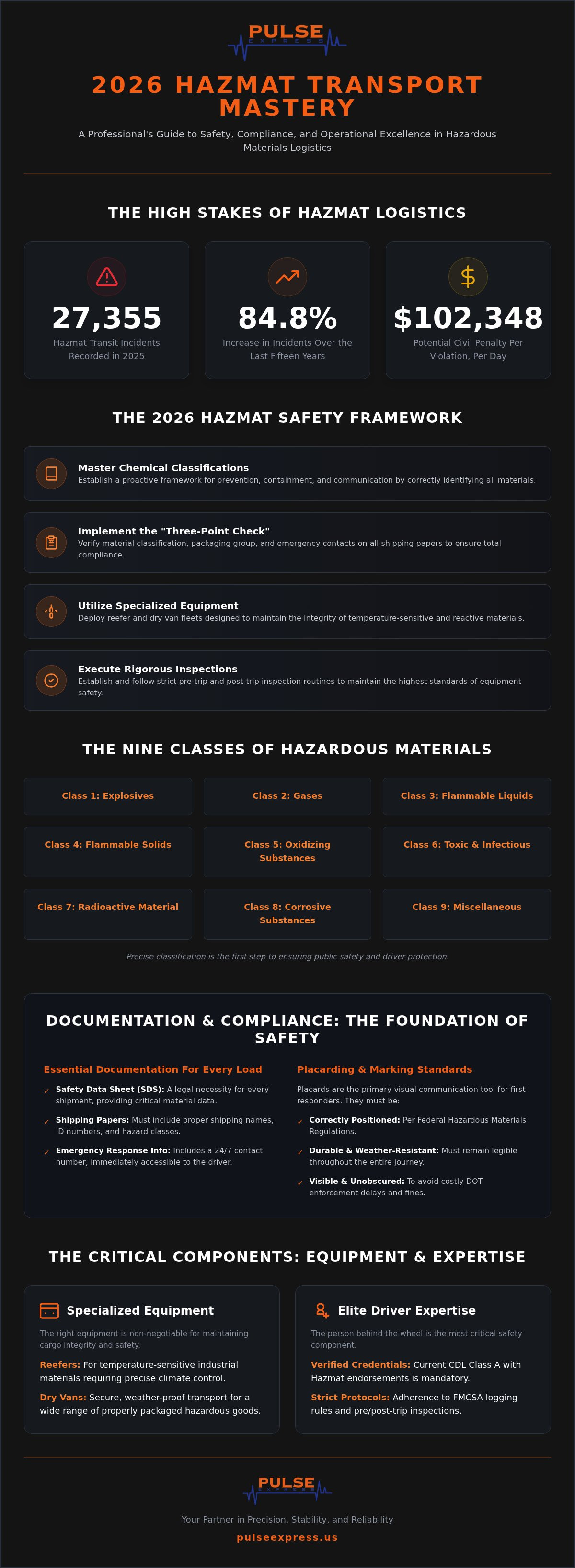
With hazmat transit incidents reaching 27,355 in 2025, an 84.8% increase over the last fifteen years, the margin for error in your supply chain has effectively vanished. Achieving consistent, safe hazmat freight handling is no longer just a regulatory requirement; it's a fundamental pillar of operational stability. You understand the pressure of managing complex federal mandates while facing potential civil penalties that now reach $102,348 per day for standard violations. It's a heavy burden to carry alone, especially when the safety of your cargo and the environment rests on the precision of your logistics partners.
This comprehensive 2026 checklist is designed to give you total mastery over hazardous materials transport. By following these professional protocols, you'll reduce liability, streamline your shipping roadmap, and gain the confidence to choose carriers that prioritize elite driver expertise. We'll examine the essential components of a secure shipment: rigorous regulatory compliance, specialized reefer and dry van equipment, and the high-tier CDL Class A drivers who make it all possible. Let's build a safer, more reliable future for your most sensitive freight together.
Key Takeaways
- Master the 2026 chemical classification system to establish a proactive framework for prevention, containment, and communication.
- Implement the "Three-Point Check" for shipping papers and manifests to ensure total regulatory compliance and reduce liability.
- Evaluate the necessity of specialized reefer and dry van equipment for maintaining the integrity of temperature-sensitive industrial materials.
- Establish rigorous pre-trip and post-trip inspection routines to maintain the highest standards of safe hazmat freight handling.
- Learn how to select an expert logistics partner that combines elite driver expertise with a long-standing commitment to operational excellence.
Fundamentals of Safe Hazmat Freight Handling in 2026
Safe hazmat freight handling is a disciplined system of prevention, containment, and communication. It isn't just a checklist; it's a commitment to operational excellence that protects drivers, the public, and the environment. In 2026, the increasing complexity of industrial chemicals requires a more nuanced approach to specialized logistics. When freight moves across state lines, the safety margins must be significantly higher than those used for local delivery. High-speed travel on interstate highways increases the potential impact of any incident. This makes cargo integrity a vital component of public safety that requires constant vigilance and specialized expertise.
The Nine Classes of Hazardous Materials
Identifying the specific risks of your cargo is the primary step toward a secure shipment. The global regulations for dangerous goods categorize materials into nine distinct classes. These range from Class 1 explosives and Class 2 gases to Class 8 corrosives. Shippers must provide accurate material data to prevent hidden hazards from being mislabeled as general freight. This transparency allows for proper planning, specialized equipment selection, and correct placarding. We believe that safety begins with clarity, ensuring that every person in the supply chain understands the nature of the materials they handle. Precise classification protects the driver and ensures that emergency responders have the information they need if an issue arises.
The 2026 Safety Landscape for OTR Carriers
The logistics industry has transitioned toward a more sophisticated, data-driven approach to risk management. Modern standards now emphasize environmental sustainability alongside physical security. Long-haul trucking has seen a significant shift toward predictive safety analytics, which helps carriers identify potential issues before they reach the highway. This proactive stance is essential for safe hazmat freight handling across the United States. At Pulse Express, our philosophy is built on three core values: precision, stability, and reliability. We view ourselves as a seasoned guide for our clients, ensuring that every shipment meets the rigorous demands of the 2026 regulatory environment. By focusing on elite driver quality and specialized equipment, we maintain a protective shield around your most sensitive cargo.
Regulatory Compliance and Documentation Checklist
Precision in documentation is the backbone of safe hazmat freight handling. In 2026, the cost of oversight is higher than ever, with standard civil penalties for violations remaining at $102,348 per day. Maintaining a valid Safety Data Sheet (SDS) for every shipment isn't just a best practice; it's a legal necessity. We recommend the "Three-Point Check" for all manifests and shipping papers: verify the material classification, confirm the packaging group, and validate the emergency contact details. This methodical approach ensures that every stakeholder has the information they need to maintain a secure environment.
Essential Documentation for Every Load
Every shipment must be accompanied by accurate documentation that includes proper shipping names, identification numbers, and specific hazard classes. This information allows carriers to implement the correct safety protocols for each material. Additionally, emergency response information must be immediately accessible to the driver at all times. Shippers are required to provide a 24/7 emergency contact number, ensuring that expert guidance is available during every mile of the journey. For those seeking a partner that prioritizes this level of detail, our specialized hazmat freight services offer the reliability you need.
Placarding and Marking Standards
Placards serve as the primary visual communication tool for first responders and enforcement officers. Whether you're using dry vans or reefers, these markings must be durable, weather-resistant, and correctly positioned according to the Federal Hazardous Materials Regulations. Common mistakes, such as obscured placards or faded markings, often lead to significant DOT enforcement delays and costly fines. In 2026, the focus on data-driven enforcement means that even minor labeling errors can trigger comprehensive inspections. We ensure all markings are visible and accurate across long distances to prevent transit interruptions.
Safety also extends to the person behind the wheel. Verifying current hazmat endorsements for all OTR drivers is a non-negotiable step in our vetting process. We also maintain strict compliance with the latest FMCSA electronic logging and reporting rules to ensure transparency, accountability, and efficiency. All employees involved in the shipping process must receive updated training at least every three years, covering general awareness, security, and function-specific tasks. This commitment to continuous education minimizes the risk of catastrophic loss and reinforces a culture of operational excellence.
Specialized Equipment and Temperature Control Standards
The trailer is the primary containment unit for every shipment. For safe hazmat freight handling, the physical integrity of this equipment is non-negotiable. Whether you're moving industrial solvents in a dry van or volatile organic compounds in a reefer, the vehicle must act as a protective shield. We prioritize a rigorous maintenance schedule that focuses on three critical areas: structural integrity, mechanical reliability, and cargo securement. A standard inspection checklist includes a deep dive into tire pressure, brake responsiveness, and the condition of all internal tie-down points. These checks prevent mechanical failures that could lead to catastrophic cargo loss on interstate highways.
High-spec equipment provides the stability required for long-distance OTR travel. While rail transport offers bulk capacity, it often lacks the door-to-door precision and climate control necessary for sensitive industrial goods. By utilizing modern reefer and dry van fleets, shippers gain greater control over the transit environment. This control is essential for maintaining the safety margins required by current federal mandates. Every piece of equipment in our fleet is designed to meet the highest safety standards, ensuring that your freight remains secure from the moment it's loaded until it reaches its final destination.
Advanced Reefer Safety Protocols
Temperature-sensitive chemicals require an environment that is both stable and predictable. Thermal fluctuations don't just damage the product; they can trigger chemical instability or hazardous reactions. Our temperature controlled trucking services utilize advanced sensors that are calibrated to detect even minor deviations in the cold chain. These reefers are equipped with redundant cooling systems and emergency power units to ensure that the environment remains consistent during long-haul transit. This level of technical precision is what separates a standard carrier from a specialized logistics partner.
Dry Van Security and Securement
For materials that don't require temperature regulation, dry van security remains a top priority. Cargo shifting is one of the most common causes of transit incidents. We use specialized blocking and bracing techniques to lock hazardous material drums and totes in place. This includes the use of high-quality dunnage and heavy-duty load bars that exceed standard requirements. Following OSHA hazmat transportation guidelines, our teams ensure that all personnel are protected during the loading process. To add an extra layer of protection, every load is secured with high-security seals and monitored via real-time GPS tracking for total visibility.
The Human Element: Training and Operational Best Practices
While specialized trailers and precise documentation provide the framework, the driver remains the most critical factor in the safety equation. Safe hazmat freight handling requires a specific set of operational behaviors that go beyond standard driving skills. Professional OTR specialists must master speed management, maintain rigorous space cushioning, and implement strict fatigue management protocols. A heavy hazmat load reacts differently to sudden movements or braking than general freight. We prioritize drivers who understand these physics, ensuring that every mile is covered with a focus on stability and risk mitigation.
Routine inspections take on a higher level of importance when transporting hazardous materials. A pre-trip check for hazmat isn't just a glance at the tires; it's a methodical verification of valve seals, secondary containment systems, and placarding security. Post-trip reviews are equally vital, allowing drivers to identify potential wear that could compromise future loads. This rhythmic cycle of inspection creates a culture of constant vigilance. It ensures that the equipment remains as reliable at the end of a long-haul journey as it was at the beginning.
Driver Training and Certification
Elite hazmat OTR driver jobs in 2026 demand a level of expertise that basic licensing cannot provide. We believe that hiring CDL drivers with a safety-first mindset is the most effective way to reduce shipper risk. Our partners receive carrier-specific training that includes spill prevention drills and advanced defensive driving techniques. By investing in the human element, we provide our clients with a protective layer of expert oversight. This approach transforms the driver from a simple operator into a seasoned guide for your most sensitive cargo.
Real-Time Monitoring and Incident Response
Modern telematics allow us to monitor hazmat loads across our nationwide logistics network in real time. This technology tracks more than just location; it provides data on temperature stability, route adherence, and sudden braking events. If a deviation occurs, we have immediate reporting protocols in place to address the issue before it becomes a hazard. In the rare event of an incident, the OTR driver acts as the first responder, utilizing their specialized training to contain the situation and communicate with emergency services. If you're looking for a team that treats your cargo with this level of care, explore our hazmat freight transport solutions today.
Partnering with Pulse Express for Secure Hazmat Logistics
Pulse Express has spent over 25 years refining the art of specialized OTR logistics. Since our founding in 2000, we've prioritized a "Zero-Incident" culture that puts safety at the forefront of every operational decision. Choosing an asset-based carrier means you aren't just hiring a middleman; you're partnering with a team that owns the trucks, maintains the equipment, and employs the drivers. This direct control is the only way to guarantee the level of precision required for safe hazmat freight handling in 2026. We bridge the gap between complex nationwide hazmat logistics and the personalized, high-touch service your sensitive cargo deserves.
Our commitment to stability and reliability is rooted in our history as a family-oriented partner with global capabilities. We understand that your reputation is on the line with every shipment. That's why we don't just follow regulations; we set higher internal benchmarks for performance. By integrating advanced telematics with a seasoned guide's intuition, we provide a logistics experience that's protective, efficient, and deeply committed to your success. Our team is ready to manage the variables so you can focus on growing your business.
Customized Solutions for Complex Freight
Every chemical compound has unique requirements, and a one-size-fits-all approach doesn't work for high-value industrial goods. We tailor our reefer and dry van services to meet the specific stability needs of your freight. Whether you require strict temperature maintenance or specialized dunnage for securement, our long-haul fleet is equipped to handle the task. Pulse Express remains the preferred partner for sensitive OTR logistics because we combine technical expertise with a genuine investment in cargo integrity. We're here to streamline your supply chain and provide the peace of mind that comes with proven experience.
Join Our Elite Driving Team
We're always looking for professional drivers who want to elevate their careers and join a team that values their expertise. Our environment is designed to be supportive, stable, and focused on mutual growth. We offer high-value OTR paths for those who carry the proper endorsements and a safety-first mindset. If you're ready to work with a leader in safe hazmat freight handling, we invite you to explore our current opportunities. Partner with Pulse Express for your next hazmat shipment or career move and experience the difference that 25 years of authority makes.
Building a Resilient Future for Specialized Logistics
Mastering hazardous materials transport in 2026 requires a disciplined integration of regulatory precision, specialized equipment, and elite human expertise. By implementing a rigorous safety checklist, you move beyond simple compliance to achieve true operational stability. This proactive approach reduces your liability, protects the public, and ensures the integrity of your sensitive industrial cargo. Safe hazmat freight handling is a continuous commitment to excellence that demands a partner invested in every mile of the journey.
Pulse Express has been a trusted guide in the OTR industry since 2000, offering the reliability that comes with over 25 years of specialized experience. Our elite Class A CDL driver fleet and specialized reefer hazmat capabilities provide the protective shield your supply chain needs to thrive in a complex landscape. We invite you to secure your hazmat supply chain with Pulse Express and experience the precision of a dedicated logistics partner. Let's work together to maintain the highest standards of safety and efficiency for your business.
Frequently Asked Questions
What are the main responsibilities of a shipper in safe hazmat freight handling?
Shippers bear the primary responsibility for identifying and classifying hazardous materials correctly. You must ensure all cargo is properly packaged in authorized containers, marked with correct identification numbers, and labeled with hazard class symbols. Additionally, providing accurate shipping papers and a valid Safety Data Sheet (SDS) is essential for safe hazmat freight handling. This foundational step allows carriers to implement necessary safety margins and emergency response protocols required for long-distance transport.
How often do hazmat placards need to be replaced during long-haul transit?
Placards must remain visible, durable, and legible throughout the entire journey. While there is no fixed replacement schedule, they should be inspected at every stop. If a placard becomes damaged by weather, obscured by road grime, or lost during transit, the driver must replace it immediately before continuing. Maintaining clear visual communication is vital for enforcement officers and first responders, ensuring that the nature of the cargo is always identifiable on interstate highways.
Can hazardous materials be shipped in a standard refrigerated trailer?
Hazardous materials can be transported in refrigerated trailers, but the equipment must meet specific safety standards. At Pulse Express, we use specialized reefer units designed to handle both temperature-controlled and hazardous materials simultaneously. These trailers must be properly cleaned, inspected for structural integrity, and equipped with securement points suitable for chemical drums or totes. It is essential to partner with a carrier that understands the synergy between refrigeration and hazardous material safety.
What are the penalties for non-compliant hazardous material transport in 2026?
In 2026, the Pipeline and Hazardous Materials Safety Administration (PHMSA) has maintained civil penalties at 2025 levels due to a lapse in federal appropriations. A standard violation can result in fines of $102,348 per day, per violation. If a non-compliant shipment results in death, serious illness, or severe injury, the penalty increases to $238,809 per day. These significant financial risks highlight why safe hazmat freight handling is a non-negotiable requirement for modern industrial shippers.
How does Pulse Express verify the safety records of its OTR drivers?
We implement a rigorous vetting process that focuses on hiring high-tier CDL Class A drivers with valid hazmat endorsements. Our safety team reviews each driver's long-haul experience, accident history, and compliance with federal safety regulations. We prioritize professionals with a safety-first mindset who are capable of managing the complexities of OTR logistics. By maintaining an elite fleet, we reduce risk for our clients and provide a protective layer of expert oversight for every load.
What is the difference between general freight and specialized hazmat logistics?
General freight involves standard shipping procedures for non-regulated goods, while specialized hazmat logistics requires strict adherence to federal safety mandates. The main differences lie in the level of regulatory oversight, the necessity for specialized equipment like hazmat-rated reefers, and the requirement for advanced driver training. Hazmat transport also involves higher liability and requires a methodical approach to containment, communication, and prevention that isn't typically necessary for standard dry van or reefer loads.
Are there specific route restrictions for hazmat freight in the US?
Yes, hazmat freight is subject to specific routing requirements designed to minimize risks to populated areas and sensitive environments. These include designated hazmat routes, restrictions on certain tunnels or bridges, and local ordinances that may limit transit during specific hours. OTR drivers must plan their routes using specialized GPS systems that account for these limitations. Proper route planning is a critical component of a secure logistics strategy, ensuring that sensitive cargo avoids high-risk infrastructure.
What happens if a hazmat load experiences a temperature deviation in a reefer?
If a temperature deviation occurs in a reefer, the driver must follow immediate reporting protocols to notify the dispatcher and the shipper. Such fluctuations can trigger chemical instability or hazardous reactions, depending on the material class. Our specialized reefer units use redundant cooling systems to prevent these issues. In the event of a failure, the driver acts as a first responder to contain the situation and follow the emergency response instructions provided in the shipping papers.


