

The most convenient shipping option may not be the right one for a flammable liquid. Flammable liquids hazmat shipping starts with the product itself: its properties and shipment details help determine which rules and transport options may apply.
If you’re unsure whether your product is regulated, or what packaging, paperwork, markings, and carrier acceptance it requires, you’re not alone. Requirements can vary across postal, parcel, air, and highway transportation. Choosing a mode before checking the details can lead to avoidable complications.
This guide explains what product information to gather, how to assess classification and preparation requirements, and what to consider when comparing shipping options. You’ll also learn how to evaluate a freight partner’s safety practices, equipment, route fit, and communication. For shipments that may suit over-the-road freight, you can assess that option alongside other modes without assuming it fits every product. With the shipment details in hand, you can make a more informed choice and confirm service fit before moving forward.
Key Takeaways
- Gather product identity and relevant product data before assessing whether the liquid is regulated. A product name alone may not be enough.
- Understand how classification guides packaging, markings, labels, and shipping documents, and identify which details to clarify with the carrier.
- Use the Flammable liquids hazmat shipping mode comparison to weigh parcel, postal, air, and OTR freight against shipment size, route, handling, and service acceptance.
- Prepare a freight inquiry with the shipment’s quantity, packaging, origin, destination, and handling needs so potential carriers can assess fit.
- Compare OTR carriers on hazmat experience, communication, route, and equipment suitability, then confirm acceptance for the specific shipment.
What Makes a Liquid a Hazmat Shipment in the United States?
A liquid’s properties help determine how it is classified, while the transport mode affects which requirements and carrier rules need to be checked. Flammable liquids hazmat shipping therefore starts with reliable product information, not assumptions based on a familiar product name. A coating, cleaner, or personal-care product may have different transport considerations depending on its formulation and classification.
As a plain-language starting point, Hazard Class 3 covers flammable liquids. Under the U.S. Hazardous Materials Regulations (HMR), a flammable liquid is a liquid with a flash point of not more than 60°C (140°F). This is a baseline, not a complete classification decision for every product or shipment. Review the HAZMAT Class 3 Flammable liquids overview, then verify the applicable classification and transport requirements using current regulatory guidance.
Which product details help determine whether a liquid is regulated?
Start with the current Safety Data Sheet (SDS) and any product classification information from the manufacturer. Check the product’s composition and listed transport details, including its flash point where provided. Flash point describes the temperature at which a liquid can produce enough vapor to ignite under specified test conditions. It can inform classification, but it should not be treated as a universal shortcut across all shipping contexts.
If the SDS is missing, unclear, or inconsistent with other product records, don’t guess from the label or brand name. Ask the manufacturer for clarification or consult a qualified hazmat compliance resource. Confirm the classification, including whether Hazard Class 3 applies, before planning the shipment.
Why do shipping mode and carrier matter?
Postal mail, parcel networks, air cargo, and highway freight operate in different shipping contexts. Rules and service conditions for one mode don’t automatically determine what is required or accepted in another. For example, USPS mailing guidance does not establish the requirements for an over-the-road (OTR) freight shipment.
Once you’ve checked the product information, verify the requirements for the intended mode and ask the carrier whether it accepts the specific shipment. A carrier may have service-specific acceptance rules in addition to applicable regulations. Clarify the shipment’s classification, packaging, route, and handling needs before choosing a service. This keeps product classification separate from carrier acceptance and avoids basing the decision on a mode-related assumption.
How Classification, Packaging, and Documentation Shape Flammable Liquid Shipments
After establishing the product’s transport classification, use it to guide the next checks: packaging, closure, marks, labels, and shipping documents. Exact requirements may depend on the product, quantity, packaging, route, and transport mode. Treat a general checklist as a starting point, not a final compliance decision. Confirm the requirements that apply to the specific shipment against current U.S. guidance.
What packaging and shipment information should shippers prepare?
Before requesting service, gather the product identity, current Safety Data Sheet (SDS), confirmed classification, quantity, and packaging details. Note the type and size of each container and any relevant closure information. These details give a qualified compliance contact useful context for determining which packaging and closure specifications need verification.
Don’t apply packaging rules for postal or air shipments to highway freight without checking. Modes can have different requirements, and carrier acceptance conditions can vary as well. If the product needs temperature control, treat that as a separate handling consideration. Temperature control does not replace hazardous-material classification or packaging review.
What paperwork and markings may need to be confirmed?
Ask which shipping papers, hazard communication, package marks, and labels apply to the shipment’s classification and transport mode. Confirm the details with a qualified compliance resource, and check that the documents match the actual product, quantity, and packages. The Federal Hazardous Materials Regulations resource from the Federal Motor Carrier Safety Administration can help orient shippers to ground-transportation compliance topics. Shipment-specific requirements still need current verification.
Classification and transport mode determine which shipment requirements apply. Use this as a practical checkpoint, not a substitute for confirming current rules. Verify the requirements before tendering freight, especially if shipment details have changed since the documents were prepared.
The shipper should provide accurate product and shipment information and confirm applicable preparation requirements with a qualified compliance contact. The carrier separately assesses whether it can accept the shipment under its service rules, route, and equipment constraints. Carrier acceptance does not establish that the shipment has been prepared correctly, and a shipper’s preparation review does not guarantee carrier acceptance.
Shippers comparing OTR hazmat transport options can share these details with Pulse Express freight services to discuss the shipment requirements and confirm whether the requested service is available.
Parcel, Postal, Air, or OTR Freight: Which Option Fits?
There isn’t one best mode for every flammable-liquid shipment. Compare load size, route, delivery needs, handling conditions, and whether a provider will accept the specific shipment. Mode-specific rules and provider acceptance are separate checks: a shipment that appears suitable for one service still needs confirmation for the route and service you plan to use.
When should a shipper investigate parcel, postal, or air options?
For smaller shipments or time-sensitive destinations, investigate parcel or air services, but check the provider’s current hazmat acceptance rules first. Postal mail has its own conditions, and USPS mailing guidance doesn’t determine whether a parcel carrier, air service, or highway freight provider will accept the same product. Check each provider’s guidance for the service you plan to use.
Use this comparison to organize questions, not to assume acceptance:
| Mode | Mode-specific question | Confirm with the provider |
|---|---|---|
| Postal | Does the applicable mail service allow this product and destination? | Product eligibility, preparation, and service limits with USPS. |
| Parcel | Does the network handle this shipment type and size? | Hazmat acceptance, packaging, route, and delivery conditions. |
| Air cargo | Can the shipment meet applicable air-transport requirements? | Current acceptance rules, handling needs, and destination service. |
| OTR freight | Does the load and long-haul route fit highway freight? | Shipment acceptance, equipment suitability, and route constraints. |
For ground transportation, the FMCSA’s overview of the Federal Hazardous Materials Regulations provides a useful reference. It doesn’t replace checking the requirements for the shipment and service at hand.
When might OTR freight be a better fit to assess?
Consider an OTR inquiry for a commercial load when shipment size, freight handling, or long-haul routing makes parcel or postal service less suitable to assess. Ask whether dry van equipment fits the confirmed cargo and handling requirements, and verify that the carrier accepts the particular shipment. No mode is universally safer, faster, cheaper, or preferable.
If the liquid is temperature-sensitive, confirm the required temperature conditions separately from hazmat classification and acceptance. Temperature control doesn’t replace hazardous-material compliance. For more on temperature-controlled freight, see this cold chain logistics guidance.
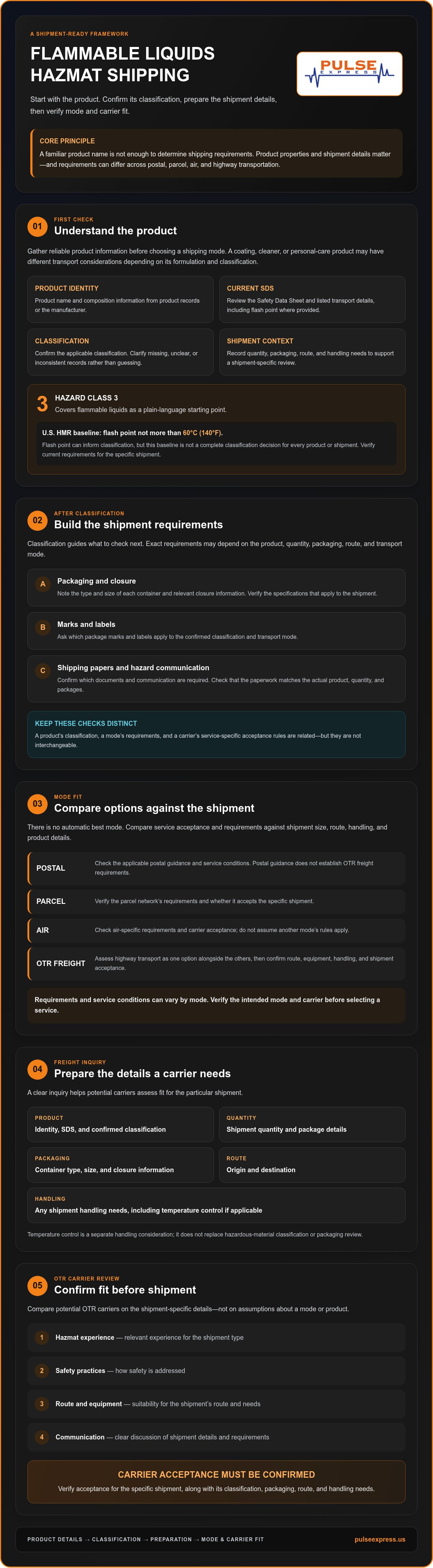
A Practical Checklist for Preparing a Flammable Liquid Freight Inquiry
A complete inquiry helps a carrier assess shipment, route, and service fit before pickup is planned. Use these steps to organize the facts, flag open questions, and get clear answers. For broader OTR planning, review this specialized hazmat logistics guide.
What should you have ready before contacting carriers?
Gather the product and shipment details first. Keep the current Safety Data Sheet and confirmed classification information available, and identify anything that still needs review by a qualified compliance resource.
- Step 1: Identify the product. Provide its product name and relevant manufacturer or SDS information. Don’t rely on a trade name alone to establish classification.
- Step 2: Record the classification. Share the confirmed transport classification and note unresolved questions rather than making assumptions.
- Step 3: Describe the quantity and packaging. Specify the amount being shipped and how it is packaged, including container and outer packaging details. Ask a qualified compliance contact to resolve any uncertainty about packaging requirements.
- Step 4: Define the route. Provide the pickup and delivery locations, plus the requested timing. For a long-haul load, long-distance freight transportation guidance can help frame OTR planning questions.
- Step 5: Explain handling needs. Identify temperature-control requirements or other special handling considerations, if applicable. Don’t assume a particular equipment type is suitable until the cargo and requirements are reviewed.
What should you confirm before tendering the load?
Provide the same shipment facts to each prospective carrier so you can compare their responses clearly. Ask whether the carrier accepts the specific product and route, which equipment may be appropriate, what documents it needs, and whether any shipment-specific restrictions apply.
Before pickup, resolve open questions about classification, documentation, packaging, and handling with the appropriate compliance contact and carrier. Request written confirmation of service acceptance and the carrier’s shipment-specific requirements. Keep the confirmed information together, and update the inquiry if the product, quantity, packaging, route, or handling plan changes.
For an OTR hazmat freight inquiry, share your shipment details with Pulse Express to discuss the requested service and confirm availability for the specific load.
Choosing an OTR Hazmat Carrier for Flammable Liquid Freight
Once the shipment details are assembled, use them to evaluate whether a carrier is an operational fit. In flammable liquids hazmat shipping, a general claim of hazmat experience isn’t enough. Look for clear answers about relevant shipment types, acceptance requirements, equipment, routing, and how the carrier will communicate if details need clarification.
What should shippers ask a prospective OTR carrier?
Discuss the exact product and shipment configuration, rather than asking only whether the carrier handles hazardous materials. A useful review covers product classification, quantity, packaging, origin, destination, route, and special handling needs. Ask the carrier to explain its service-specific requirements and identify any information it still needs before confirming acceptance.
- Experience: Can the carrier describe relevant hazmat transportation experience and explain how it assesses shipment-specific requirements?
- Acceptance: Will it consider this exact product, quantity, and packaging on the requested route?
- Equipment: Which equipment may suit the confirmed cargo and handling conditions, and what details support that recommendation?
- Communication: Who will clarify open questions, and how will changes to shipment details or plans be handled?
Equipment should match the confirmed cargo, route, and handling requirements, not a default assumption. A dry van may be an option to assess for some shipments, while temperature-sensitive cargo may require a separate discussion about temperature control. Reefer equipment does not replace hazmat compliance, and it isn’t automatically suitable for every flammable liquid. Ask the carrier to explain the proposed fit and confirm it for the specific load.
How can Pulse Express assess a shipment?
Pulse Express provides U.S. over-the-road freight transportation, including hazmat freight using dry van and reefer equipment. This may make the company a potential partner to consider for an OTR shipment, but availability, acceptance, and equipment suitability depend on the shipment details and require confirmation.
Share the product classification, quantity, packaging, pickup and delivery locations, and handling needs when discussing the load. Ask which service may fit and clarify outstanding requirements before booking. A careful review helps both shipper and carrier understand the request without assuming acceptance in advance.
If you’re assessing an OTR option, discuss your hazmat freight shipment with Pulse Express to review the details and confirm whether the required service is available.
Move Forward With a Clear Shipping Plan
Flammable liquids hazmat shipping starts with verified product information, followed by shipment-specific packaging, documentation, and carrier acceptance checks. Postal, parcel, air, and OTR freight each have distinct considerations, so guidance for one mode shouldn’t be treated as a universal shipping standard.
Before choosing a freight partner, prepare the product classification, quantity, packaging details, route, and handling needs. Use those facts to ask clear questions about service acceptance, equipment, and carrier-specific requirements. If the load is temperature-sensitive, confirm temperature-control needs separately from hazmat compliance.
Pulse Express provides U.S. OTR freight transportation for hazardous materials, with dry van and refrigerated freight offerings. The right service and equipment depend on the shipment, so availability and suitability need to be confirmed for your specific load. Discuss your flammable-liquid freight requirements with Pulse Express and share the details needed to assess potential fit.
A careful review helps you make informed decisions at each step. With the right information and clear communication, you can move toward a transport plan with greater confidence.
Frequently Asked Questions
Are all flammable liquids classified as Hazard Class 3?
No. A liquid’s everyday description as “flammable” doesn’t by itself confirm its transport classification. Under U.S. hazardous materials regulations, Hazard Class 3 covers flammable liquids, including liquids with a flash point of not more than 60°C (140°F), but classification depends on product data and applicable rules. Check the current Safety Data Sheet and transport classification information. If details are unclear, consult a qualified hazmat compliance resource before arranging shipment.
Can you ship flammable liquids by regular parcel or postal service?
Sometimes, but don’t assume a standard parcel or postal service will accept the product. Acceptance can depend on the liquid, quantity, packaging, destination, and service. USPS has specific mailing conditions, and its guidance doesn’t establish rules for other carriers or transport modes. Check the current requirements with the provider you plan to use and confirm the shipment is eligible before tendering it.
How do I know whether my liquid needs hazmat shipping?
Review the current Safety Data Sheet, especially its transport information, along with the manufacturer’s product classification details. Consider product data, including flash point where available, but don’t decide based on a product name or a single value alone. Flammable liquids hazmat shipping requirements can depend on the product and transport mode. If the classification remains uncertain, ask the manufacturer or a qualified compliance resource to clarify it.
What information should I provide to a hazmat freight carrier?
Give the carrier enough detail to assess both shipment requirements and service fit. Share the product identity, current Safety Data Sheet, confirmed classification, quantity, packaging, pickup and delivery locations, and requested timing. Describe temperature-control or other special handling needs if they apply. Ask about shipment-specific acceptance, appropriate equipment, route considerations, required documents, and carrier rules. Confirm that the details are accurate and complete before arranging pickup.
Does USPS guidance apply to flammable liquids shipped by truck?
No. USPS guidance concerns mailability within postal services, not the requirements for highway freight. A product that meets a USPS mailing condition isn’t automatically prepared or accepted for truck transportation. For an OTR shipment, confirm the current requirements for ground transport and the carrier’s own acceptance conditions. Keep postal, parcel, air, and highway guidance separate, and don’t use one mode’s instructions as a substitute for another’s.
Can flammable liquids be shipped in a refrigerated trailer?
Possibly, but a refrigerated trailer isn’t suitable for every flammable liquid. First confirm the product’s classification and any applicable packaging, documentation, and handling requirements. Then ask the carrier whether it accepts the specific shipment and whether reefer equipment meets the cargo, route, and temperature needs. Temperature control is separate from hazmat compliance; it doesn’t replace classification or other required shipment preparation. Confirm equipment suitability before booking.
What should I do if the product classification is unclear?
Pause the shipping decision rather than guessing from the product name, label, or packaging. Request a current Safety Data Sheet and classification details from the manufacturer, then ask a qualified hazmat compliance resource to review unresolved questions. Once classification is confirmed, verify the requirements for the intended transport mode and carrier. Clear product information helps prevent a mismatch between shipment preparation and carrier acceptance.


