

What if a single degree of temperature fluctuation could cost your business its entire quarterly profit margin? For shippers of pharmaceuticals, fresh produce, and sensitive chemicals, this isn't a hypothetical question; it's a daily risk. You understand the immense pressure of maintaining a perfect cold chain, especially when cargo spoilage or a lack of transparency in temperature logs can lead to devastating losses. Relying on full truckload reefer services provides the dedicated environment your high-value freight requires to stay safe, compliant, and on schedule.
We believe that shipping sensitive cargo should be a source of confidence, not stress. This guide will help you master the complexities of temperature-controlled logistics, ensuring your operations meet the latest FSMA standards and pharmaceutical requirements. We'll explore how to achieve zero-loss deliveries, manage specialized reefer Hazmat transport, and utilize dedicated routes to reduce transit times. By the end of this article, you'll have a clear roadmap for selecting a partner that prioritizes precision, safety, and operational excellence. It's about protecting your cargo, your reputation, and your bottom line through a partnership built on stability and expert care.
Key Takeaways
- Understand why dedicated 53-foot trailers provide the precise environmental control required for high-value cold chain logistics.
- Identify the essential features of full truckload reefer services, focusing on real-time temperature visibility and driver expertise.
- Analyze the cost-to-risk ratio of FTL versus LTL to protect your bottom line during long-haul transit.
- Master freight preparation techniques, such as pre-cooling and pallet stacking, to maintain optimal airflow throughout the journey.
- Explore specialized transport solutions for sensitive cargo, including the integration of reefer and Hazmat safety standards.
Understanding Full Truckload (FTL) Reefer Services in 2026
In 2026, the definition of reliability in cold chain logistics has shifted from simple refrigeration to total environmental command. A standard full truckload reefer services agreement involves the dedicated use of a 53-foot temperature-controlled trailer for a single shipment. Unlike shared freight models, this approach grants you absolute control over the climate from the moment the doors are sealed until they reach the final destination. This level of exclusivity is essential for high-stakes industries like pharmaceuticals, fresh produce, and sensitive industrial chemicals where a single degree of variance can compromise the entire load.
Modern Refrigerator truck technology now incorporates AI-driven telematics that monitor far more than just ambient air temperature. These systems use predictive analytics to identify potential equipment failures before they occur, providing real-time data streaming to both the carrier and the shipper. This transparency ensures that "reliable" is no longer just a marketing promise; it's a verifiable, data-backed fact. Shippers now expect this level of precision to protect their high-value cargo and maintain strict regulatory compliance.
The Mechanics of Modern Temperature-Controlled Trailers
Modern trailers are engineering marvels designed for thermal precision. Many units now feature multi-zone capabilities, allowing different sections of a single 53-foot trailer to maintain distinct temperature setpoints if needed. This is achieved through high-grade insulation and sophisticated airflow management systems that prevent "hot spots" from forming near the rear doors or floor. Continuous run cooling provides a constant stream of conditioned air to maintain tight temperature tolerances, whereas cycle-entry cooling allows the unit to shut off once the target temperature is reached to conserve fuel. Choosing the right mode depends entirely on the sensitivity of your specific freight and the ambient conditions of the route.
Why FTL is the Gold Standard for Sensitive Cargo
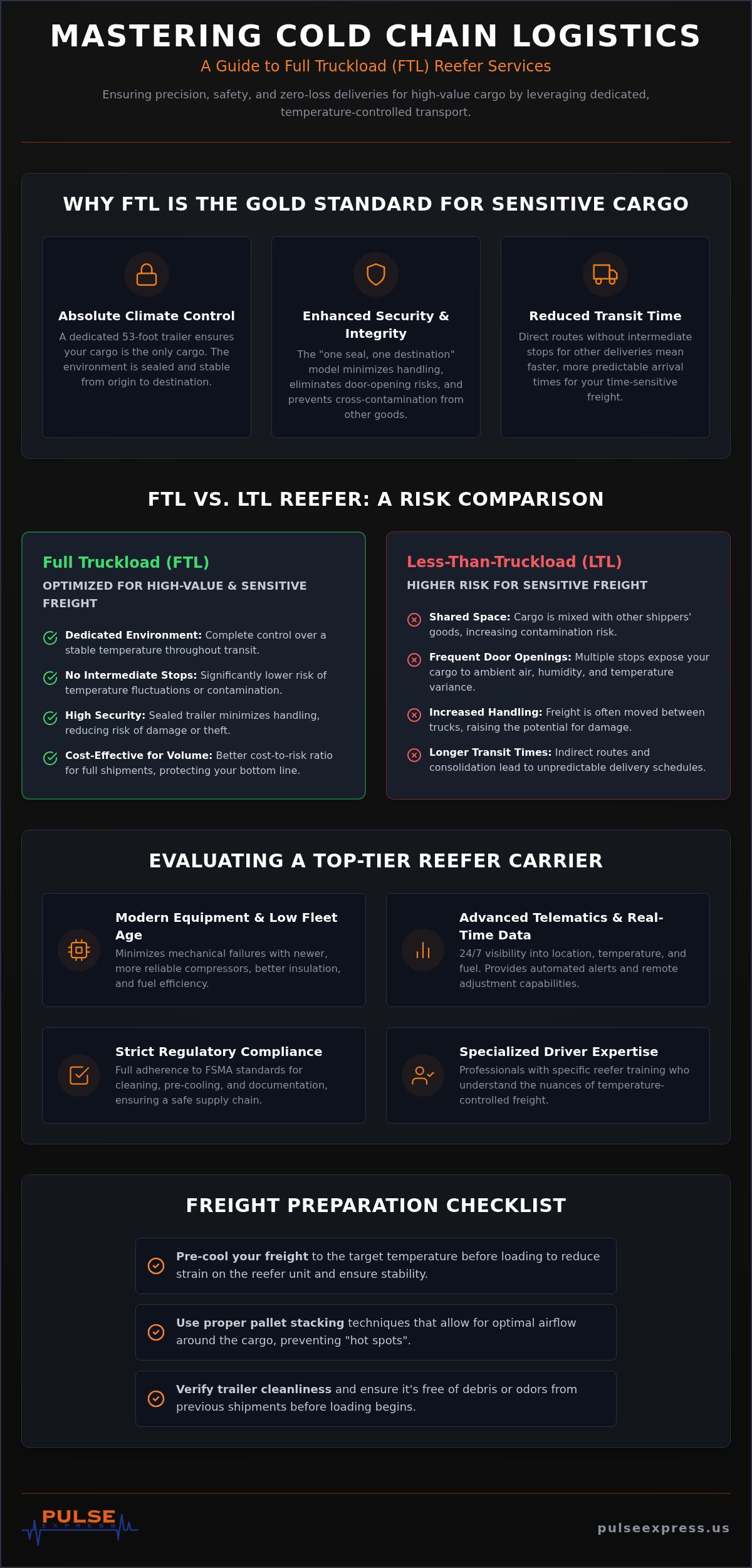
For sensitive freight, FTL is the undisputed gold standard because it eliminates the "door-opening" risks inherent in Less-Than-Truckload (LTL) shipping. Every time an LTL driver stops to offload another shipper's goods, your cargo is exposed to outside air, humidity, and potential contaminants. FTL logistics provide a "one seal, one driver, one destination" security model that keeps the environment stable throughout the journey. This approach minimizes handling and significantly reduces the risk of vibration damage or shifting. Carriers that prioritize hiring CDL drivers with specialized reefer training ensure that your dedicated route is managed with the highest level of professional care and operational stability.
Key Features to Evaluate When Choosing a Reefer Carrier
Selecting a partner for full truckload reefer services requires a deep look into operational stability and technical precision. High-value freight demands a commitment to three specific pillars: modern equipment, technical expertise, and regulatory compliance. Shippers should prioritize fleets with a low average equipment age to minimize the risk of mechanical failures. Newer units provide better insulation, more reliable compressors, and advanced fuel efficiency. This investment in hardware directly translates to the safety and security of your cargo.
Compliance with federal standards is equally non-negotiable. A reliable carrier must demonstrate full adherence to the FDA's Sanitary Transportation of Human and Animal Food rule. This regulation establishes the essential baseline for cleaning, pre-cooling, and documentation. When you vet a carrier, ask for their specific FSMA protocols. A partner that is transparent about their safety records and maintenance schedules provides the reassurance your supply chain needs to thrive.
Telematics and Real-Time Monitoring
The industry has moved past passive logging. In 2026, top-tier carriers utilize active telematics that offer 24/7 visibility into both location and internal trailer conditions. This technology provides automated alerts for door openings, fuel levels, and temperature shifts. If a deviation occurs, remote adjustment capabilities allow the carrier to correct the setpoint instantly. This level of data transparency builds a foundation of trust between you and your over the road logistics partner. It ensures you are never left wondering about the state of your freight while it is in transit.
The Critical Factor: Reefer Hazmat Endorsements
Managing sensitive industrial chemicals often requires a unique intersection of skills. Some products are not only temperature-sensitive but also hazardous. This requires a carrier with specialized Reefer Hazmat Transport capabilities and the proper certifications. You should evaluate a carrier's safety record specifically regarding hazardous materials. It is not enough for a driver to have a standard license; they must understand the chemistry and safety requirements of the cargo. Our focus on hiring CDL drivers who specialize in high-value OTR careers ensures that every load is handled by a professional who prioritizes safety, precision, and reliability. Finding a partner that offers integrated full truckload reefer services for hazardous materials simplifies your logistics and reduces the risk of compliance gaps.
FTL vs. LTL Reefer: Which Service Fits Your Business Goals?
Choosing between FTL and LTL isn't just about pallet count; it's about evaluating the total cost of ownership for your cargo. While LTL might appear cheaper on a per-pallet basis, the hidden costs often outweigh the initial savings. Spoilage, insurance claims, and reduced shelf life are frequent side effects of the multi-stop LTL model. Utilizing full truckload reefer services eliminates these variables by providing a dedicated, sealed environment that remains undisturbed until it reaches its destination. This approach protects your quarterly margins by ensuring that 100% of your product arrives in sellable condition.
Transit speed is another primary differentiator for long-haul OTR routes. FTL shipments move directly from your loading dock to the receiver without the delays of regional hubs or cross-docking. This efficiency is vital for perishable goods where every hour in transit impacts the final quality. Dedicated services also offer superior scheduling flexibility. You can tailor pickup and delivery windows to match your facility's specific operational hours, avoiding the rigid and often unpredictable windows associated with shared freight networks.
Risk Mitigation: Why Fewer Stops Matter
Every stop in an LTL route introduces significant temperature fluctuations. As the doors open to offload other shipments, the internal climate is compromised, forcing the reefer unit to work harder to recover. This is particularly dangerous for "Protect from Freeze" requirements during winter long-haul routes, where even a brief exposure to sub-zero temperatures can ruin sensitive chemicals or liquids. For a deeper look at managing these environmental threats, read our guide on Cold Chain Logistics: The Definitive Reference. Reducing the number of touchpoints is the most effective way to maintain thermal integrity.
Volume and Capacity Considerations
Determining the break-even point between FTL and LTL requires a look at both volume and market stability. Generally, if your shipment occupies more than ten pallets, full truckload reefer services become more economical due to the reduced risk and faster turnaround. Organizations like the Global Cold Chain Alliance emphasize that a consistent thermal environment is the most critical factor in food safety and pharmaceutical efficacy. During seasonal surges, such as peak produce months, dedicated FTL contracts provide price stability and guaranteed capacity. This prevents your business from being subject to the volatile spot market where rates can spike by 20% or more when trucks are scarce.
Preparing Your Freight for Long-Haul Temperature-Controlled Transit
Success in cold chain logistics isn't just about the truck; it's about the preparation. When you utilize full truckload reefer services, you're paying for a controlled environment. However, that environment is only as effective as the cargo's initial state. Proper documentation is the first line of defense. Ensure your Bill of Lading (BOL) explicitly states the required temperature set points and any specific instructions for "continuous run" or "cycle" modes. This clarity prevents ambiguity, establishes a legal record of your expectations, and ensures the driver has the precise data needed for a successful haul.
Beyond documentation, physical protection plays a vital role in high-value shipments. For products with extreme sensitivity, incorporating thermal transport blankets provides an essential layer of secondary insulation. These tools help maintain internal temperatures during the critical moments of loading and unloading when the trailer doors are open. This level of care demonstrates a commitment to precision, safety, and reliability throughout the entire transit process.
The Golden Rule of Pre-Cooling
Shippers must remember that reefer units are designed to maintain temperature, not lower it. Loading warm cargo into a cold trailer creates a "heat sink" effect that the refrigeration unit may never overcome, potentially leading to spoilage at the core of the pallet. This is particularly dangerous for fresh produce or temperature-sensitive chemicals that can generate their own respiratory heat. Cargo must reach its thermal equilibrium through a minimum of 24 hours of pre-cooling to guarantee a stable environment during transit. This step ensures that the refrigeration unit is only fighting ambient heat, not the internal temperature of the freight itself.
Loading Best Practices for Airflow
Airflow is the lifeblood of a temperature-controlled trailer. To ensure consistent cooling, pallets must be loaded to allow for the "chimney effect," where air can circulate freely around and through the cargo. Block loading might maximize space, but it often creates dead zones where heat can accumulate and damage your goods. You can maintain thermal integrity by following these three standards:
- Maintain T-rail floor clearance to allow cold air to return to the refrigeration unit.
- Keep the bulkhead clear to avoid "short-cycling," which occurs when air bounces back too quickly and causes the unit to misread the temperature.
- Secure the load with straps, load bars, or dunnage to prevent shifting during long-haul OTR transit.
Achieving a zero-loss delivery requires attention to detail at every stage of the loading process. If you need a partner that understands these technical nuances, contact Pulse Express for a reefer transport quote today and ensure your freight is handled with expert care.
Pulse Express: Precision Full Truckload Reefer Solutions
Pulse Express defines its service through a commitment to being safe, secure, and seamless. We provide full truckload reefer services that prioritize the integrity of your freight above all else. Our specialized expertise in Reefer Hazmat transport allows us to manage sensitive industrial goods that many standard carriers simply aren't equipped to handle. This niche capability is backed by a fleet of modern trailers featuring the latest telematics, ensuring you have 100% transparency throughout the journey. We believe that stability in the cold chain comes from a combination of advanced technology and professional experience.
The person behind the wheel is the most critical component of a successful delivery. Our focus on professional OTR driver hiring ensures that your cargo is in the hands of seasoned experts who understand the nuances of temperature-sensitive freight. These drivers are trained to manage specialized equipment with a high level of care and attention to detail. This results in better cargo handling, reduced transit times, and a significant decrease in the risk of spoilage. We don't just move freight; we manage a mobile climate-controlled environment with precision.
Nationwide Reach with a Personal Touch
Since our founding in 2000, we've built a reputation for stability and reliability in the logistics industry. Our OTR network spans the entire United States, providing consistent long-haul service for businesses of all sizes. We combine the capabilities of a nationwide carrier with the personalized, solution-focused approach of a dedicated partner. This allows us to solve complex logistics challenges while maintaining a steady, purposeful rhythm that respects your time and your bottom line. Our goal is to instill confidence through established reliability and a deep commitment to operational excellence.
Get Started with Your Cold Chain Evaluation
Every shipment has unique requirements, especially when dealing with Hazmat or pharmaceutical standards. Our experts are ready to consult with you on your specific cargo needs to ensure full compliance and zero-loss delivery. We take the time to understand your business goals, providing a customized approach that simplifies your supply chain. We invite you to contact Pulse Express for a specialized reefer quote today and experience a partnership rooted in safety and precision. Let us help you protect your high-value cargo with full truckload reefer services designed for the modern shipper.
Securing the Future of Your Cold Chain
Mastering the intricacies of temperature-controlled logistics requires a blend of technical precision, specialized equipment, and operational stability. By choosing full truckload reefer services, you eliminate the risks of multi-stop transit and ensure your cargo remains in a dedicated, sealed environment. Success in the cold chain starts with rigorous pre-cooling and ends with a partner who prioritizes real-time visibility and regulatory compliance. These proactive steps safeguard your quarterly margins and your professional reputation.
Pulse Express brings over 25 years of OTR expertise to every shipment. Our specialized Reefer Hazmat certification and advanced real-time telematics provide the transparency you need for high-value cargo. We're committed to delivering a logistics experience that is safe, secure, and seamless. You don't have to manage these complexities alone; we're here to guide you toward a more reliable and efficient supply chain. Request a Specialized FTL Reefer Quote from Pulse Express today. We look forward to helping your business grow through precision and partnership.
Frequently Asked Questions
What is the difference between FTL and LTL reefer services?
FTL uses the entire 53-foot trailer for one shipper, while LTL shares space among multiple clients. FTL offers a dedicated environment with no door-opening risks at intermediate stops. This reduces temperature fluctuations and significantly shortens transit times. Most high-value shippers choose full truckload reefer services to ensure total climate control from origin to destination. It's the preferred choice for freight that requires a single, sealed environment for the duration of the trip.
Can full truckload reefer services handle hazardous materials?
Yes, specialized carriers like Pulse Express are equipped to manage both temperature-controlled and hazardous freight simultaneously. This requires specific equipment and Reefer Hazmat Transport certifications. We handle sensitive industrial chemicals that must stay within a strict thermal range to remain stable. Not all reefer providers offer this dual capability, so it's vital to verify a carrier's safety record and Hazmat endorsements before booking your shipment for these complex loads.
How does Pulse Express ensure temperature integrity during long-haul transit?
We combine advanced technology with established operational protocols to protect every load. Our fleet consists of modern trailers with high-grade insulation and precision airflow systems. We utilize active telematics to monitor internal conditions 24/7, allowing for immediate remote adjustments if needed. Our professional CDL A drivers follow strict pre-cooling requirements and loading best practices. This three-pronged approach ensures your cargo remains safe, secure, and seamless throughout its long-haul journey across the country.
What industries benefit most from dedicated FTL reefer shipping?
Industries with high-value or highly sensitive products gain the most from dedicated transport. This includes pharmaceutical companies moving life-saving medications and food producers shipping fresh, perishable produce. Additionally, industrial chemical manufacturers rely on full truckload reefer services to prevent dangerous reactions in heat-sensitive materials. Any business that cannot afford the risks of cross-contamination or temperature variance at multiple stops should prioritize a dedicated FTL solution for their logistics to ensure product efficacy.
How should I prepare my warehouse for a reefer pickup?
Preparation starts with pre-cooling your cargo to the target temperature at least 24 hours before the trailer arrives. Your warehouse team should also ensure the loading dock is clear and that the Bill of Lading clearly states the required set points. During loading, maintain floor clearance for air circulation and avoid blocking the bulkhead. These steps help the reefer unit maintain a stable climate from the moment the doors are sealed for transit.
What happens if there is a temperature excursion during a reefer haul?
Our real-time monitoring systems trigger automated alerts the moment a temperature deviation is detected. This allows our dispatch team or the driver to intervene immediately, often correcting the issue through remote setpoint adjustments. We provide full transparency by sharing temperature logs and excursion reports with you. If a mechanical failure occurs, our established OTR network allows us to provide rapid support to protect your freight and minimize any potential loss during the journey.
Are your reefer drivers trained in Hazmat handling?
Every driver at Pulse Express who handles hazardous materials must maintain a current Hazmat endorsement on their Class A CDL. We focus on hiring experienced OTR professionals who understand the specific safety requirements of sensitive chemicals. This includes knowledge of proper placarding, segregation rules, and emergency response protocols. Our drivers aren't just operators; they're trained specialists who take personal responsibility for the safety and integrity of your most complex and sensitive freight shipments.
How do you monitor reefer units in real-time across the country?
We utilize AI-driven telematics integrated into every reefer unit in our fleet. This system streams data on location, ambient air temperature, and fuel levels directly to our centralized monitoring hub. We can see if doors are open or if the unit has switched from continuous run to cycle mode. This nationwide visibility ensures that we can maintain total environmental command, providing you with verifiable data-backed proof of a stable and secure cold chain.


