

Could a single layer of specialized fabric be the difference between a successful 2,000-mile delivery and a total loss of high-value chemical cargo? In the world of long-haul logistics, the margin for error is razor-thin. You already know that keeping sensitive freight within a strict temperature range requires more than just a powerful refrigeration unit. It demands precision, constant monitoring, and a deep commitment to safety. When you rely on reefer hazmat transport services, you're looking for solutions that offer reliability, efficiency, and total peace of mind.
This article will help you master the essentials of thermal transport blankets to ensure total cold chain integrity for your most sensitive OTR shipments. We'll examine how these passive cooling tools work in tandem with active systems to protect your cargo from spoilage. You will learn how to reduce energy costs through hybrid cooling, maintain compliance for pharma and hazmat loads, and leverage the expertise of seasoned drivers. We'll show you how to combine active and passive technologies to create a secure, stable, and cost-effective environment for every mile of the journey.
Key Takeaways
- Master the science of thermal conductivity and dead air space to effectively block heat transfer during long-haul transit.
- Evaluate the strengths of active refrigeration versus passive insulation to build a redundant, cost-effective shipping strategy.
- See how reefer hazmat transport services implement thermal blankets as a vital fail-safe for stabilizing volatile industrial chemicals.
- Protect high-value pharmaceutical biologics by eliminating the minor temperature fluctuations that often lead to cargo spoilage.
- Partner with experienced OTR drivers who provide the precision, safety, and manual monitoring required for sensitive freight.
Defining Thermal Transport Blankets in Temperature Controlled Logistics
Thermal transport blankets are heavy-duty, multi-layered insulating covers engineered to maintain internal cargo temperatures by blocking external environmental heat. As we look toward the cold chain requirements of 2026, passive insulation has moved from an optional accessory to a core requirement for high-stakes freight. Pulse Express, an industry leader since 2000, considers these blankets essential for long-haul OTR reliability. They provide a vital layer of security that complements our specialized reefer and dry van equipment. Our team views these tools as a critical fail-safe that ensures cargo remains stable even during unforeseen transit delays.
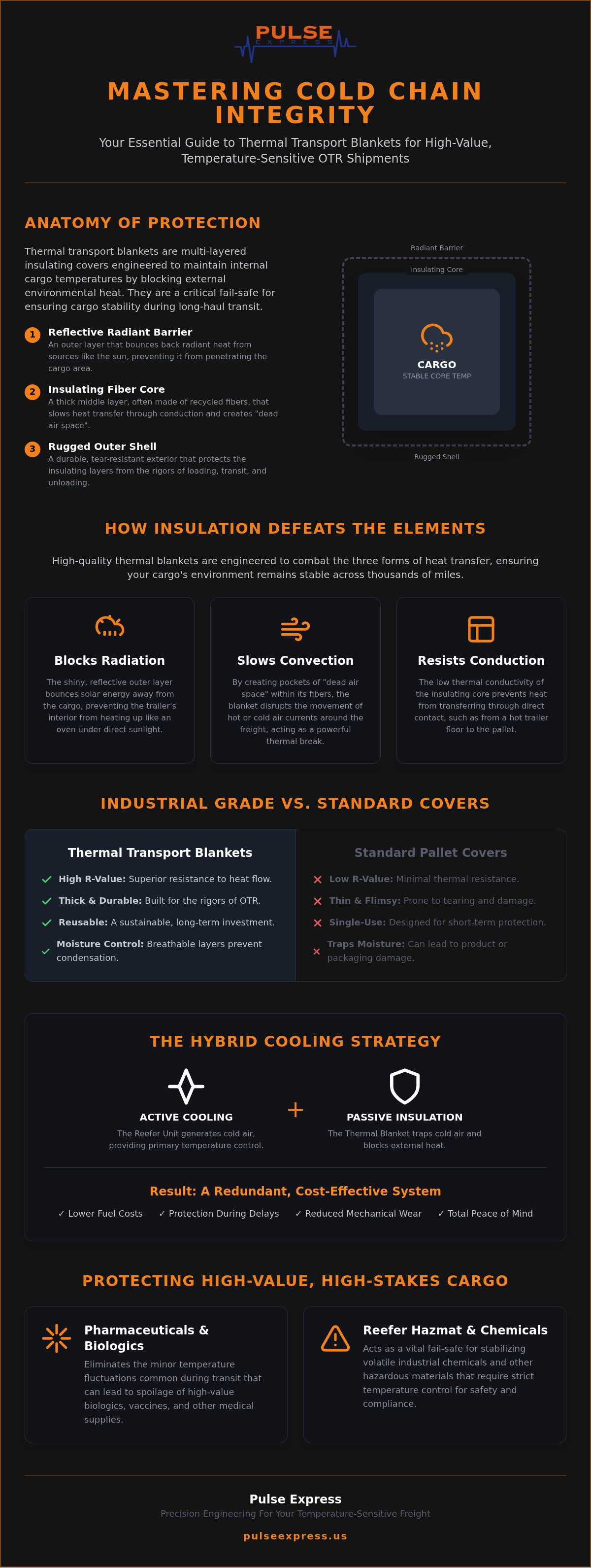
These blankets typically consist of three primary layers: a reflective radiant barrier to bounce back radiant heat, a core of recycled insulating fibers to slow conduction, and a rugged, tear-resistant outer shell. Together, these elements create a robust defense against temperature excursions during thousand-mile journeys across diverse climates. By utilizing these specialized materials, shippers can achieve a level of protection that active cooling alone can't always guarantee. This layered approach is particularly effective when managing the complex requirements of reefer hazmat transport services.
How Thermal Blankets Differ from Standard Pallet Covers
Standard pallet covers are often thin and designed for short-term protection during cross-docking or brief storage. In contrast, industrial-grade thermal blankets used in reefer hazmat transport services offer significantly higher material thickness and thermal resistance. The R-value measures a material's capacity to resist heat flow; in freight insulation, a higher R-value indicates superior effectiveness at maintaining a stable internal environment against external temperature gradients. While single-use covers might suffice for local deliveries, reusable industrial blankets are the standard for professional OTR routes. They're built to withstand the rigors of frequent loading, securing, and unloading without losing their insulating properties.
The Core Purpose: Temperature Stability and Protection
The primary goal of a thermal blanket is to provide a consistent environment for sensitive goods. This protection is most critical during the first and last mile where cargo is often exposed to extreme ambient heat on loading docks before trailer doors are sealed. For certain non-reefer hazmat shipments, these blankets act as a thermal buffer to prevent freezing in harsh winter climates. By trapping the cargo's existing temperature, they reduce the workload on active reefer units. This leads to lower fuel consumption, reduced mechanical wear, and a more sustainable shipping process. Our Class A CDL drivers rely on this partnership between active technology and passive protection to deliver every shipment with the care it deserves.
The Science of Thermal Protection: How Insulation Safeguards Cargo
Protecting sensitive cargo requires a fundamental understanding of thermodynamics. It isn't enough to simply cover a pallet; we must actively manage the three ways heat moves. Conduction occurs through direct contact between materials. Convection involves the movement of air around the cargo. Radiation is the transfer of energy through electromagnetic waves, such as sunlight hitting a trailer roof. High-quality thermal blankets are engineered to address all three energy transfers simultaneously. This scientific approach is what allows reefer hazmat transport services to maintain stability across thousands of miles and varying climate zones.
One of the most effective features of these blankets is the creation of dead air space. By trapping thin layers of air between specialized fabric plies, the blanket creates a powerful thermal break. Because air is a poor conductor of heat, these pockets significantly slow the rate of temperature change. Moisture control is another vital factor during cross-country transit. As trailers move through different humidity levels, condensation can form on the cargo. Professional-grade blankets incorporate breathable layers that prevent moisture buildup, protecting both the product and its packaging from degradation.
Understanding R-Values and Thermal Resistance
The R-value is a standard measurement of a material's resistance to heat flow. For a shipper, a higher R-value provides greater peace of mind and a wider safety margin during transit. You should choose the thickness of your insulation based on three factors: the total transit time, the specific temperature sensitivity of your goods, and the expected external conditions. A shipment moving through the extreme heat of the desert requires a different insulation profile than one traveling through a temperate coastal region. Pulse Express utilizes this technical data to enhance our reefer hazmat transport services, ensuring every load is protected by more than just a thermostat. If you need a partner who understands the technical side of safety, you can explore our specialized freight solutions to see how we prioritize cargo integrity.
Radiant Barriers and Heat Reflection
Radiant barriers are a critical component in modern freight protection. These layers typically use aluminum or metalized films to reflect up to 97% of radiant heat away from the cargo. In a standard dry van, the interior can become a "hot box" as the sun beats down on the trailer's exterior. Reflective barriers prevent this heat from being absorbed by the freight, maintaining a stable internal environment regardless of the sun's intensity. Radiant barriers in OTR transport significantly reduce the thermal load on cargo by reflecting infrared energy away from the trailer's interior. This reflection ensures that the temperature you set at the start of the trip is the temperature that arrives at the destination.
Active vs. Passive Solutions: Comparing Reefers and Thermal Blankets
Choosing between active and passive cooling is one of the most critical decisions in temperature-controlled logistics. Active refrigeration units provide precise temperature control, constant air circulation, and real-time monitoring. While these systems are highly effective, they also involve higher operating costs, require consistent fuel levels, and carry the inherent risk of mechanical failure. Passive insulation offers a different set of benefits for reefer hazmat transport services. These solutions require no power, involve zero maintenance, and provide a fail-safe environment that cannot break down.
Pulse Express has spent over 25 years refining how we deploy these tools to maximize cargo safety. We don't view this as an "either-or" choice, but rather as a strategic decision based on the specific needs of your nationwide logistics. Our team evaluates the sensitivity of your goods, the duration of the haul, and the expected climate shifts to determine the most reliable equipment profile. This methodical approach ensures that your freight is protected by the most efficient combination of technology and professional handling.
When to Choose Thermal Blankets Over Active Reefers
There are specific scenarios where passive blankets are the superior choice. For short-duration transits involving products with high thermal mass, such as bulk industrial liquids, blankets are often sufficient to maintain stability. They're also an excellent tool for "Keep From Freezing" (KFF) requirements in standard dry vans during winter. This allows for cost-saving strategies on less sensitive OTR freight without sacrificing regulatory compliance. Choosing the right equipment profile is a hallmark of professional reefer hazmat transport services. It requires a partner who understands where passive insulation can safely replace active systems.
The Critical Fail-Safe: Why Hybrid Solutions Win
The most secure method for transporting sensitive pharma or hazmat goods is the hybrid approach. By placing thermal blankets over cargo within a reefer trailer, you create a secondary line of defense. This "belt and braces" strategy protects the load during reefer unit downtime, refueling stops, or unexpected mechanical issues. It also allows for maintaining micro-climates for mixed loads within a single trailer, ensuring that different products stay within their required ranges. To understand how these strategies fit into the broader industry, see our guide on Cold Chain Logistics: The Definitive Reference for Temperature-Controlled Freight. This redundancy provides the stability, security, and peace of mind that modern shippers demand.
Industry-Specific Uses for Thermal Freight Blankets
Thermal freight blankets aren't a one-size-fits-all solution; they're specialized tools adapted for diverse industrial needs. In the food and beverage sector, they maintain the cool chain for dairy and produce during grueling cross-country hauls. For industrial electronics, these blankets act as a shield against condensation, static, and extreme heat that can ruin sensitive circuits. By creating a stable micro-environment, they provide a level of protection that standard trailers simply can't match. This targeted approach ensures that every shipment, regardless of its industry, arrives in peak condition.
The versatility of these blankets allows Pulse Express to customize our approach for every client. Since 2000, we've focused on the secure long-haul delivery of sensitive industrial goods. We understand that a shipment of semiconductors requires a different thermal profile than a load of organic produce. By integrating passive insulation into our standard operating procedures, we enhance the reliability of our OTR routes. We prioritize precision, safety, and cargo integrity for every mile of the journey.
Hazmat and Chemical Safety Standards
Chemical stability is paramount when moving hazardous materials over long distances. Thermal blankets play a vital role in preventing thermal runaway, a dangerous condition where a chemical's temperature rises uncontrollably. According to DOT safety guidelines, maintaining specific temperature ranges is often a regulatory requirement for certain classes of hazardous goods. Our specialized reefer hazmat transport services combine these passive barriers with active monitoring to ensure total cargo stability. We focus on safe handling, regulatory compliance, and environmental protection. Pulse Express leverages over 25 years of expertise to manage these volatile loads with the highest level of care.
Pharmaceutical Cold Chain Integrity
Pharmaceutical logistics require an even higher level of precision to meet strict FDA and Controlled Room Temperature (CRT) standards. Life-saving vaccines and biologics can lose their efficacy if exposed to even minor temperature fluctuations. Thermal blankets extend the safe window during loading dock exposures, where cargo is most vulnerable to ambient air. It's a system built on precision, timing, and care. This high-stakes work requires the expertise of seasoned professionals who understand the weight of their cargo. If you're interested in joining a team that handles these critical shipments, check out our guide on Hiring CDL Drivers in 2026: A Guide to High-Value OTR Careers. To secure your own sensitive supply chain, contact our logistics team for a reefer hazmat transport services consultation today and experience the Pulse Express difference.
Pulse Express: Precision Engineering for Your Temperature-Sensitive Freight
Technology alone isn't enough to secure a complex supply chain. At Pulse Express, we believe that precision engineering must be paired with human expertise. Since our founding in 2000, we've focused on the secure, long-distance transportation of high-value industrial goods. Our specialized fleet is equipped to manage both active reefer units and passive thermal blanket solutions. This dual-layered approach is central to our reefer hazmat transport services. We understand that your cargo represents more than just a shipment; it represents your reputation and your bottom line. Every mile is managed with a focus on stability, safety, and operational excellence.
Partnering with a carrier that understands the stakes of temperature-controlled logistics is vital for your growth. We don't just move freight; we provide a sense of established reliability that instills confidence. Our methodical approach flows from a deep understanding of thermodynamics to the practical application of cargo protection. We treat every load as if it were our own, ensuring that sensitive materials arrive exactly as intended. This commitment to quality has defined our business for over 25 years.
Expert Drivers for Sensitive Logistics
The success of any temperature-controlled route rests on the person behind the wheel. Our Class A CDL drivers receive specialized training in thermal management and the nuances of hazardous material handling. They don't just drive; they monitor, verify, and protect. Our drivers ensure proper blanket placement to eliminate thermal gaps and perform precise reefer calibration throughout the journey. This level of manual oversight provides a layer of security that automated systems can't replicate. We build trust through operational excellence, driver reliability, and a commitment to safety. When you partner with us, you're working with professionals who treat your cargo with the highest level of care.
Your Partner for Nationwide OTR Excellence
Scalability and reliability are the cornerstones of our service model. Whether you need general freight, hazmat transport, or specialized refrigerated solutions, we have the capacity to meet your needs. The vision of Adelina Pavlov is rooted in reassurance, stability, and expert partnership. We aim to be more than a carrier; we strive to be a seasoned guide for your logistics challenges. Our reefer hazmat transport services are designed to handle the most sensitive OTR shipments across thousands of miles. We provide the stability you need to grow your business with confidence. If you're looking for a reliable cold chain partner to secure your sensitive freight, reach out to Pulse Express today. We're ready to help you maintain the integrity of every shipment you trust to our care.
Secure Your Supply Chain with Thermal Precision
Mastering the science of thermal transport blankets is a critical step in achieving total cold chain integrity. These tools provide a robust barrier against heat transfer, moisture, and external climate shifts. By integrating passive insulation with active refrigeration, you build a redundant system that safeguards your most sensitive shipments from loading dock to final delivery. This hybrid approach is especially vital for reefer hazmat transport services where the margin for error is non-existent. You deserve a partner that understands the technical nuances of thermodynamics and the practical demands of the road.
Pulse Express has provided specialized OTR logistics since 2000. Our professional Class A CDL drivers are experts in managing both active and passive cooling systems for Hazmat and refrigerated cargo. We prioritize safe handling, precise monitoring, and operational excellence to ensure your freight arrives in peak condition. If you're ready to enhance your shipping reliability, Request a Quote for Temperature-Controlled Freight Solutions today. Let's work together to build a more stable and secure future for your sensitive logistics.
Frequently Asked Questions
What is the difference between a thermal blanket and a pallet cover?
Thermal blankets are multi-layered, industrial-grade insulating covers designed for long-haul temperature maintenance, whereas standard pallet covers are often single-layer and intended for short-term protection during loading. Blankets feature high R-values and durable outer shells to survive the rigors of over the road transport. While covers might block dust or light rain, blankets actively resist heat transfer through conduction and radiation. This makes them a superior choice for sensitive cargo.
How long can a thermal transport blanket maintain cargo temperature?
A thermal transport blanket can typically maintain cargo temperature for 24 to 72 hours, depending on the cargo's thermal mass and the external environment. High-density liquids retain their temperature longer than lightweight electronics. In professional reefer hazmat transport services, these blankets are often used to extend the safety window during loading or as a fail-safe. The exact duration varies based on the temperature gradient between the trailer and the ambient air.
Are thermal blankets effective for hazardous material transport?
Yes, thermal blankets are highly effective for hazardous material transport because they stabilize chemicals that are sensitive to temperature spikes. They help prevent thermal runaway and ensure cargo stays within regulatory compliance ranges. Pulse Express uses these blankets to provide a redundant layer of protection alongside active refrigeration. This combination is essential for maintaining the chemical integrity of volatile industrial goods during long-distance OTR hauls across varying climate zones.
Can I use thermal blankets in a standard dry van trailer?
You can use thermal blankets in a standard dry van trailer for "Keep From Freezing" (KFF) shipments or goods with high thermal mass. This passive approach is a cost-effective way to manage less sensitive freight without the expense of active refrigeration. However, for highly volatile chemicals or biologics, we recommend combining blankets with reefer hazmat transport services. This ensures that the cargo has a constant, monitored power source to maintain its required temperature range.
Do thermal blankets protect against freezing as well as heat?
Thermal blankets protect against both freezing and heat by slowing the rate of energy transfer between the cargo and the trailer environment. In cold climates, they trap the existing heat of the freight to prevent it from reaching the freezing point. In hot climates, their reflective layers bounce radiant heat away from the load. This dual-purpose insulation makes them a versatile tool for year-round OTR logistics across the entire United States.
How do I calculate the R-value needed for my OTR shipment?
Calculating the necessary R-value requires evaluating the specific temperature sensitivity of your product, the expected transit time, and the extreme ambient temperatures of your route. A higher R-value indicates better resistance to heat flow and provides a wider safety margin. Our experienced team helps shippers determine the right insulation thickness to ensure cargo stability. We consider the thermal mass of the load and the performance specs of our specialized reefer equipment.
Are thermal transport blankets reusable or single-use?
Most industrial-grade thermal transport blankets used in professional logistics are reusable and designed for multiple OTR trips. They feature rugged, tear-resistant outer shells that withstand the constant handling required during loading and unloading. While single-use liners exist for specific pharmaceutical applications, our focus on sustainability and durability favors high-quality reusable blankets. This approach reduces waste while providing consistent, reliable protection for sensitive industrial freight over thousands of miles.


