

In 2026, the difference between a resilient supply chain and a total logistical breakdown often comes down to a single, specialized trailer. Identifying the right long haul hazmat trucking companies is no longer just about moving goods; it's about protecting your brand, your cargo, and your peace of mind. You've likely felt the sting of supply chain delays or the anxiety of ever-changing safety compliance. It's a high-stakes environment where driver turnover and aging equipment can threaten your most critical operations.
We understand that you need more than a vendor; you need a seasoned guide that is personally invested in your success. This guide helps you navigate these challenges by revealing how modern OTR logistics operate today and what defines a truly professional partner. You'll discover the specific markers of reliability, safety, and operational excellence that distinguish industry leaders from the rest of the pack.
We'll break down the essential safety requirements for reefer and hazmat freight, explore how to spot stable carriers, and examine the career opportunities that keep the best professionals on the road. By the end, you'll have a clear roadmap for securing your freight and building a partnership rooted in stability, precision, and trust.
Key Takeaways
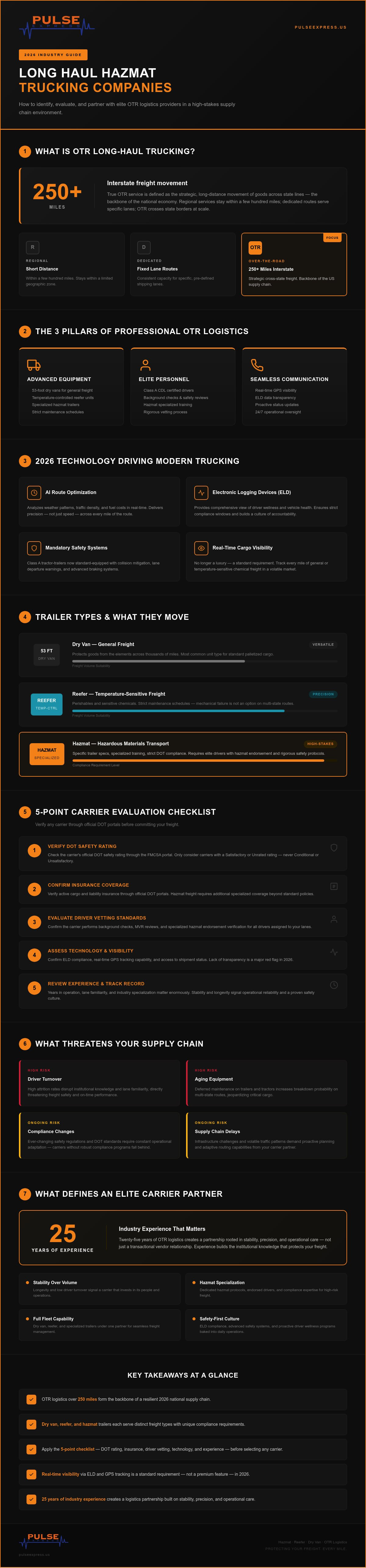
- Understand how OTR logistics over 250 miles serve as the backbone of a resilient 2026 national supply chain.
- Identify the essential equipment required for secure transport, including dry van, reefer, and specialized hazmat units.
- Learn the rigorous safety protocols and regulatory standards that distinguish elite long haul hazmat trucking companies.
- Apply a professional five-point checklist to verify carrier safety ratings and insurance through official DOT portals.
- Discover how twenty-five years of industry experience creates a partnership rooted in stability, precision, and operational care.
The Evolution of US Long Haul Trucking Services in 2026
The American supply chain relies on the steady pulse of interstate transit. In 2026, long haul trucking has moved beyond simple delivery to become a high-tech, precision-driven discipline. This evolution is driven by a need for greater stability, enhanced safety, and absolute transparency. Shippers now look for long haul hazmat trucking companies that offer more than just a truck; they seek integrated partners capable of managing complex, sensitive cargo across thousands of miles. This shift toward integrated logistics means that real-time visibility is no longer a luxury but a standard requirement. Whether you're moving general freight or temperature-sensitive chemicals, the ability to track every mile provides the reassurance needed in a volatile market. Specialized freight handling has become the cornerstone of the modern economy, ensuring that essential goods reach their destination without compromise.
Defining the Modern OTR Landscape
Understanding the distinctions in today's market is essential for operational efficiency. Regional services typically stay within a few hundred miles, while dedicated routes provide consistent capacity for specific lanes. True long-haul over-the-road (OTR) services specialize in the interstate movement of freight over 250 miles. The current state of US highway infrastructure, while undergoing significant modernization, still presents challenges that require expert navigation and proactive planning. Success in this environment depends on a carrier's ability to adapt to shifting traffic patterns and infrastructure developments. In the context of 2026 logistics, OTR trucking is defined as the strategic, long-distance movement of goods across state lines to ensure the continuous flow of the national economy.
The Impact of Technology on 2026 Long-Distance Freight
Technology is the silent engine behind modern trucking. AI-driven route optimization now analyzes weather patterns, traffic density, and fuel costs in real-time to maximize efficiency. This isn't just about speed; it's about precision. Class A tractor-trailers now come standard with mandatory safety technology, including collision mitigation, lane departure warnings, and advanced braking systems. These tools support the driver and protect the cargo from the unpredictable nature of the road. Electronic Logging Device (ELD) data has also matured. It now provides a comprehensive view of driver wellness and vehicle health. This data ensures that long haul hazmat trucking companies maintain strict compliance windows, prioritizing driver safety above all else. These systems create a culture of accountability that protects the driver, the cargo, and every other traveler on the road.
Core Components of Professional OTR Logistics
Professional OTR logistics require a foundation built on three pillars: advanced equipment, elite personnel, and seamless communication. For shippers, this combination ensures that cargo moves efficiently across state lines without interruption. Leading long haul hazmat trucking companies prioritize these components to maintain the highest levels of operational excellence. This commitment to quality creates a sense of established reliability that clients can trust through every mile of the journey.
Equipment Standards for Nationwide Transport
The choice of equipment determines the safety and integrity of the shipment. Standard 53-foot dry vans provide the versatility needed for general freight, protecting goods from the elements across thousands of miles. In contrast, temperature-controlled reefer units offer the precision required for perishables and sensitive chemicals. These units must adhere to strict maintenance schedules; mechanical failure is not an option on multi-state routes. High-value cargo often requires sensitive freight transportation services that utilize specific trailer specifications to mitigate risk and ensure stability.
The Human Element: Class A CDL Expertise
While the truck carries the load, the driver carries the responsibility. Experience remains the primary factor in ensuring freight safety. Professional OTR drivers undergo a rigorous vetting process that includes background checks, safety performance reviews, and specialized training for hazardous materials. This expertise is vital for navigating the complexities of modern highways and maintaining compliance. For those looking to join an established team, exploring CDL A long haul driver careers provides a path toward a stable and rewarding professional future.
Reliability in long-distance hauling also demands nationwide coverage and clear communication protocols. Dispatchers, drivers, and shippers must remain in constant alignment to handle the variables of the road. A safety-first standard is non-negotiable when managing high-value or hazardous cargo. This approach protects your investment, maintains the integrity of the supply chain, and ensures peace of mind. When evaluating long haul hazmat trucking companies, look for this blend of technical capability and human expertise. If you're ready to partner with a carrier that values precision and safety, consider how our nationwide OTR solutions can support your business goals.
Navigating Specialized Freight: Hazmat and Reefer Services
Moving specialized freight across the United States requires a level of precision that standard carriers simply can't match. When you're dealing with hazardous materials or temperature-sensitive goods, the margin for error disappears. Long haul hazmat trucking companies operate under a rigorous framework of federal regulations designed to protect the public and the environment. These rules govern everything from the specific routes a driver can take to the documentation that must remain in the cab at all times. This complexity demands a partner that treats compliance as a core value rather than a checklist.
A unique challenge arises when cargo requires both hazardous material handling and climate control. This intersection, known as reefer hazmat, requires specialized trailers equipped with redundant cooling systems and drivers who understand the chemical properties of their load. Top-tier carriers use advanced risk mitigation strategies, such as geofencing sensitive routes and maintaining 24/7 safety desks, to ensure these high-stakes shipments arrive without incident. This protective approach provides the stability needed for industries ranging from pharmaceuticals to industrial chemicals.
Hazmat Compliance and Safety Standards
Safety in this sector starts with the professional behind the wheel. Drivers must hold specific Class A endorsements, such as the H or X endorsement, which require thorough background checks and specialized testing. Beyond the driver's credentials, every shipment must adhere to strict placarding and documentation requirements. These visual markers are essential for interstate transit, allowing first responders to identify cargo quickly if an incident occurs. For a deeper look at these regulatory hurdles and how to stay ahead of them, you can explore our guide on specialized hazmat logistics.
The Cold Chain: Long-Distance Refrigerated Shipping
Maintaining a consistent environment for perishable goods is a significant challenge when traversing varied climates. A truck might start its journey in the humid Southeast and end in the frigid Pacific Northwest. Modern 2026 reefer units solve this through integrated remote temperature monitoring. This technology allows dispatchers to adjust settings and receive alerts instantly if a deviation occurs, protecting the cargo from spoilage. Keeping up with cross country refrigerated freight trends is essential for shippers who need to maintain the integrity of their cold chain over thousands of miles. These systems ensure that your products remain within the required temperature range from the moment they're loaded until they reach their final destination.
Evaluation Framework: Choosing the Right Long-Haul Partner
Selecting a logistics partner is a strategic decision that directly impacts your brand's reputation and bottom line. When you evaluate long haul hazmat trucking companies, you aren't just buying space on a trailer; you're investing in a safety culture and a commitment to operational excellence. A professional partner should offer transparency, stability, and specialized expertise. Use the following five-point checklist to vet potential OTR carriers: verify their asset ownership, review their safety scores, assess their financial health, confirm their driver retention rates, and test their communication technology. This methodical approach ensures that your cargo remains in capable hands from origin to destination.
Safety Ratings and Compliance Records
The Federal Motor Carrier Safety Administration (FMCSA) provides the Safety Measurement System (SMS) as a public tool for shippers. You can use this data to identify patterns in a carrier's history, focusing on categories like crash indicator, hours-of-service compliance, and vehicle maintenance. A "Satisfactory" safety rating is the highest standard, indicating that the carrier has functional safety management controls in place. Red flags include frequent roadside inspection failures or a high frequency of preventable accidents. These metrics are not just numbers; they are a direct reflection of how a carrier values your cargo and the safety of the motoring public.
Carrier vs. Broker: Understanding the Difference
Working directly with an asset-based carrier offers distinct advantages over using a third-party broker. Asset-based partners own their equipment and employ their drivers, which creates a shorter line of communication and greater accountability. This direct relationship reduces the risk of "cargo blind spots" where information gets lost between multiple parties. Furthermore, carriers that focus on hiring CDL A reefer drivers directly can ensure that every professional behind the wheel meets their specific internal safety standards. This investment in personnel translates to higher service quality and fewer disruptions for your high-value shipments.
Financial stability is another hallmark of a reliable long-haul partner. A carrier that consistently reinvests in a modern fleet and advanced safety technology is better positioned to handle the challenges of 2026 logistics. This financial health ensures they can maintain rigorous maintenance schedules and offer competitive compensation to attract elite drivers. If you're looking for a partner that combines 25 years of experience with a modern, safety-first approach, we invite you to learn more about our specialized OTR services and how we can secure your supply chain.
Pulse Express: Setting the Standard for US Long-Haul Trucking
Pulse Express has served as a trusted guide in the US logistics market since 2000. For over 25 years, we've bridged the gap between global corporate capability and the personal touch of a service-oriented partner. Our organization is built on a culture of reassurance, stability, and operational excellence. We don't just move freight; we secure the future of your supply chain through a relentless focus on precision. This approach allows us to manage everything from standard dry van shipments to the most sensitive reefer and hazmat loads with absolute confidence. We invite you to experience a partnership where your success is our primary objective.
Our Asset-Based Reliability
Operating as an asset-based carrier gives us the unique ability to guarantee quality across every mile. We own our fleet, maintain our equipment, and employ our drivers directly. This structure eliminates the uncertainty often found when working with third-party brokers. Among long haul hazmat trucking companies, Pulse Express stands out for its specialized equipment and rigorous safety protocols. Our reefer units and dry vans are equipped with the latest 2026 monitoring technology to ensure cargo integrity. We provide nationwide OTR coverage while maintaining the high level of care and attention to detail that our partners have come to expect. Our goal is to provide a seamless, supportive, and solution-focused experience for every shipment.
Join the Pulse Express Fleet
We believe that professional driver hiring and secure freight delivery are two sides of the same coin. An elite fleet requires elite drivers who are treated as valued partners. For Class A CDL professionals seeking long-haul success, we offer a career path rooted in stability and mutual growth. Our focus on driver safety isn't just a policy; it's a core value that protects our people and our clients' cargo. We provide the modern equipment and the technological support necessary for you to excel on the road. We value the expertise you bring to the table and are committed to your long-term success as part of our close-knit team.
Choosing a long-haul partner is about more than just finding a truck. It's about finding a seasoned guide that is personally invested in your operational success. Whether you're a shipper looking for a reliable carrier or a driver looking for a professional home, we invite you to join a network built on twenty-five years of excellence. If you are ready to experience the difference that a dedicated partner can make, Join the Pulse Express OTR Fleet today. Together, we can navigate the complexities of the 2026 landscape with precision, safety, and trust.
Securing Your Supply Chain in the 2026 Landscape
Modern logistics demands more than just transportation; it requires a commitment to safety, precision, and operational excellence. We've explored how the OTR landscape has evolved to prioritize real-time visibility and specialized handling. Selecting the right partner from the field of long haul hazmat trucking companies involves a careful evaluation of safety ratings, equipment standards, and financial stability. By focusing on these core components, you can build a supply chain that is both resilient and efficient. Stability is your greatest asset. This organized approach ensures your cargo moves without interruption across state lines.
Pulse Express is ready to be your expert guide in this complex environment. Since our founding in 2000, we've maintained a safety-first culture for every shipment we handle. Our specialized hazmat and reefer certifications, combined with our nationwide asset-based fleet, provide the stability your business needs to thrive. We offer the professional authority of a global leader with the personal investment of a dedicated, service-oriented partner. We're committed to your operational success every mile of the way.
Partner with Pulse Express for Reliable Long-Haul Logistics
Let's work together to drive your success forward and keep your business moving with confidence.
Frequently Asked Questions
What qualifies as a long-haul trucking service in the US?
Long-haul trucking, also known as over-the-road (OTR) service, typically refers to the interstate movement of freight over distances exceeding 250 miles. Unlike regional drivers who return home daily, OTR professionals travel across multiple states and regions to deliver cargo. This service is the backbone of the national supply chain, ensuring that goods move efficiently from production hubs to distant markets. It requires specialized equipment and experienced drivers capable of managing extended periods on the road.
How do hazmat trucking companies ensure safety during long-distance transit?
Elite long haul hazmat trucking companies utilize a combination of specialized driver training, rigorous equipment maintenance, and advanced route planning to maintain safety. Drivers must hold specific endorsements and undergo thorough background checks. Trailers are equipped with the necessary placarding and safety technology to mitigate risks. By following strict federal regulations and using real-time monitoring systems, these carriers protect both the sensitive cargo and the motoring public throughout the entire journey across the country.
What are the requirements for a Class A CDL OTR driver in 2026?
In 2026, a professional OTR driver must hold a valid Class A CDL and maintain a clean safety performance history. For those handling specialized freight, endorsements like the H (Hazmat) or X (Tanker/Hazmat) are essential. Drivers must be proficient with modern Electronic Logging Devices (ELD) and integrated safety technology standard in late-model tractors. Beyond technical skills, successful long-haul professionals demonstrate strong communication abilities and a commitment to operational excellence during multi-state transit across the national network.
Why is reefer hazmat transport more complex than standard refrigerated shipping?
Reefer hazmat transport combines the challenges of temperature stability with the strict regulatory requirements of hazardous material handling. This service requires specialized trailers with redundant cooling systems to prevent chemical reactions caused by temperature fluctuations. Drivers must understand the specific properties of the chemicals they carry and be prepared for complex safety protocols. This intersection of disciplines demands a higher level of precision and technical expertise than standard cold chain logistics to ensure safe delivery.
How can I track my freight during a cross-country long-haul trip?
Modern shippers track their freight through integrated GPS systems and real-time visibility platforms that provide constant updates. These systems offer transparency by showing the exact location of the truck and the status of the cargo. For temperature-sensitive loads, remote monitoring technology provides live data on the internal environment of the trailer. This level of detail allows dispatchers and shippers to respond quickly to any delays or environmental changes, ensuring a secure and predictable delivery process.
What insurance coverage should a long-haul trucking company carry?
Professional long-haul carriers must maintain comprehensive insurance portfolios that include primary liability, cargo insurance, and specialized hazmat coverage. Liability protection is essential for covering potential damages during transit, while cargo insurance protects the value of the goods being moved. When evaluating long haul hazmat trucking companies, shippers should verify that the carrier meets or exceeds federal minimums. This financial protection provides a necessary layer of security for both the logistics provider and the client during interstate transport.
Are dry van services suitable for hazardous materials?
Dry van trailers are suitable for hazardous materials that don't require temperature control. Many industrial chemicals, batteries, and manufactured goods fall into this category. Pulse Express offers specialized Dry Freight Hazmat Transport, utilizing 53-foot trailers that meet all federal safety and placarding requirements. While these shipments don't need refrigeration, they still demand the same level of driver expertise and regulatory compliance as temperature-controlled hazardous loads to ensure they arrive safely at their final destination.
How does Pulse Express handle temperature-sensitive pharmaceutical freight?
Pulse Express manages sensitive pharmaceutical freight using its asset-based fleet of modern reefer units equipped with advanced remote monitoring. We prioritize temperature integrity by setting strict climate parameters and receiving instant alerts for any deviations. Our drivers receive specialized training in cold chain protocols to ensure that high-value medical cargo remains stable throughout the journey. By combining twenty-five years of experience with precision technology, we provide the reliable environment necessary for these critical life-science shipments.


