

Labeling a shipment as miscellaneous shouldn't imply it's simple or low-priority. In 2026, treating Class 9 hazmat shipping as a vague catch-all category is a mistake that leads to heavy DOT fines and dangerous safety failures. You likely feel the pressure of navigating these complex regulations while managing the unique risks of items like lithium batteries or environmentally hazardous substances. It's often a challenge to find a logistics partner that provides the right specialized equipment, expert drivers, and deep regulatory knowledge.
We understand that your priority is a stable, reliable supply chain that protects your brand and your bottom line. This guide will help you master the complexities of miscellaneous hazardous materials to ensure your sensitive freight arrives safely and remains fully compliant. We'll explore 2026 regulatory updates, essential equipment like reefer hazmat transport, and the documentation steps needed to streamline your operations. By the end, you'll have a clear path toward precision, safety, and partnership in your logistics strategy.
Key Takeaways
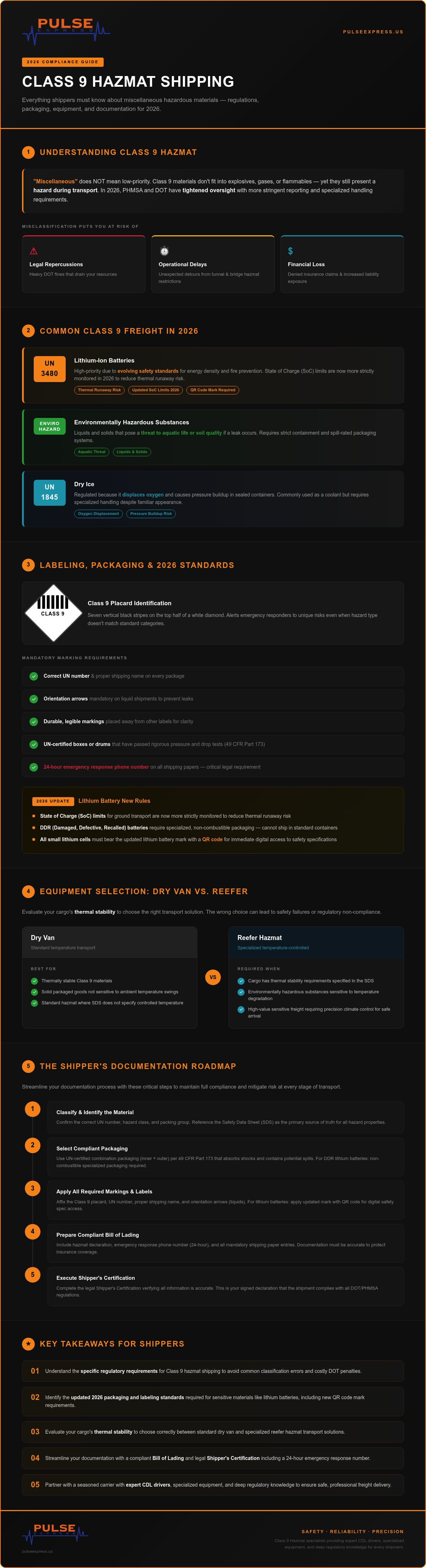
- Understand the specific regulatory requirements for Class 9 hazmat shipping to avoid common classification errors and costly DOT penalties.
- Identify the updated 2026 packaging and labeling standards required to ensure the safe transport of sensitive materials like lithium batteries.
- Evaluate your cargo’s thermal stability to choose correctly between standard dry van and specialized reefer hazmat transport solutions.
- Streamline your documentation process with a step-by-step roadmap for creating compliant Bills of Lading and legal Shipper’s Certifications.
- Learn how partnering with a seasoned carrier that prioritizes expert CDL drivers ensures the safe, professional arrival of your high-value freight.
Understanding Class 9 Hazardous Materials: The 'Miscellaneous' Challenge
Class 9 materials represent a unique challenge within the global hazardous materials classification system. These substances don't fit into the specific definitions of explosives, gases, or flammables, yet they still present a hazard during transport. This catch-all designation is often misunderstood. Many shippers mistakenly believe "miscellaneous" implies a lower level of risk. In 2026, PHMSA and the DOT have tightened oversight to correct this misconception. Class 9 hazmat shipping now involves more stringent reporting and specialized handling requirements than ever before.
Common Examples of Class 9 Freight in 2026
The commodities found in Class 9 are incredibly diverse. This variety requires shippers to be experts in multiple types of safety protocols. In 2026, the most common items include:
- Lithium-ion batteries (UN3480): These are high-priority items due to evolving safety standards for energy density and fire prevention.
- Environmentally hazardous substances: These include both liquids and solids that pose a threat to aquatic life or soil quality if a leak occurs.
- Dry ice (UN1845): While commonly used as a coolant, dry ice is regulated because it displaces oxygen and can cause pressure buildup in sealed containers.
Managing these materials requires a partner who understands the nuances of each commodity. It's about more than just a label; it's about specialized equipment, trained drivers, and deep regulatory knowledge. Providing safety, reliability, and precision is essential for every shipment.
Why Proper Classification Matters for Your Supply Chain
Classification isn't just a regulatory hurdle. It's a foundational step for a stable supply chain. When you correctly identify Class 9 hazmat shipping requirements, you protect your business from three primary risks: legal repercussions, operational delays, and financial loss. Misclassification can lead to heavy DOT fines that drain your resources. It also creates safety hazards for the CDL drivers who handle your cargo.
Logistics planning also changes when Class 9 is involved. Many routes have specific tunnel or bridge restrictions for hazardous materials. If your carrier isn't prepared for these limitations, your freight will face unexpected detours. Your insurance coverage depends on accuracy too. Failing to disclose hazardous materials can result in denied claims and increased liability. By prioritizing precision, you ensure your cargo arrives safely, your documentation stays clean, and your partnerships remain strong.
Essential Compliance: Labeling, Packaging, and 2026 Standards
Precision starts with the right visual cues. The Class 9 placard is distinct, featuring seven vertical black stripes on the top half of a white diamond. While it doesn't represent a specific hazard like fire or poison, its presence alerts emergency responders to unique risks. Every package must also display the correct UN number and proper shipping name. Orientation arrows are mandatory for liquid shipments to prevent leaks. These markings must be durable, legible, and placed away from other labels to ensure clarity.
Compliance extends deep inside the container. Following 49 CFR Part 173 hazmat packaging regulations ensures your freight remains stable during long-haul transit. You must use a combination of inner and outer packaging designed to absorb shocks and contain potential spills. For many Class 9 items, this means using UN-certified boxes or drums that have passed rigorous pressure and drop tests. Including a 24-hour emergency response phone number on the shipping papers is a critical legal requirement. This number connects responders to a person with specific knowledge of the cargo's hazards and emergency mitigation steps.
Navigating 2026 Lithium Battery Regulations
Lithium battery standards have evolved significantly this year. For ground transport, the State of Charge (SoC) limits are now more strictly monitored to reduce the risk of thermal runaway. Damaged, defective, or recalled (DDR) batteries require specialized, non-combustible packaging and cannot be shipped in standard containers. In 2026, all small lithium cells must bear the updated lithium battery mark featuring a clear QR code for immediate digital access to safety specifications.
The Role of the Safety Data Sheet (SDS)
Effective logistics management relies on the Safety Data Sheet as the ultimate source of truth for Class 9 hazmat shipping. Section 14 contains the transport information you need to cross-reference with the official Hazardous Materials Table. This data dictates your packaging group, labeling requirements, and quantity limits. We ensure our specialized hazmat drivers have immediate, easy access to these documents throughout the journey. This level of preparation provides the stability and reassurance you need for high-value logistics.
Strategic Equipment Selection: Dry Van vs. Reefer for Class 9 Freight
Choosing the right equipment for Class 9 hazmat shipping requires a deep understanding of your cargo's physical and chemical thresholds. You must evaluate whether your materials are thermally stable or if they risk degradation when exposed to environmental extremes. While the "miscellaneous" label might suggest a one-size-fits-all approach, the reality is far more complex. We provide specialized equipment tailored to the unique risks of your freight, ensuring a balance of safety, compliance, and cost-efficiency for every mile of the journey.
Air-ride suspension is a critical feature for many Class 9 shipments, particularly those involving sensitive electronics or high-capacity battery systems. This technology absorbs road shocks and minimizes the vibrations that could lead to internal damage or friction-induced heat. By combining advanced suspension with expert handling, we protect the structural integrity of your most valuable assets. We believe that every shipment deserves a customized logistics plan that accounts for its specific vulnerabilities and transport requirements. This focused attention to detail reflects our deep commitment to partnership and operational excellence.
Reefer Hazmat Transport for Sensitive Chemicals
Temperature control is often a vital necessity for Class 9 commodities that are prone to polymerization or decomposition. Maintaining a precise climate prevents these hazardous chemical reactions from occurring during long-haul transit. Utilizing temperature controlled trucking services offers the stability needed for temperature-sensitive chemicals and specialized coolants. Our reefer units are equipped with sophisticated redundancy systems to mitigate risk. In the event of a mechanical failure, our drivers are trained to follow immediate intervention protocols. This ensures your cargo stays within its safe temperature range until the journey is complete.
Dry Van Hazmat Carriers for Industrial Goods
Dry van transport remains the most efficient choice for Class 9 materials that are chemically stable and physically robust. This equipment is perfectly suited for bulk shipments of non-reactive solids, consumer electronics, and magnetized industrial machinery. Choosing a dry van allows you to maximize payload capacity while adhering to all federal safety standards. To ensure safety, we implement rigorous cargo-securing procedures that prevent shifting and protect against friction. Our dry van standards focus on three core pillars: security, capacity, and reliability. This approach guarantees that even your largest Class 9 shipments move through the supply chain with absolute precision.
The Shipper’s Roadmap: Documentation and Risk Mitigation
Documentation is the bridge between your warehouse and the open road. It's your primary tool for ensuring safety, maintaining compliance, and mitigating risk. In 2026, a single error on a Bill of Lading (BOL) can ground a shipment or trigger substantial penalties. We recommend implementing a rigorous multi-check system that reviews every document before the truck leaves your dock. This ensures that your warehouse staff, carriers, and responders all have the precise information they need. Proper training for your team on Class 9 specific handling is just as vital as the paperwork itself. When your staff understands the unique risks of miscellaneous hazards, they become your first line of defense against operational errors.
The Shipper’s Certification is your legal promise that the materials are properly classified, packaged, and labeled. By signing this document, you take responsibility for the accuracy of the shipment’s profile. This certification isn't just a formality; it's a foundational element of transport safety that protects every person who handles your cargo. We view this process as a shared commitment to excellence. Our goal is to provide the stability and reassurance you need to move your freight with confidence.
Preparing the Bill of Lading (BOL)
Correct sequencing on your BOL is a non-negotiable requirement for Class 9 hazmat shipping. You must list the information in this exact order: UN Number, Proper Shipping Name, Hazard Class, and Packing Group. You're also required to include a 24-hour emergency contact number and accurate quantity declarations for every item. While physical papers remain the legal standard for drivers in 2026, digital documentation has become the industry norm for back-office auditing. This digital-first approach allows for faster verification, better record-keeping, and improved communication across your entire supply chain.
Incident Prevention and Emergency Response
Safety protocols must extend beyond the loading dock. Developing a clear Standard Operating Procedure (SOP) for spills or leaks ensures your team can react with speed and precision if an accident occurs. We prioritize this level of preparation in everything we do. Our drivers receive intensive training for specialized hazmat logistics emergencies to ensure they can manage risks effectively on the road. Real-time GPS tracking is another essential layer of risk mitigation for high-value Class 9 freight. It provides constant visibility, enhances security, and allows for immediate intervention if a vehicle deviates from its planned route. This proactive strategy keeps your cargo safe and your business protected.
Secure your hazardous freight with a partner that values precision as much as you do by contacting Pulse Express today.
Partnering for Safety: Why Pulse Express Leads in Class 9 Logistics
Pulse Express has been a trusted leader in the transportation industry since 2000. For over 25 years, we've provided the stability and reassurance businesses need to manage complex freight. Class 9 hazmat shipping requires a level of attention that general carriers simply can't provide. We focus on three foundational pillars: precision, safety, and reliability. This commitment to excellence allows us to build long-term partnerships that drive mutual growth and operational success.
Our nationwide logistics network is designed to handle the most sensitive hazardous materials with ease. We don't just move freight; we provide a comprehensive safety net for your entire supply chain. By choosing a partner with deep operational history, you're investing in a legacy of security and professional authority. We manage every shipment with the care and attention to detail that your high-value cargo deserves.
The Pulse Express Commitment to Driver Excellence
Safety starts with the professional behind the wheel. We prioritize hiring CDL drivers who demonstrate a proven track record of excellence in hazardous materials transport. Our vetting process for hazmat OTR driver jobs is among the most rigorous in the industry. Every driver receives ongoing training on 2026 DOT and OSHA compliance standards to ensure they're prepared for the latest regulatory updates. This focus on driver quality is a core part of CEO Adelina Pavlov’s vision for operational safety. It's how we maintain the highest standards of freight protection across the country.
Streamlining Your Nationwide Hazmat Logistics
We integrate our specialized reefer and dry van assets to offer a truly flexible shipping experience. This allows us to serve as a premier nationwide hazmat logistics partner for Fortune 500 companies and growing businesses alike. Whether your Class 9 cargo requires strict climate control or standard secure transport, we have the resources to execute the job perfectly. We manage the complexities of your supply chain so you can focus on your core business goals. Our team is ready to provide the stability, safety, and efficiency you deserve.
Request a specialized Class 9 shipping quote from Pulse Express to secure your 2026 logistics strategy with a trusted expert partner.
Mastering Your 2026 Hazmat Logistics Strategy
Success in Class 9 hazmat shipping requires more than just following a checklist. It demands a proactive strategy that combines precise classification, specialized equipment, and a commitment to safety. By mastering the 2026 standards for labeling and documentation, you protect your supply chain from costly delays and regulatory risks. Whether your cargo requires the climate-controlled environment of a reefer or the high-capacity security of a dry van, making informed choices today ensures operational excellence tomorrow.
Pulse Express is here to serve as your seasoned guide. We offer over 25 years of OTR experience, a specialized fleet for both temperature-sensitive and dry freight, and a team of expert drivers with valid hazmat endorsements. We focus on providing the stability and reassurance you need to move your most sensitive materials with absolute confidence. It's our mission to provide a supportive partnership and a deep investment in your long-term success.
Secure your sensitive freight with Pulse Express, Get a Hazmat Shipping Quote. We look forward to helping you streamline your logistics and achieve full compliance for the year ahead.
Frequently Asked Questions
What exactly qualifies as a Class 9 hazardous material?
Class 9 hazardous materials include substances that pose a hazard during transportation but don't meet the specific definitions of other hazard classes. This category covers a wide range of items such as lithium-ion batteries, dry ice, and magnetized equipment. It also includes environmentally hazardous substances that could damage soil or water if a spill occurs. Because this class is so diverse, accurate identification of your specific commodity is the first step toward achieving full compliance.
Do I need a hazmat placard for Class 9 shipments?
For domestic highway transport within the United States, you generally don't need a placard for Class 9 hazmat shipping unless the material is shipped in bulk. However, the package itself must still display the correct markings and labels. International shipments or specific bulk quantities may require the black and white striped Class 9 placard. Always verify your specific shipment's requirements against the Hazardous Materials Table to ensure you're meeting all legal standards for your route.
What are the packaging requirements for shipping lithium batteries in 2026?
In 2026, shipping lithium batteries requires UN-certified packaging designed to withstand specific pressure and drop tests. You must adhere to strict State of Charge limits for air and ground transport to minimize the risk of thermal runaway. Damaged, defective, or recalled batteries require even more specialized, non-combustible outer packaging. Every shipment must also feature the updated lithium battery mark, which now includes a QR code for immediate access to digital safety data and emergency protocols.
Can Class 9 materials be shipped in a standard dry van?
Yes, many Class 9 materials are perfectly suited for transport in a standard dry van. This equipment is ideal for stable industrial goods, consumer electronics, and non-reactive solids that don't require temperature regulation. The key is ensuring that the cargo is properly secured to prevent shifting and friction during transit. We provide high-quality dry freight hazmat transport that prioritizes safety and payload efficiency, helping you move large volumes of materials without unnecessary equipment costs.
Is a Bill of Lading required for all Class 9 freight?
A compliant Bill of Lading is a mandatory requirement for all Class 9 freight shipments. This document must list the UN number, proper shipping name, hazard class, and packing group in the correct sequence. It also serves as the legal record of the shipment’s contents and safety protocols. Failing to provide an accurate BOL can result in significant DOT fines and shipment delays. Maintaining precise documentation is essential for protecting your business and ensuring a smooth logistics process.
How do I find a carrier with a hazmat endorsement for OTR shipping?
You should look for established OTR carriers like Pulse Express that specialize in hazardous materials logistics. We've spent over 25 years building a fleet of expert drivers who hold valid hazmat endorsements and undergo continuous safety training. Finding a carrier that provides an OTR driver for reefer and dry van hazmat freight ensures you have the flexibility needed for diverse cargo. Our rigorous vetting process guarantees that only qualified professionals handle your sensitive freight.
What are the penalties for non-compliant Class 9 hazmat shipping?
Penalties for non-compliant Class 9 hazmat shipping can be severe, often involving heavy civil fines from the DOT and PHMSA. Beyond financial costs, misclassification or improper labeling can lead to increased legal liability and higher insurance premiums. In extreme cases, repeated non-compliance can result in the loss of your shipping privileges or criminal charges. Partnering with a specialized carrier helps you mitigate these risks by ensuring every aspect of your shipment meets the latest 2026 safety standards.
Does Class 9 hazmat require a temperature-controlled environment?
Some Class 9 materials definitely require a temperature-controlled environment to remain stable. For example, temperature-sensitive chemicals or shipments using dry ice as a coolant often need reefer hazmat transport to prevent hazardous reactions or decomposition. While many miscellaneous items are stable in a dry van, you must analyze the thermal thresholds of your specific cargo. We offer specialized reefer units with advanced redundancy systems to maintain the precise climate control needed for your most sensitive hazardous materials.


