

In 2026, nationwide refrigerated trucking is no longer just about maintaining a set temperature; it's a high-stakes discipline of risk management where thermal stability meets rigorous Hazmat compliance. You've likely felt the pressure of evolving FSMA regulations or the anxiety of a long-haul OTR route where real-time visibility feels more like a luxury than a standard. It's frustrating when cargo loss or compliance gaps threaten your bottom line, your reputation, and your peace of mind. We understand these challenges because we've spent decades solving them.
You deserve a transparent partnership that guarantees 100% temperature integrity and full regulatory compliance for every food-grade or hazardous load. This guide will help you master the complexities of modern cold chain logistics by identifying the traits of a truly reliable, compliant, and specialized transport partner. We'll explore how to choose a dependable OTR fleet, ensure safety through expert Class A CDL drivers, and leverage asset-based stability to protect your freight. Our goal is to provide a shipping experience that is dependable, efficient, and secure from pickup to delivery.
Key Takeaways
- Understand how nationwide refrigerated trucking has evolved into active digital thermal management to ensure total cargo protection in 2026.
- Identify the critical equipment standards and Class A CDL driver expertise required to maintain 100% temperature integrity on long-haul routes.
- Learn why asset-based carriers provide superior accountability and direct control over sensitive freight compared to outsourced logistics networks.
- Master the intersection of thermal stability and Hazmat compliance to meet the strict regulatory demands for specialized cargo.
- Discover how a trusted OTR partner with decades of experience can streamline your operations and eliminate the risk of costly temperature excursions.
The State of Nationwide Refrigerated Trucking in 2026
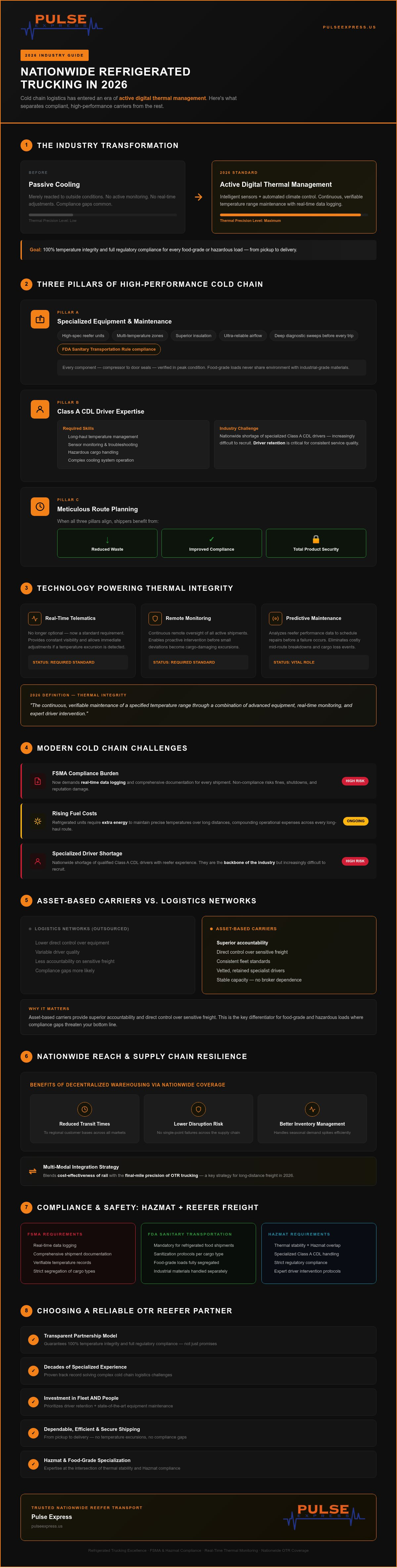
Nationwide refrigerated trucking is the specialized transport of climate-sensitive goods across interstate routes using refrigerated transport containers or advanced reefer units. By 2026, the industry has moved decisively away from "passive" cooling models that merely react to outside conditions. We've entered an era of active digital thermal management. This involves using intelligent sensors and automated climate control systems to ensure a stable environment. A broad nationwide reach is now a critical component of supply chain resilience. It enables decentralized warehousing, which offers several key advantages:
- Reduced transit times to regional customer bases
- Lower risk of widespread disruption from single-point failures
- Improved inventory management for seasonal demand spikes
Multi-modal integration has also emerged as a key strategy for long-distance freight, blending the cost-effectiveness of rail with the final-mile precision of OTR trucking.
Modern Cold Chain Challenges
Maintaining a cold chain in 2026 involves overcoming several significant hurdles for nationwide refrigerated trucking. Shippers must adhere to the latest FSMA requirements, which now demand real-time data logging and comprehensive documentation for every shipment. Rising fuel costs also present a challenge, as refrigerated units require extra energy to maintain precise temperatures over long distances. Perhaps the most pressing issue is the nationwide shortage of specialized Class A CDL drivers. These professionals are the backbone of the industry, but they're increasingly difficult to recruit. A successful operation depends on drivers who can manage complex cooling systems, navigate long-haul routes, and handle sensitive or hazardous cargo with care. Finding a partner who invests in their fleet and their people is the best way to mitigate these risks.
The Role of Technology in Thermal Integrity
Modern technology has turned temperature control into a precise science. Real-time telematics and remote monitoring are no longer optional features; they're standard requirements for safe transport. These systems provide constant visibility, allowing for immediate adjustments if a temperature excursion is detected. Predictive maintenance tools also play a vital role by analyzing reefer performance data to schedule repairs before a failure occurs. In 2026 logistics standards, thermal integrity is defined as the continuous, verifiable maintenance of a specified temperature range through a combination of advanced equipment, real-time monitoring, and expert driver intervention. This level of care ensures that your products arrive in perfect condition, every single time.
Key Pillars of High-Performance Cold Chain Logistics
Achieving excellence in nationwide refrigerated trucking requires more than just a functional cooling unit. It demands a robust framework built on three essential pillars: cutting-edge equipment, elite driver expertise, and meticulous route planning. When these elements align, shippers benefit from reduced waste, improved compliance, and total product security. This synergy is what transforms a simple delivery into a reliable logistics solution.
Specialized Equipment and Maintenance
High-performance fleets distinguish themselves through the use of high-spec reefer units rather than standard trailers. These advanced systems offer superior insulation, multi-temperature zones, and ultra-reliable airflow. Maintaining this equipment requires a proactive approach. We believe in moving beyond basic checklists to perform deep diagnostic sweeps before every trip. This ensures that every component, from the compressor to the door seals, is in peak condition. Additionally, strict adherence to the FDA Sanitary Transportation Rule for refrigerated food shipments is mandatory. Our sanitization protocols vary based on the cargo, ensuring food-grade loads never share the same environment as industrial-grade materials.
Human Capital: The OTR Driver Advantage
The most sophisticated technology is ineffective without a skilled professional at the wheel. This is why hiring CDL drivers with specific reefer experience is non-negotiable for high-stakes logistics. Drivers must understand the nuances of long-haul temperature management, including how to monitor sensors and troubleshoot equipment while on the road. We prioritize driver retention because consistent service quality stems from experienced hands. Professionals pursuing CDL A long haul driver careers bring a level of dedication that directly impacts shipper peace of mind. They act as the first line of defense for your cargo's integrity, providing the stability your supply chain needs.
Efficiency also depends on minimizing "door-open" time through intelligent route optimization. Every minute a trailer remains open during loading or unloading represents a potential risk to the thermal environment. By integrating temperature controlled trucking services into your broader supply chain strategy, you ensure that nationwide refrigerated trucking remains a reliable link in your distribution network. If you're looking for a partner that prioritizes these standards, consider how an asset-based reefer fleet can secure your sensitive shipments.
Evaluating Capacity: Asset-Based Carriers vs. Logistics Networks
Choosing the right partner for nationwide refrigerated trucking requires a clear understanding of how capacity is managed. Shippers often find themselves deciding between asset-based carriers and logistics networks or brokers. An asset-based carrier owns the equipment and employs the drivers directly. In contrast, a logistics network acts as a bridge, coordinating freight through third-party fleets. While both models have their place in a modern supply chain, the distinction becomes critical when handling sensitive cargo that requires strict thermal stability and specialized care.
Asset-based fleets offer superior accountability because they maintain total control over the entire transportation process. If a temperature excursion occurs, there is no ambiguity about who was responsible. The carrier has the data, the equipment logs, and a direct relationship with the driver. This transparency simplifies risk management and provides a more secure environment for high-value freight. When you partner with an asset-based fleet, you're investing in a relationship built on precision, safety, and direct operational oversight.
The Benefits of Direct Asset Control
Direct asset control eliminates the communication gaps that often plague outsourced logistics. You gain a direct line to the professionals managing your cargo, which allows for real-time updates and immediate adjustments. This model ensures consistent equipment standards because every trailer in the fleet is maintained to the same rigorous specifications. Whether it's a routine shipment or complex long distance freight transportation, having a single point of contact leads to faster resolutions. This streamlined approach provides three distinct advantages: enhanced cargo security, reliable transit times, and simplified billing processes.
When to Use a Logistics Partner
Logistics partners and 3PLs excel at providing flexibility during seasonal peaks or when managing surge capacity. They leverage a wide network of carriers to find space when your primary fleet is at capacity. This is particularly useful for managing complex, multi-stop nationwide routes that require a high degree of coordination. Shippers often turn to logistics networks for LTL reefer needs, where consolidating smaller loads into a single shipment can help balance costs. Many businesses find success with a hybrid model, using a trusted asset-based partner for their core nationwide refrigerated trucking needs while utilizing brokers for overflow or specialized regional lanes.
It's vital to consider the insurance and liability differences between these two models. Asset-based carriers carry their own primary insurance, providing a clear path for claims if damage occurs. Brokers typically carry contingent cargo insurance, which adds a layer of complexity during the claims process. Understanding these nuances helps you build a resilient supply chain that prioritizes both cost-efficiency and cargo integrity.
Compliance and Safety: Managing Hazmat and Sensitive Reefer Freight
The intersection of temperature control and hazardous material safety represents one of the most complex challenges in modern logistics. When your cargo is both volatile and climate-sensitive, there's zero margin for error. Nationwide refrigerated trucking providers must manage the delicate balance of maintaining thermal stability while adhering to strict safety protocols for flammables, corrosives, or toxic substances. This dual requirement ensures that sensitive chemicals and high-value pharmaceuticals remain stable, safe, and effective throughout their journey. We approach these high-stakes shipments with a focus on precision, safety, and absolute regulatory adherence.
Navigating specialized hazmat logistics in 2026 involves more than just following a handbook. It requires a deep understanding of how fluctuating temperatures can affect the chemical stability of hazardous loads. Security protocols for these shipments often include constant monitoring, geofencing, and specialized locking mechanisms to prevent unauthorized access. Because the stakes are so high, hazmat OTR driver jobs are reserved for the most elite professionals in the industry. These drivers undergo rigorous vetting, extensive background checks, and continuous safety training to handle high-consequence freight with the respect it deserves.
Hazmat Reefer Best Practices
Effective management of hazardous reefer loads starts with strict segregation rules. It's vital to ensure that mixed temperature-controlled loads never place incompatible materials in the same trailer environment. Emergency response planning is equally critical; teams must have clear, pre-defined procedures for handling thermal excursions that could lead to a hazardous reaction. Shipping hazardous materials in temperature-controlled environments requires simultaneous adherence to both PHMSA safety standards and FSMA thermal integrity regulations. By prioritizing these three areas-segregation, planning, and compliance-shippers can significantly reduce their operational risk and ensure a smooth delivery process.
Vetting Your Hazmat Carrier
Choosing a partner for sensitive freight requires a methodical vetting process. You should begin by checking safety ratings and FMCSA compliance history to identify a pattern of established reliability. It's also essential to verify driver endorsements and review specialized training logs to ensure the team is prepared for the specific requirements of your cargo. Finally, confirm that the carrier maintains specialized insurance coverage designed for high-consequence freight. This level of diligence protects your assets, your reputation, and the public. If you need a partner that specializes in these complex requirements, explore our reefer hazmat transport solutions to see how we maintain safety and integrity on every mile.
Choosing Your Nationwide Reefer Partner: The Pulse Express Advantage
Selecting a partner for nationwide refrigerated trucking is a decision that defines the stability and resilience of your entire supply chain. Since 2000, Pulse Express has served as a trusted expert guide for shippers who require more than just a standard transport service. We've built our reputation on a foundation of professional authority and a personal commitment to our clients' success. Our asset-based model ensures that we maintain direct control over every piece of equipment and every safety standard. This approach eliminates the uncertainty often found in brokerage networks, providing you with a single, reliable point of contact for your most sensitive freight.
Our commitment to operational excellence is rooted in a partnership approach. We don't just move cargo; we manage risks through precision, safety, and a focus on mutual growth. We offer comprehensive solutions that integrate Hazmat, Reefer, and Dry Van freight into a streamlined logistics strategy. This versatility allows us to support your business as it scales, providing the stability you need to navigate the complexities of the 2026 market. We carry the confidence of an established leader while maintaining the approachability of a service-oriented partner.
Why Shippers Trust Pulse Express
Our clients value the peace of mind that comes from a proven track record in handling high-consequence materials. We specialize in the intersection of thermal stability and hazmat compliance, ensuring that every load meets the highest safety standards. When you partner with us, you gain several distinct advantages:
- Direct access to a modern, well-maintained nationwide fleet designed for maximum reliability.
- A culture of safety that starts with our rigorous Class A CDL driver recruitment and continuous training.
- Decades of specialized OTR experience managing complex, long-haul routes across the United States.
We hire only the most elite professionals who understand the nuances of temperature management and hazardous material safety. This results in a service that is protective, efficient, and deeply committed to the integrity of your cargo.
Getting Started with Your Logistics Strategy
Customizing your nationwide shipping plan starts with a conversation about your specific operational goals. Our logistics experts help you navigate the evolving regulatory landscape, from FSMA updates to specialized hazmat requirements. We don't believe in one-size-fits-all solutions. Instead, we focus on creating a plan that aligns with your unique distribution needs and volume requirements. You can request a specialized quote for your complex reefer or hazmat needs to begin the process of securing your supply chain. It's time to move toward a more transparent, reliable logistics partnership. Partner with Pulse Express for secure nationwide refrigerated trucking and see how our asset-based stability can drive your success.
Securing Your Supply Chain for the Road Ahead
The landscape of nationwide refrigerated trucking in 2026 demands a shift from reactive cooling to proactive, digital thermal management. Success now hinges on three core factors: advanced equipment standards, elite driver expertise, and unwavering regulatory compliance. By prioritizing asset-based carriers, you gain the direct control and accountability necessary to eliminate temperature excursions and protect your high-value cargo. Whether you're moving food-grade products or complex hazardous materials, the right partnership transforms logistics from a source of stress into a competitive advantage.
Pulse Express has been a leader in this space since 2000. As specialized Hazmat and reefer experts with an asset-based nationwide fleet, we provide the stability your business requires. Our focus on operational excellence ensures your freight remains secure from pickup to delivery. It's time to move forward with a partner who's personally invested in your growth. Secure your cold chain with Pulse Express nationwide trucking. We look forward to helping you navigate the future of cold chain logistics with confidence, ease, and reliability.
Frequently Asked Questions
What is the difference between refrigerated and climate-controlled trucking?
Refrigerated trucking, often called reefer transport, uses a powered cooling unit to maintain a specific temperature range for perishable goods. Climate-controlled trucking is broader; it often regulates both temperature and humidity levels to protect sensitive items like fine art or electronics. While both provide protection, reefer units are the industry standard for food and medical supplies. We focus on providing high-spec reefer units that deliver consistent thermal stability for every mile of the journey.
How do nationwide refrigerated trucking companies monitor temperature during transit?
Modern nationwide refrigerated trucking depends on real-time telematics and remote sensors to track conditions inside the trailer. These systems send instant alerts to both the driver and the dispatch team if the temperature deviates from the set point. This proactive monitoring allows for immediate adjustments before cargo is compromised. Digital data logs also provide a verifiable record of temperature integrity from the moment of pickup through final delivery.
Can hazardous materials be shipped in a refrigerated trailer?
Yes, hazardous materials can be transported in refrigerated units, provided the carrier has the proper endorsements and equipment. Pulse Express specializes in Reefer Hazmat Transport, ensuring that volatile chemicals or sensitive pharmaceutical ingredients stay within safe thermal limits. This requires specialized training for drivers and meticulous planning. Our team manages the complex intersection of temperature control and hazmat safety to keep your high-consequence freight secure and compliant.
What are the common causes of temperature excursions in cold chain logistics?
Excursions often stem from mechanical equipment failure, improper pre-cooling, or excessive door-open time during loading and unloading. Poor airflow caused by incorrect pallet placement can also create hot spots within the trailer. We mitigate these risks through rigorous pre-trip inspections, predictive maintenance, and expert driver oversight. By maintaining an asset-based fleet, we ensure that every trailer meets our strict standards for insulation, airflow, and cooling performance.
What certifications should I look for in a reefer driver?
A qualified reefer driver must hold a valid Class A CDL and have specific training in temperature-controlled equipment operation. If your cargo is hazardous, the driver must also possess a current Hazmat endorsement. We prioritize hiring experienced professionals who understand the nuances of long-haul temperature management. Look for drivers with a proven safety record and a commitment to continuous training in FSMA compliance and specialized freight handling.
How does Pulse Express ensure compliance with 2026 FSMA regulations?
We ensure compliance through a combination of asset-based control and advanced digital documentation. Every shipment in our nationwide refrigerated trucking network is monitored using real-time data logging, which provides the verifiable records required by the FDA. Our sanitization protocols meet the highest standards for food-grade transport, preventing cross-contamination between loads. We invest in late-model trailers and elite driver training to maintain a safe, transparent, and fully compliant cold chain.
What should be included in a refrigerated freight shipping contract?
A robust contract should clearly define the required temperature range, pre-cooling protocols, and acceptable humidity levels. It's also essential to include specific liability clauses for temperature excursions and detailed sanitation requirements for the trailer. Ensure the agreement outlines how data logs will be shared for compliance verification. A transparent partnership with a reliable carrier like Pulse Express provides the legal and operational clarity needed to protect your sensitive cargo.
Does nationwide refrigerated trucking include LTL options for smaller shipments?
While many carriers offer LTL (Less Than Truckload) options for refrigerated freight, Pulse Express focuses on providing dedicated OTR reefer and dry van services. This approach allows us to maintain maximum control over the thermal environment and safety protocols for each shipment. Dedicated transport reduces the risk of temperature fluctuations that can occur during multiple stops in an LTL network. We prioritize the security and integrity of your full-load shipments across the United States.


